Year 6 Maths Reasoning Questions That Trip Up CSSE Hopefuls (With Parent-Friendly Fixes)
Year 6 Maths Reasoning Questions That Trip Up CSSE Hopefuls (With Parent-Friendly Fixes)
Every September, thousands of capable children across Essex sit down for the 11+ grammar school entrance exam and hit an unexpected wall. Many of these pupils comfortably score top marks in classroom assessments, yet they freeze when faced with authentic maths reasoning questions year 6 candidates encounter in the CSSE paper.
The shock is understandable. Standard primary school worksheets often signpost exactly which operation to use. By contrast, selective entrance exams demand raw problem-solving instincts, multi-layered logic, and an ability to extract mathematical meaning from dense text without a teacher dropping hints.
If your child is aiming for one of the selective grammar schools in Chelmsford, Colchester, or Southend, helping them unpick these non-standard questions is the single most valuable revision step you can take. In this step-by-step guide, we walk through the exact reasoning hurdles that regularly derail candidates—and give you practical, parent-friendly techniques to fix them at home.
Prerequisites: Why Maths Reasoning Questions Year 6 Pupils Face in the CSSE Differ from SATs
Before jumping into worked examples, it helps to understand why your child’s standard school homework does not fully prepare them for selective exam papers.
According to the Standards and Testing Agency, approximately 73% of pupils achieved the expected standard in Key Stage 2 mathematics in the 2023/24 national curriculum assessments. The national curriculum is intentionally structured to ensure broad competence across age-related expectations.
The Consortium of Selective Schools in Essex (CSSE) operates under a completely different mandate. The Consortium of Selective Schools in Essex typically sees over 6,000 candidates sit the 11+ exam annually for approximately 1,000 grammar school places. Because its goal is selection rather than certification, the CSSE mathematics paper includes open-ended, non-routine problems designed to separate the top percentiles.
+------------------------------------+---------------------------------------+
| Feature                            | Standard KS2 SATs Reasoning           | CSSE 11+ Mathematics Exam             |
+------------------------------------+---------------------------------------+
| Format                             | Structured questions, some ticks/boxes| Free-response, extensive working space|
| Predictability                     | Familiar curriculum layouts           | Novel contexts and puzzle-style stems |
| Working Out                        | 1-2 marks per question                | Heavy weighting on transparent method |
| Multiple Choice                    | Occasionally used                     | Rarely used; full written answers     |
+------------------------------------+---------------------------------------+
What You Need Before You Start
To make genuine headway with advanced 11+ mathematical reasoning, ensure your child has the following foundations firmly in place:
- Instant times-tables recall: Multiplication facts up to $12 \times 12$ must be automatic, requiring zero conscious processing time.
- FDP Fluency: Rapid conversion between common fractions, decimals, and percentages (e.g., $0.375 = \frac{3}{8} = 37.5%$).
- A dedicated reasoning notebook: Square-grid paper (5mm) is far superior to lined paper for aligning digits and drawing scale representations.
- Time commitment: A focused 20-minute daily session produces better retention than exhausting two-hour weekend marathons.
Step 1: Decode Multi-Step Maths Reasoning Questions Year 6 Candidates Struggle With
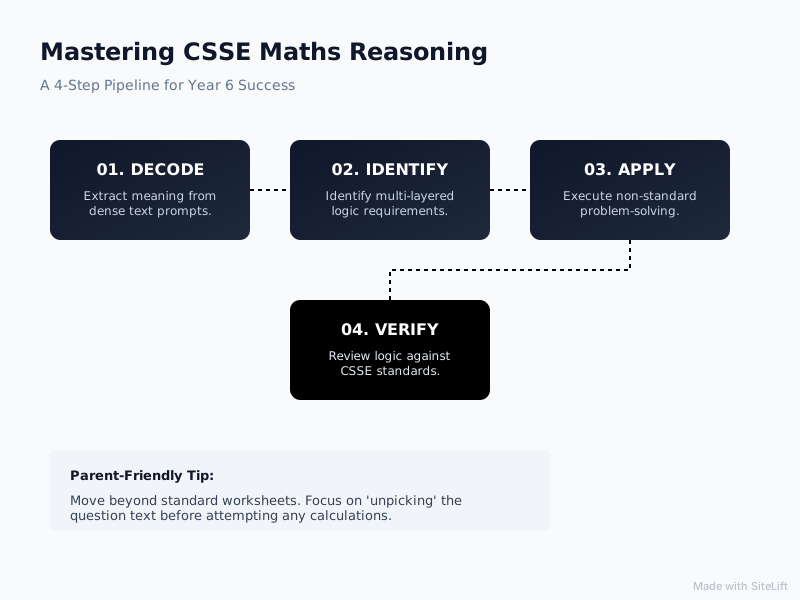
The most common point of failure on the CSSE paper is not computational inability; it is cognitive overload. When children see a 5-line worded problem featuring three different characters, unequal sharing, and mixed units, their working memory short-circuits.
Visualising Word Problems Using the Bar Model
The best antidote to cognitive overload is visual representation. Evidence published by the Education Endowment Foundation shows that teaching metacognitive strategies and visual representations like bar modelling can add up to +7 months of additional progress in primary mathematics.
When words turn into visual blocks, the brain no longer needs to juggle language while simultaneously calculating values.
Example Problem:
"Oliver has three times as many marbles as Sophia.
Liam has 14 fewer marbles than Oliver.
Altogether, the three children have 98 marbles.
How many marbles does Oliver have?"
The Action Steps:
- Identify the base unit: Sophia has the smallest, simplest share. Draw 1 rectangular block for Sophia.
- Draw comparative units: Oliver has three times as many, so draw 3 identical blocks for Oliver.
- Represent the deficit: Liam has Oliver's share minus 14. Draw 3 blocks for Liam, then draw a dotted line cutting off a section labelled "14".
- Sum the blocks:
- Total blocks = $1 \text{ (Sophia)} + 3 \text{ (Oliver)} + 3 \text{ (Liam)} = 7 \text{ equal blocks}$.
- The equation becomes: $7 \text{ blocks} - 14 = 98$.
- $7 \text{ blocks} = 98 + 14 = 112$.
- $1 \text{ block} = 112 \div 7 = 16$.
- Answer the specific question asked: The question asks for Oliver's total, not Sophia's base unit.
- Oliver $= 3 \times 16 = 48 \text{ marbles}$.
Parent Fix: The "Three-Pass Read" Technique
Teach your child to stop picking up their pencil the moment they finish reading the last word. Train them in this three-pass routine:
- Pass 1 (The Story): Read purely to understand what is happening in real life. Put the pencil on the desk. Who is buying what? Who is running where?
- Pass 2 (The Data): Underline concrete values and operational trigger words ("twice as many", "shared equally", "remaining").
- Pass 3 (The Target): Circle the final question sentence. Highlight what unit the examiner wants (e.g., hours or minutes? pence or pounds?).
Pro Tip: If your child consistently makes early arithmetic mistakes, have them narrate the question back to you in their own words before they write down a single calculation.

Step 2: Conquer Year 6 Logic Puzzles and Working Backwards Problems
Grammar school entrance papers regularly feature year 6 logic puzzles maths problems that cannot be solved with standard column addition or subtraction. These questions test whether a child can deduce facts systematically under time pressure.
Mystery Number and Balancing Scales Questions
A classic CSSE challenge features algebraic shapes or symbols arranged in balance scales or grids where row and column totals are provided, but individual values are hidden.
Example Problem:
  ▲ + ● + ● = 22
  ▲ + ▲ + ● = 26
  Find the value of: ▲ × ●
Many students attempt to randomly plug in numbers. Unstructured guessing works well when numbers are small, but examiners deliberately use awkward two-digit primes or decimals that penalise trial-and-error.
Action Steps for Systematic Deduction:
- Compare differences between lines: Compare the two equations directly. What changed?
- Equation 2 has one more ▲ and one fewer ● than Equation 1.
- The total increased by $26 - 22 = 4$.
- Therefore: $\text{▲} - \text{●} = 4$, meaning $\text{▲} = \text{●} + 4$.
- Substitute back into the simpler statement:
- Replace ▲ in Equation 1 with $(\text{●} + 4)$:
- $(\text{●} + 4) + \text{●} + \text{●} = 22$
- $3 \text{●} + 4 = 22 \implies 3 \text{●} = 18 \implies \text{●} = 6$.
- Calculate the missing variables:
- If $\text{●} = 6$, then $\text{▲} = 6 + 4 = 10$.
- Final Step: $10 \times 6 = 60$.
Common Pitfalls to Avoid
Children often calculate the individual symbols correctly ($\text{●} = 6, \text{▲} = 10$) and write both down on the answer line, completely ignoring that the question asked for their product ($\text{▲} \times \text{●}$). Remind your child that finding the components is only halfway through the journey.
Step 3: Unpick Ratio, Proportion, and Scaling Traps
Ratio questions on standard classroom assessments are generally direct: "Share £40 in the ratio 3:5." On selective exams, questions disguise ratio within recipes, chemical mixtures, map scales, or unequal group exchanges.
Infographic by SiteLift
+------------------------------------------+-------------------------------------------------------+
| National Curriculum Ratio Problem        | CSSE-Style Multi-Layered Ratio Problem                |
+------------------------------------------+-------------------------------------------------------+
| "A paint mix uses blue and yellow in     | "Paint mix A contains blue and yellow in ratio 2:3.   |
| the ratio 2:3. If you have 600ml of      | Paint mix B contains blue and yellow in ratio 1:4.    |
| blue, how much yellow do you need?"      | If 500ml of mix A is combined with 500ml of mix B,   |
|                                          | what fraction of the total mixture is blue paint?"    |
+------------------------------------------+-------------------------------------------------------+
Parent Fix: The Unitary Method Mastery
Whenever proportion or recipe questions appear, avoid cross-multiplication shortcuts that confuse KS2 pupils. Teach the unitary method: always bring the values back down to what one single unit represents.
Example Problem:
"A baker uses 360g of flour to make 12 scones.
He wants to make 20 scones for a party.
Flour is sold in 500g bags.
How many bags of flour must he purchase?"
Step-by-Step Resolution:
- Find the value of 1 scone (The Unit):
- $360\text{g} \div 12 = 30\text{g of flour per scone}$.
- Scale up to the desired target:
- $20 \text{ scones} \times 30\text{g} = 600\text{g of flour required}$.
- Interpret the context of real-world packaging:
- 1 bag $= 500\text{g}$ (not enough).
- 2 bags $= 1000\text{g}$ (leaves $400\text{g}$ spare, but covers the required $600\text{g}$).
- The answer is 2 bags, not $1.2$ bags.
Examiners love setting questions where remainders cannot simply be rounded down using normal mathematical rules. If a child writes "1.2 bags", they score zero for the final answer.
Step 4: Solve Spatial, Perimeter, and Compound Area Reasoning Challenges
Spatial reasoning questions test whether a child can handle geometry when essential measurements are intentionally omitted. CSSE papers regularly feature composite rectilinear shapes, overlapping rectangles, or shaded fractions of geometric diagrams.
Navigating Composite 2D Shapes
Children frequently look at a compound shape with missing wall lengths and assume they cannot work out the perimeter without guessing.
           14 cm
     +---------------+
     |               |
     |         +-----+ 4 cm
8 cm |         |
     |         +-----+
     |               | 5 cm
     +---------------+
           ? cm
Parent Fix: The "Cut and Shift" Geometry Technique
Show your child that perimeters of rectilinear shapes (shapes where all corners are right angles) can almost always be solved by "projecting" or shifting internal lines outward to form a standard rectangle.
- Spot opposite parallel sides: In any rectilinear polygon, the sum of horizontal steps going right must equal the sum of horizontal steps going left.
- Deduce vertical heights: The total vertical height on the left ($8\text{ cm}$) must equal the sum of all vertical heights on the right side.
- Handle shaded areas by subtraction: Instead of trying to calculate an irregular shaded triangle directly, teach children to calculate the area of the bounding rectangle first, then subtract the unshaded right-angled triangles around it.
Area of Shaded Region = Area of Outer Bounding Box - Sum of Unshaded White Shapes
Pro Tip: Watch out for unit traps. CSSE questions frequently provide edge dimensions in centimetres (cm) but ask for the area in square millimetres ($\text{mm}^2$), or give side lengths in metres and costs in pence per centimetre. Circle all units immediately.
Troubleshooting: Why Do Bright Students Freeze on CSSE Reasoning Problems?
When working with families preparing for the Essex 11+, we see the same three psychological and procedural stumbling blocks trip up otherwise gifted mathematicians.
1. The "Clean Paper" Syndrome
Many children are terrified of writing messy calculations on an examination script. They try to work out complex 3-step algorithms in their heads, get tangled, lose track of their working, and write down an incorrect guess.
The Fix: Insist that blank space on a maths paper is meant to be written on. Marks in the CSSE exam are awarded for method. If a child writes down the correct process but makes a basic subtraction slip at the final step, a clear written method can salvage 1 or 2 method marks out of 3. A blank working area with an incorrect answer scores zero every single time.
2. Misinterpreting Contextual Remainders
In standard classroom arithmetic, pupils learn to represent remainders as decimals or fractions. In selective reasoning papers, the context dictates whether you round up, round down, or discard the remainder entirely:
- Buses/Taxis needed: Round UP (you cannot leave 3 children on the pavement).
- Items you can buy with a set budget: Round DOWN (you cannot purchase half a book).
- Equal distribution: State the remainder precisely as items left over.
Why Showing Method Marks Is Underrated (Editorial Perspective)
In our view, parents spend far too much time obsessing over whether their child got the final answer box right, and far too little time auditing how they laid out their working.
Exam markers mark hundreds of scripts every single day. If your child's script shows an unorganised scattering of random figures across the margins, the marker will struggle to award discretionary method marks. If, however, your child numbers their steps clearly (Step 1: Flour per scone, Step 2: Total flour), they guarantee themselves partial credit even on questions where their final calculation fails under pressure. Clear layout is not neatness for neatness's sake; it is an active mark-recovery strategy.
Expected Outcome: Turning Mathematical Reasoning Practice into 11+ Exam Fluency
When you systematically apply these visual decoding and structured working techniques, your child moves away from anxious guessing and begins approaching unusual questions as puzzles waiting to be solved.
To turn this understanding into reliable exam performance, build a balanced weekly routine:
- Monday to Thursday: Spend 20 minutes tackling 3–4 complex CSSE reasoning problems focused on one specific topic (e.g., ratio on Monday, compound perimeter on Tuesday).
- Keep an Error Log: Maintain a notebook titled "My Favourite Mistakes". When your child gets a question wrong, do not simply give them the correct answer. Have them write out the problem again two days later to confirm the concept has truly stuck.
- Weekend Timed Fluency: Once foundational concepts are secure, use timed papers to build pace.
If you are looking for exam-authentic materials, Essex 11+ Maths Practice for the CSSE Exam provides style-matched questions, realistic papers, and worked solutions mapped directly to the local Essex format. Having access to instant topic tracking makes it much easier to pinpoint whether multi-step wording, geometry, or speed is holding your child back.
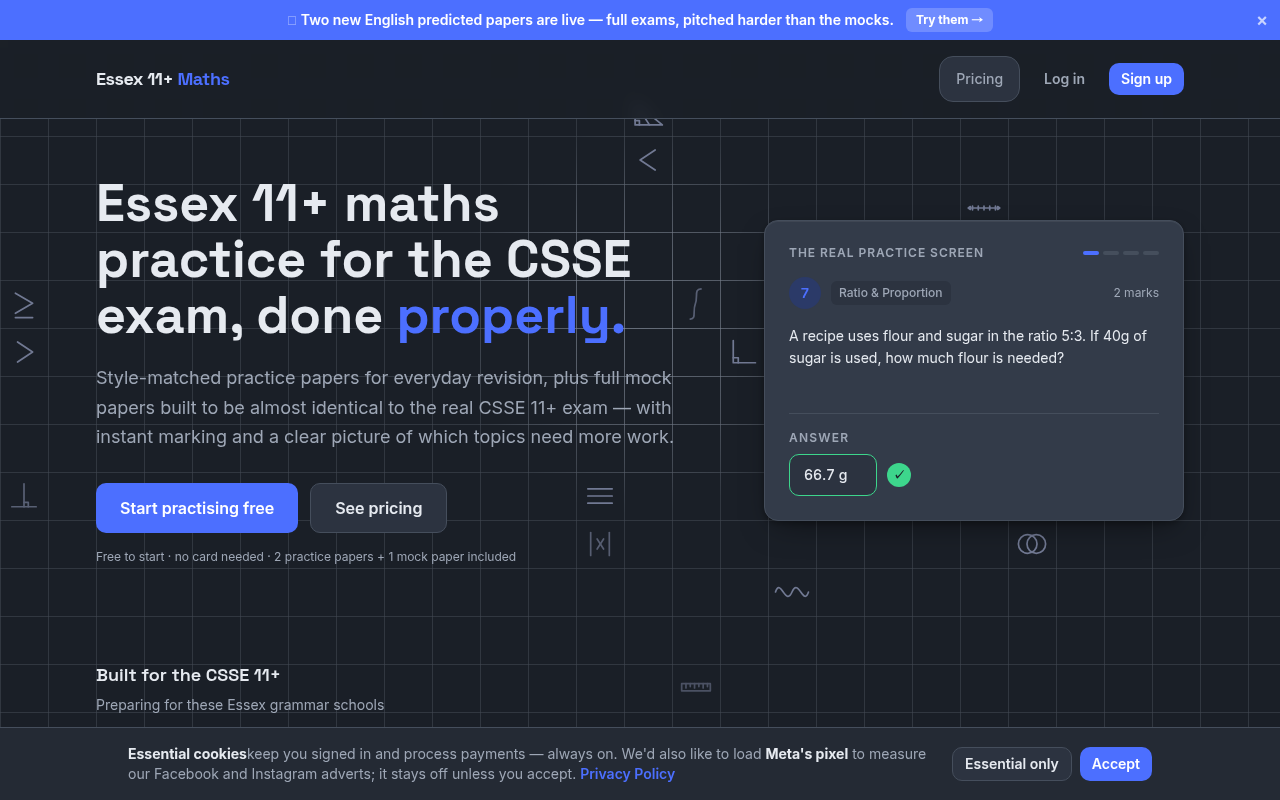
For families balancing preparation across both subjects, exploring dedicated Essex 11+ (CSSE) Maths & English Practice resources ensures your child is building verbal analysis and mathematical problem-solving side by side. You can also view transparent options via our pricing plans, which include a free tier to get started without commitment.
Consistent, thoughtful practice with the right question styles transforms unfamiliar reasoning challenges into a predictable, manageable process.
— essex11mathspractice.co.uk
FAQ
What is the difference between Year 6 SATs maths reasoning questions and CSSE 11+ questions?
SATs reasoning papers (Papers 2 and 3) assess whether a child meets age-related national curriculum expectations. The questions feature predictable layouts, standard phrasing, and structured steps. The CSSE 11+ maths exam is a selective competition designed to identify the top applicants for Essex grammar schools. CSSE questions feature non-routine contexts, multi-layered problem solving, puzzle-style logic, and less visual scaffolding, requiring children to decide their own mathematical path to the solution.
How can parents help Year 6 pupils with mathematical reasoning if they are not confident in maths themselves?
You do not need an advanced mathematics degree to help your child prepare. Focus on questioning rather than lecturing: ask your child to read the problem aloud, identify the keywords, and explain what the question is asking in their own words. Encourage them to draw visual representations like bar models or sketches. When working through past papers, use resources that provide comprehensive worked solutions so you can follow the deductive process together step by step.
Which maths reasoning topics appear most frequently in the CSSE Essex 11+ exam?
While the CSSE paper covers the entire upper Key Stage 2 curriculum, the most heavily weighted reasoning areas typically include:
- Multi-step worded problems involving money and fractions
- Ratio, proportion, and scaling (including recipes)
- Compound area, missing perimeter dimensions, and volume of cuboids
- Algebra grids, sequence patterns, and logic balances
- Interpreting timetables, charts, and contextual remainders
How should a Year 6 student manage their time during the CSSE mathematics paper?
The CSSE mathematics paper generally allows 60 minutes for around 45–50 marks. A good rule of thumb is roughly one minute per mark, leaving 10–12 minutes at the end for checking. Train your child in the "triage technique": if they make zero progress on a question after 60 seconds of thought, they should put a small star next to it in pencil, move straight to the next problem, and return to all starred questions during their final check.