What Is Cubed Numbers? A Simple KS2 Guide with CSSE 11+ Examples
What Is Cubed Numbers? A Simple KS2 Guide with CSSE 11+ Examples
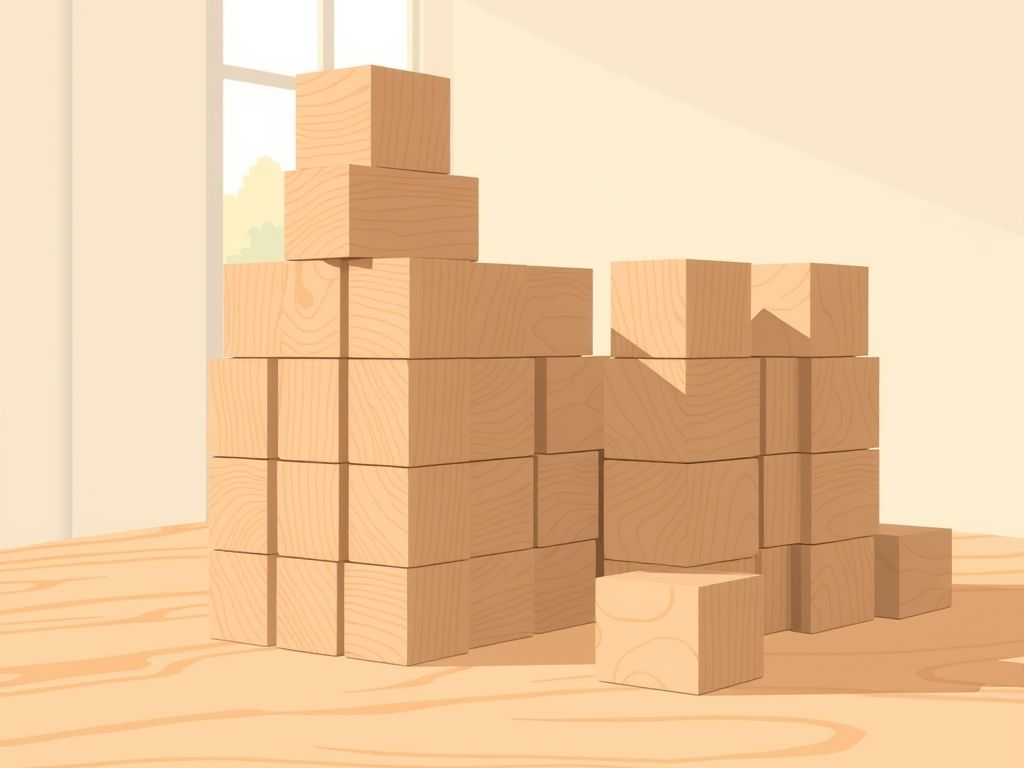
If your Year 5 or Year 6 child has ever stared blankly at a maths sheet and asked, "what is cubed numbers, and why is there a tiny three floating in the air?", they are not alone. Powers and indices can feel like an entirely new language when children transition from standard multiplication to Key Stage 2 arithmetic.
According to the Department for Education Key Stage 2 mathematics programmes of study, pupils in Year 5 are expected to recognise and use square numbers and cube numbers, along with the notation for squared (²) and cubed (³). For children sitting selective entrance exams, this fundamental skill carries even higher stakes. In this practical guide, we break down everything parents and students need to know about cube numbers, complete with visual explanations, memory tables, and exam-style questions adapted for the Consortium of Selective Schools in Essex (CSSE) 11+.
What Is Cubed Numbers? The KS2 Definition Explained Simply
At its heart, answering what is cubed numbers (more formally referred to as cube numbers) comes down to a straightforward rule: a cubed number is the result when an integer is multiplied by itself, and then multiplied by itself once more.
In arithmetic, that means you take a starting whole number and multiply three identical copies together:
$$\text{Number} \times \text{Number} \times \text{Number} = \text{Cube Number}$$
For instance, if we pick the number 4: $$4 \times 4 \times 4 = 64$$
Therefore, 64 is a cube number.
The Core Mathematical Concept: Multiplying by Itself Twice
A common linguistic tripwire for 10-year-olds is the phrasing. When we say "multiply by itself twice", children often think of $4 \times 2$. In reality, you are carrying out two multiplication steps across three identical factors:
- Step 1: Multiply the base number by itself: $4 \times 4 = 16$ (giving the square number).
- Step 2: Multiply that product by the base number again: $16 \times 4 = 64$ (giving the cube number).
Understanding Index Notation ($n^3$)
In maths worksheets and 11+ exam papers, examiners rarely write out "4 times 4 times 4". Instead, they use index notation (also called powers or exponents). A cubed number is written with a small, raised digit 3 called a superscript:
$$4^3 = 64$$
The base number ($4$) tells you which number you are multiplying, while the exponent ($^3$) tells you how many times that base number appears in the multiplication chain. We read $4^3$ aloud as "four cubed" or "four to the power of three".
Visualising 3D Blocks: Connecting Arithmetic to Geometry
The reason mathematicians call this operation "cubing" rather than "tripling" connects directly to 3D geometry.
Imagine you have a collection of 1 cm unit blocks:
- 1 Dimension (Length): A straight line of 3 blocks is $3\text{ cm}$ long.
- 2 Dimensions (Area / Square): Lay out a flat square grid measuring 3 blocks wide by 3 blocks long. You need $3 \times 3 = 9$ blocks ($3^2$).
- 3 Dimensions (Volume / Cube): Build that flat square upwards until it is 3 layers tall. You now have a solid 3D cube measuring $3\text{ cm} \times 3\text{ cm} \times 3\text{ cm}$. Counting all the blocks gives $3 \times 3 \times 3 = 27$ blocks ($3^3$).
This physical bridge makes the concept stick far better than abstract flashcards ever could. When children understand that a cube number represents the actual volume of a physical cube, spatial and sequence questions become much easier to navigate.
List of Essential Cube Numbers for KS2 and 11+ Maths
To succeed under time pressure, students cannot afford to calculate $6 \times 6 \times 6$ with long multiplication in the middle of a paper. Instant recall saves time and protects mental energy for complex reasoning questions.
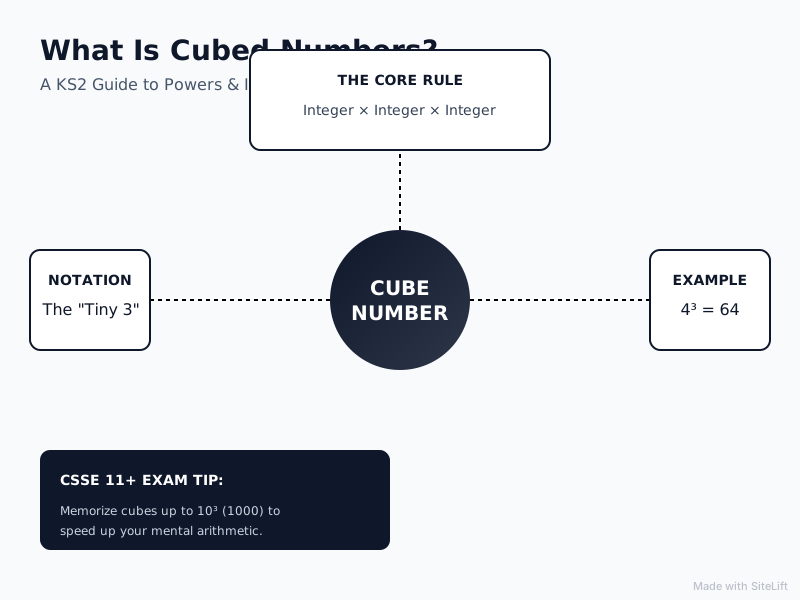
Infographic by SiteLift
The First 12 Cube Numbers Every Year 5/6 Child Should Know
Here is the reference table of the core cube numbers required for primary school mastery and selective school entrance tests:
| Base Number ($n$) | Calculation ($n \times n \times n$) | Cube Number ($n^3$) | Last Digit |
|---|---|---|---|
| 1 | $1 \times 1 \times 1$ | 1 | 1 |
| 2 | $2 \times 2 \times 2$ | 8 | 8 |
| 3 | $3 \times 3 \times 3$ | 27 | 7 |
| 4 | $4 \times 4 \times 4$ | 64 | 4 |
| 5 | $5 \times 5 \times 5$ | 125 | 5 |
| 6 | $6 \times 6 \times 6$ | 216 | 6 |
| 7 | $7 \times 7 \times 7$ | 343 | 3 |
| 8 | $8 \times 8 \times 8$ | 512 | 2 |
| 9 | $9 \times 9 \times 9$ | 729 | 9 |
| 10 | $10 \times 10 \times 10$ | 1,000 | 0 |
| 11 | $11 \times 11 \times 11$ | 1,331 | 1 |
| 12 | $12 \times 12 \times 12$ | 1,728 | 8 |
While standard school work focuses on $1^3$ through $5^3$ and $10^3$, competitive entrance exams frequently include $6^3$ ($216$) and $7^3$ ($343$). Memorising up to $12^3$ provides an immediate edge.
Key Differences Between Square Numbers and Cube Numbers
Children often conflate squares and cubes when rushing. Keeping their mathematical properties distinct is essential:
- Square Numbers ($n^2$): Two equal factors ($n \times n$). They correspond to 2D flat surfaces (area, measured in $\text{cm}^2$). Square numbers grow steadily ($1, 4, 9, 16, 25, 36\dots$).
- Cube Numbers ($n^3$): Three equal factors ($n \times n \times n$). They correspond to 3D solid objects (volume, measured in $\text{cm}^3$). Cube numbers grow at an explosive, non-linear rate ($1, 8, 27, 64, 125, 216\dots$).
Pro Tip: Notice that $64$ is unique in this list: it is both a square number ($8^2 = 64$) and a cube number ($4^3 = 64$). 11+ sequence writers love testing this overlap!
Spotting Number Patterns (Unit Digit Cycles)
Unlike square numbers, which can only ever end in the digits 0, 1, 4, 5, 6, or 9, cubed numbers can end in any single digit from 0 to 9.
Notice these neat memory rules:
- Numbers whose cubes end in the same digit: $1 \to 1$, $4 \to 4$, $5 \to 5$, $6 \to 6$, $9 \to 9$, and $0 \to 0$.
- Numbers that swap with their 10-partner:
- $2^3$ ends in 8, and $8^3$ ends in 2 ($2 + 8 = 10$).
- $3^3$ ends in 7, and $7^3$ ends in 3 ($3 + 7 = 10$).
This pairing trick allows children to double-check their calculations instantly without redoing the arithmetic.
Exam Breakdown: What Is Cubed Numbers and How Are They Tested in the CSSE 11+?
If you are preparing for grammar schools in Essex, such as King Edward VI Grammar School (KEGS), Colchester Royal Grammar School (CRGS), or the Southend grammar schools via the Consortium of Selective Schools in Essex (CSSE), you need to know how these concepts appear in actual test papers.
Data published by the CSSE indicates that competitive candidates generally aim for scores above 75–80% on the Maths paper to secure places at top grammar schools like KEGS or CRGS. At that level, losing easy marks on core powers can make the difference between securing an offer and landing on a waiting list.
Furthermore, according to Standards and Testing Agency (STA) Key Stage 2 test reporting, multi-step arithmetic and reasoning questions involving order of operations (BIDMAS) and powers consistently account for common dropped marks among 10- and 11-year-olds.
Here are the three primary formats the CSSE uses to test cube numbers:
1. Algebraic and Arithmetic Number Sequences
Examiners rarely ask "What is $5^3$?" directly. Instead, they embed cube numbers into sequences where the pattern is not immediately obvious: $$0, 7, 26, 63, 124, \dots$$ A student who does not know their cube numbers will spend precious minutes hunting for a common difference. A student who knows their powers immediately sees: $$(1^3 - 1), (2^3 - 1), (3^3 - 1), (4^3 - 1), (5^3 - 1)$$ The next term must be $6^3 - 1 = 216 - 1 = 215$.
2. 3D Shapes and Volume Calculations
Volume questions link directly to geometry. A question might state:
"A solid wooden cube has a volume of $125\text{ cm}^3$. Find the total surface area of all six faces combined."
To solve this, the student must apply the inverse operation: finding the cube root.
3. Word Problems and Reverse Operations (Finding Cube Roots)
The cube root of a number (written as $\sqrt[3]{x}$) is the number you multiply by itself three times to reach that value.
- The cube root of $125$ is $5$, because $5 \times 5 \times 5 = 125$.
- From there, one face of the cube has an area of $5 \times 5 = 25\text{ cm}^2$.
- The total surface area for all 6 faces is $25 \times 6 = 150\text{ cm}^2$.
Without fluent recall of cube numbers, solving this multi-step problem within the 60-second-per-mark CSSE pace is almost impossible.
Worked CSSE Maths Number Practice Examples
Let's walk through three exam-authentic examples ranging from foundation to challenging.
Example 1: Missing Number Patterns in a Sequence
Question: Find the missing values $A$ and $B$ in the sequence below: $$2, 16, 54, A, 250, B$$
Step-by-Step Solution:
- Look at the sequence growth. It is growing far too fast for simple addition.
- Check for powers. Let's test dividing each term by 2:
- $2 \div 2 = 1$
- $16 \div 2 = 8$
- $54 \div 2 = 27$
- $250 \div 2 = 125$
- The underlying pattern is $2 \times n^3$:
- Term 1: $2 \times 1^3 = 2$
- Term 2: $2 \times 2^3 = 16$
- Term 3: $2 \times 3^3 = 54$
- Term 4 ($A$): $2 \times 4^3 = 2 \times 64 = 128$
- Term 5: $2 \times 5^3 = 250$
- Term 6 ($B$): $2 \times 6^3 = 2 \times 216 = 432$
Answer: $A = 128$, $B = 432$.
Example 2: Combining Squares and Cubes in Expression Balancing
Question: Calculate the value of $k$: $$5^3 - 4^3 = k^2 - 3$$
Step-by-Step Solution:
- Evaluate the left side using known powers: $$5^3 = 125$$ $$4^3 = 64$$ $$125 - 64 = 61$$
- Set up the resulting equation: $$61 = k^2 - 3$$
- Rearrange to isolate $k^2$ by adding 3 to both sides: $$61 + 3 = k^2$$ $$64 = k^2$$
- Find the square root of 64: $$k = \sqrt{64} = 8$$
Answer: $k = 8$.
Example 3: Worded 3D Packing and Volume Challenge
Question: A toy company manufactures small cubic building blocks with side lengths of $2\text{ cm}$. They pack these tightly into a larger cubic storage box with an internal volume of $1,728\text{ cm}^3$. How many small blocks fit inside the storage box with no empty space remaining?
Step-by-Step Solution:
Method A (Volume comparison):
- Calculate the volume of one small block: $$\text{Volume} = 2 \times 2 \times 2 = 8\text{ cm}^3$$
- Divide the total box volume by the block volume: $$1,728 \div 8 = 216\text{ blocks}$$
Method B (Linear dimensions - double check):
- Recall the cube root of $1,728$: $$12 \times 12 \times 12 = 1,728\text{ cm}^3 \implies \text{box edge length} = 12\text{ cm}$$
- Find how many 2 cm blocks fit along each edge: $$12 \div 2 = 6\text{ blocks}$$
- Total number of blocks packed into a $6 \times 6 \times 6$ cube: $$6^3 = 216\text{ blocks}$$
Both methods confirm the result. Method B is often faster for students who know that $12^3 = 1,728$ and $6^3 = 216$.
Answer: 216 blocks.
Common Pitfalls with Cubed Numbers and How to Fix Them
Over years of analysing mock exam papers, we see students fall into the exact same traps. Here is how to correct them before exam day.
Mistake 1: Multiplying by 3 Instead of Cubing
This is the single most common slip in KS2 maths papers. Under exam adrenaline, a child sees $5^3$ and writes $15$.
- The Fix: Have your child read powers aloud using an action word. Instead of saying "five three", teach them to say "five cubed: five times five times five". Remind them that cubing makes positive numbers (greater than 1) grow rapidly. If their answer is close to the base number, they have multiplied rather than cubed.
Mistake 2: Confusing Volume Units with the Calculation
Students often see $64\text{ cm}^3$ on a diagram and assume they need to cube 64.
- The Fix: Teach your child that the superscript in units ($\text{cm}^3$) is merely a label indicating three dimensions. It tells you the measurement is volume. The superscript in a mathematical sum ($4^3$), however, is an instruction to perform an operation.
Pro Tip: Incorporate daily low-stakes testing into morning routines. Asking your child "What is 3 cubed? What is 7 cubed?" while eating breakfast builds automatic recall in long-term memory far better than occasional two-hour study marathons.
For students looking to build high-speed mental shortcuts, explore our dedicated breakdown on Cube Numbers for the 11+: Fast Recall Tricks and CSSE Practice Questions, which explores rapid estimation methods for large roots.
Key Takeaways
Before moving on, review this quick summary of the essential facts:
| Topic | Key Rule / Property |
|---|---|
| Definition | A number multiplied by itself, then by itself again ($n \times n \times n$). |
| Index Notation | Written as $n^3$ (e.g. $2^3 = 8$). |
| Geometric Link | Represents the volume of a 3D cube with side length $n$. |
| Core Set to Memorise | $1, 8, 27, 64, 125, 216, 343, 512, 729, 1000, 1331, 1728$. |
| Inverse Operation | Cube root ($\sqrt[3]{n}$), e.g., $\sqrt[3]{64} = 4$. |
| Crucial Pitfall | $n^3 \neq n \times 3$. |
Why Mental Fluency with Powers Is Underrated for 11+ Success
Most parents focus their initial 11+ prep on fractions, decimals, and long division. While those core skills are vital, speed in the CSSE exam is won or lost on pattern recognition.
When a student knows by heart that $7^3 = 343$ and $6^3 = 216$, sequence and spatial reasoning questions change from intimidating mathematical chores into instant five-second answers. That leaves several minutes of extra checking time for tricky comprehension passages or complex algebra puzzles at the back of the paper.
Rich, open-ended puzzles—such as those published by the University of Cambridge's NRICH mathematics project—consistently prove that pupils who understand the spatial nature of powers develop superior general problem-solving flexibility. Treating cube numbers as 3D structures rather than dry multiplication tables turns an abstract curriculum requirement into an intuitive visual tool.
— essex11mathspractice.co.uk
Master the CSSE 11+ Maths Paper with Confidence
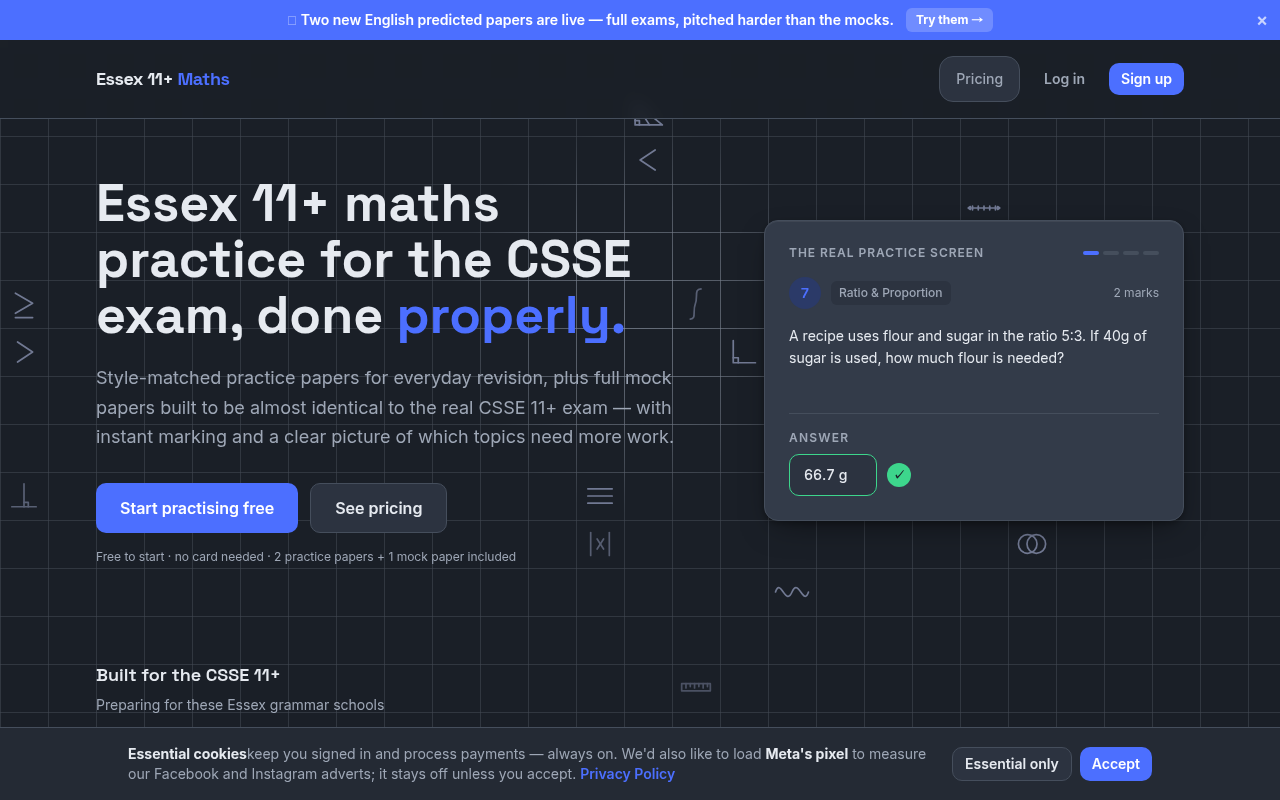
Generic KS2 worksheets will only take your child so far. The Consortium of Selective Schools in Essex tests arithmetic, geometry, and powers through distinct, multi-step problem-solving questions designed to separate the top 10% of candidates.
At essex11mathspractice.co.uk, we provide authentic, style-matched revision tests and realistic mock exams created specifically for the CSSE paper. With instant marking, step-by-step video solutions, and detailed topic tracking, your child can quickly master powers, sequences, and 3D geometry.
- Wondering where to begin? Read through our frequently asked questions to see how our targeted papers mirror the real test.
- Learn more about target scores and test structures in our comprehensive Essex 11+ (CSSE) exam guide.
- View our clear pricing options to start free practice tests today.
Frequently Asked Questions
What is the difference between a cube number and a square number?
A square number is the product of multiplying a number by itself once ($n \times n$), corresponding to the 2D area of a flat square (such as $4^2 = 16$). A cube number is the product of multiplying a number by itself twice ($n \times n \times n$), corresponding to the 3D volume of a solid cube (such as $4^3 = 64$).
Does my child need to memorise cube numbers beyond 10 cubed for the CSSE 11+?
While knowing $1^3$ through $10^3$ covers the vast majority of standard questions, memorising $11^3$ ($1,331$) and $12^3$ ($1,728$) is highly beneficial for competitive 11+ exams. CSSE volume questions regularly feature packaging problems with 12 cm dimensions.
Why do children often calculate 4 cubed as 12, and how can I fix it?
Children often rush and confuse the exponent $^3$ with standard multiplication ($\times 3$), leading them to write $4 \times 3 = 12$. To fix this, have them write out the expanded multiplication chain ($4 \times 4 \times 4$) on scrap paper until the habit of multiplying in two stages is deeply ingrained.
What is a cube root in KS2 maths?
A cube root is the inverse (opposite) operation of cubing a number. It is the original value that was multiplied by itself twice to make that cube number. For example, the cube root of 27 is 3 (written as $\sqrt[3]{27} = 3$), because $3 \times 3 \times 3 = 27$.
Are cube numbers always positive?
In Key Stage 2 and 11+ entrance exams, students only work with whole positive integers, so all cube numbers they encounter will be positive. However, in higher-level secondary maths, multiplying negative numbers produces negative cubes (for example, $-2 \times -2 \times -2 = -8$).