What Are Square Numbers? A Simple Parent-Friendly Guide with 11+ Practice
What Are Square Numbers? A Simple Parent-Friendly Guide with 11+ Practice
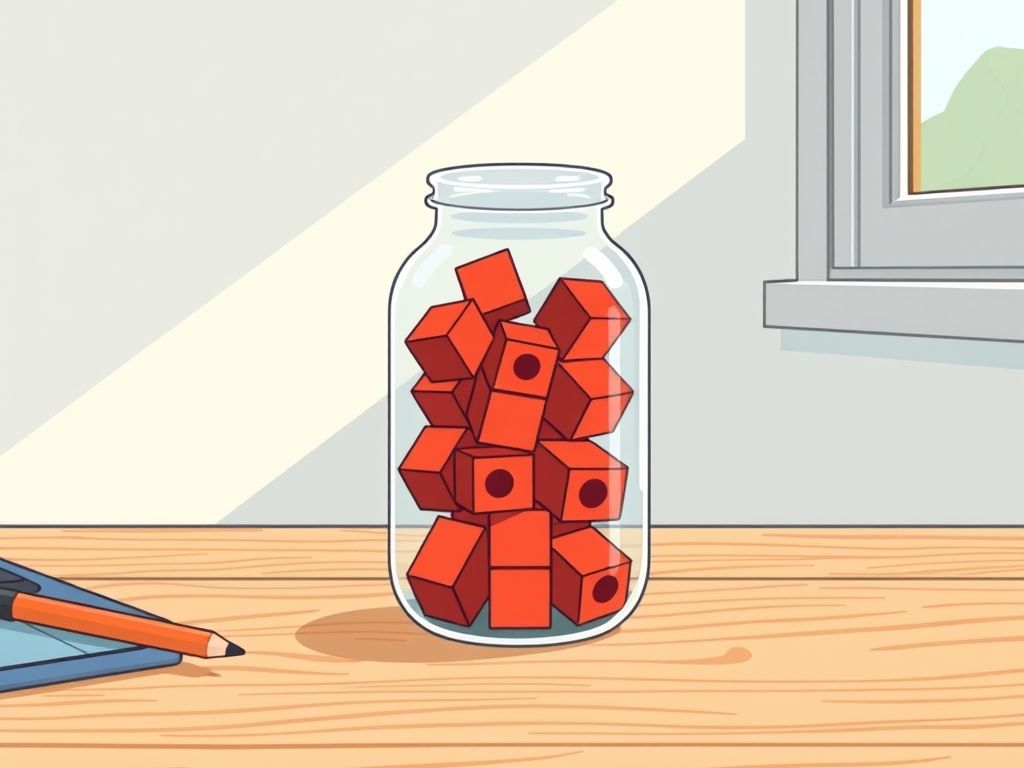
If your child is working through Key Stage 2 maths or preparing for competitive grammar school entrance tests, you will encounter square numbers everywhere. When parents ask me what are the square number concepts their child needs to master, they are often surprised by how quickly classroom maths evolves into multi-layered reasoning. In school, your child learns that a square number is simply an integer multiplied by itself. However, when sit-down entrance exams arrive, that straightforward multiplication fact transforms into complex pattern recognition and spatial reasoning.
Whether you are helping with Year 5 homework or tackling 11-plus revision, this guide breaks down square numbers into plain English, reveals the properties examiners love to test, and gives you exam-authentic problems to test at home.
What Are the Square Number Fundamentals? (Square Numbers KS2 Explained)
To grasp what are the square number building blocks, we have to look past the abstract numerals and see how numbers behave in space.
The Visual Definition: Why Are They Called 'Square'?
The term square is not arbitrary. A number is called a square number because you can arrange that exact quantity of items into a symmetrical, flat square grid where the number of rows equals the number of columns.
Consider counters on a table:
- 1 counter: 1 row of 1 ($1 \times 1 = 1$)
- 4 counters: 2 rows of 2 ($2 \times 2 = 4$)
- 9 counters: 3 rows of 3 ($3 \times 3 = 9$)
- 16 counters: 4 rows of 4 ($4 \times 4 = 16$)
If you try to build a solid square array with 6, 8, or 12 counters, you will always end up with a rectangle or leftover pieces. Resources on BBC Bitesize KS2 Maths visually illustrate how these geometric arrays bridge arithmetic and 2D geometry for primary learners.
The Mathematical Rule: Multiplying an Integer by Itself
Mathematically, a square number is the product obtained when an integer (a whole number) is multiplied by itself:
$$\text{Integer} \times \text{Same Integer} = \text{Square Number}$$
We write this mathematically using index notation—a small raised $2$ known as a superscript:
- $5 \times 5 = 5^2 = 25$
- $8 \times 8 = 8^2 = 64$
We say "$5$ squared is $25$" or "$8$ squared is $64$".
Square Numbers vs Doubling: Avoiding the Most Common KS2 Trap
The single most frequent mistake children make in Key Stage 2 maths is confusing squaring with doubling (multiplying by 2).
When a child sees the small $2$ in $4^2$, their brain often jumps to $4 \times 2 = 8$.
- Doubling: $4 \times 2 = 8$ (Adding the number to itself)
- Squaring: $4 \times 4 = 16$ (Multiplying the number by itself)
If your child falls into this trap, draw the grid. Asking them to sketch 4 rows of 4 dots instantly breaks the misconception, because they will count 16 dots, not 8.
What Are the Square Number Values to 12 Squared (and Beyond)?
According to the Department for Education (DfE) National Curriculum for Mathematics, pupils in Year 4 are expected to recall multiplication and division facts for multiplication tables up to $12 \times 12$. By Year 5, understanding square and cube notation is an explicit statutory requirement.
Data from the Standards and Testing Agency (STA) Key Stage 2 Mathematics test frameworks shows that arithmetic and reasoning papers frequently assess understanding of square and cube notation (such as $5^2$ or $3^3$) beginning in Year 5.
The Core List: Square Numbers from 1 to 144
Here are the core square numbers to 12 squared that every Key Stage 2 student must recognise immediately without manual calculation:
| Base Number ($n$) | Calculation ($n \times n$) | Square Notation ($n^2$) | Square Number |
|---|---|---|---|
| 1 | $1 \times 1$ | $1^2$ | 1 |
| 2 | $2 \times 2$ | $2^2$ | 4 |
| 3 | $3 \times 3$ | $3^2$ | 9 |
| 4 | $4 \times 4$ | $4^2$ | 16 |
| 5 | $5 \times 5$ | $5^2$ | 25 |
| 6 | $6 \times 6$ | $6^2$ | 36 |
| 7 | $7 \times 7$ | $7^2$ | 49 |
| 8 | $8 \times 8$ | $8^2$ | 64 |
| 9 | $9 \times 9$ | $9^2$ | 81 |
| 10 | $10 \times 10$ | $10^2$ | 100 |
| 11 | $11 \times 11$ | $11^2$ | 121 |
| 12 | $12 \times 12$ | $12^2$ | 144 |
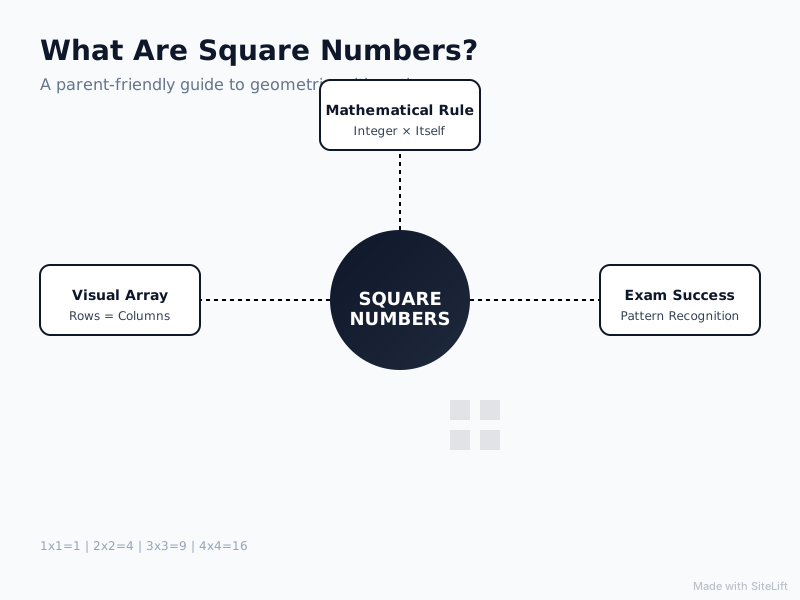
Infographic by SiteLift
Key Stage 2 Expectations: Why Year 5 and 6 Pupils Need Instant Recall
In standard SATs papers, children have limited time per question. If a child spends 30 seconds manually calculating $7 \times 7$ on scratch paper, they sacrifice precious thinking time needed for multi-step reasoning problems. Instant recognition transforms working memory into problem-solving power.
Pro Tip: Treat square numbers like sight words in reading. Your child should not need to chant the 7 times table up to 7 to identify 49; they should see 49 and immediately recognise its square identity.
Bonus Values for 11+ Candidates: Knowing Squares up to 15² and 20²
Standard state school curricula stop at $12 \times 12$. However, selective grammar school exams such as the CSSE or GL Assessment expect children to work with larger numbers effortlessly.
Commit these high-yield squares to memory:
- $13^2 = \mathbf{169}$
- $14^2 = \mathbf{196}$ (Notice the digit flip: 169 vs 196)
- $15^2 = \mathbf{225}$
- $16^2 = \mathbf{256}$
- $20^2 = \mathbf{400}$
- $25^2 = \mathbf{625}$
How to Recognise Square Numbers and Key Number Properties
Beyond basic tables, recognising square numbers involves understanding their underlying mathematical traits. Selective entrance exams intentionally create questions that reward candidates who understand these core number properties.
The Last Digit Rule: Which Digits Can Never End a Square Number?
One of the most powerful diagnostic shortcuts in maths lies in the final unit digit of a square number.
Look at the final digits of the squares of 0 through 9:
- $0^2 = 0$ (ends in 0)
- $1^2 = 1$ and $9^2 = 81$ (both end in 1)
- $2^2 = 4$ and $8^2 = 64$ (both end in 4)
- $3^2 = 9$ and $7^2 = 49$ (both end in 9)
- $4^2 = 16$ and $6^2 = 36$ (both end in 6)
- $5^2 = 25$ (ends in 5)
Notice what is missing? A square number can never end in 2, 3, 7, or 8.
If an 11-plus multiple-choice question asks: "Which of the following is a square number: 3,452, 4,098, 5,625, or 6,113?", your child does not need to compute square roots. They can instantly eliminate the numbers ending in 2, 8, and 3, leaving 5,625 as the only possible answer.
Odd and Even Properties of Square Numbers
The parity of the base number dictates the parity of the square:
- Odd $\times$ Odd = Odd: Squaring an odd number always produces an odd number ($3^2 = 9$, $7^2 = 49$, $11^2 = 121$).
- Even $\times$ Even = Even: Squaring an even number always produces an even number ($4^2 = 16$, $8^2 = 64$, $12^2 = 144$).
Furthermore, every even square number is divisible by 4. This detail eliminates wrong answers in advanced logic puzzles.
The Differences Between Consecutive Square Numbers (Consecutive Odd Numbers Pattern)
There is an elegant relationship connecting squares and odd numbers. The difference between consecutive square numbers always forms the sequence of consecutive odd numbers:
$$\begin{aligned} 1 &= 1 = 1^2 \ 1 + 3 &= 4 = 2^2 \ 1 + 3 + 5 &= 9 = 3^2 \ 1 + 3 + 5 + 7 &= 16 = 4^2 \ 1 + 3 + 5 + 7 + 9 &= 25 = 5^2 \end{aligned}$$
Notice the gap between each consecutive square:
- $4 - 1 = \mathbf{3}$
- $9 - 4 = \mathbf{5}$
- $16 - 9 = \mathbf{7}$
- $25 - 16 = \mathbf{9}$
- $36 - 25 = \mathbf{11}$
If your child forgets what $13^2$ is, but remembers that $12^2 = 144$, they can simply add the next odd number in the sequence ($12 + 13 = 25$): $144 + 25 = 169$.
How Are Square Numbers Tested in the CSSE 11+ Maths Exam?
Historical analysis of Consortium of Selective Schools in Essex (CSSE) 11+ mathematics papers indicates that non-linear number sequences and pattern recognition appear in virtually every annual paper. The examiners rarely ask: "What is 9 squared?" Instead, they disguise the concept inside multi-step problems.
CSSE Number Patterns Practice: Non-Linear Sequences
Standard primary school sequences typically feature constant addition (linear sequences such as $3, 7, 11, 15...$ where you add 4). In contrast, CSSE number patterns practice tests a pupil's ability to spot expanding gaps.
Consider this sequence: $$2, 5, 10, 17, 26, \underline{\hspace{0.8cm}}$$
A student looking for a constant step will stumble. But an 11-plus trained student will spot the square numbers shifted by one ($n^2 + 1$):
- $1^2 + 1 = 2$
- $2^2 + 1 = 5$
- $3^2 + 1 = 10$
- $4^2 + 1 = 17$
- $5^2 + 1 = 26$
- Therefore, the next term is $6^2 + 1 = \mathbf{37}$.
Algebraic and Word Problem Applications (Area and Side Lengths)
Geometry problems frequently conceal square numbers. If a question states that a square garden has an area of $81\text{ m}^2$, the child must work backwards to deduce that the side length is $\sqrt{81} = 9\text{ m}$.
From there, the question will usually demand a second step: "Calculate the cost to fence the entire perimeter of the garden at £6 per metre."
- $\text{Side} = 9\text{ m}$
- $\text{Perimeter} = 9 \times 4 = 36\text{ m}$
- $\text{Cost} = 36 \times 6 = \text{\pounds}216$
Combined Reasoning: Linking Squares, Factors, and Prime Numbers
Grammar school exams regularly combine distinct mathematical definitions into a single riddle:
"I am a two-digit number. I am a square number. If you reverse my digits, I become a prime number. I am greater than 50. What number am I?"
To solve this systematically:
- List all two-digit squares greater than 50: 64, 81.
- Reverse the digits:
- $64 \rightarrow 46$ (even number, not prime)
- $81 \rightarrow 18$ (even number, not prime)
- Wait—re-evaluate: Is there another? Look at $9^2 = 81$. Let's check $8^2 = 64$.
What about smaller or larger candidates? If the question read "between 10 and 50":
- $16 \rightarrow 61$ (Prime!)
- $25 \rightarrow 52$ (Not prime)
- $36 \rightarrow 63$ (Divisible by 3, not prime)
- $49 \rightarrow 94$ (Not prime)
Teaching children to methodically write down candidates and filter them by rules is the cornerstone of CSSE preparation.
Parent-Led Practice: 11+ Style Questions with Worked Solutions
Put your child's knowledge to the test with these three targeted questions, spanning from baseline KS2 fluency to authentic 11-plus exam standard.
Question 1 (Foundational KS2 Fluency)
Question: Calculate the value of $3^2 + 4^2$. Is the result a square number?
- Step 1: Calculate each square separately: $3^2 = 3 \times 3 = 9$, and $4^2 = 4 \times 4 = 16$.
- Step 2: Sum the two values: $9 + 16 = 25$.
- Step 3: Check if 25 is a square number: Yes, because $5 \times 5 = 25$ ($5^2$).
- Answer: 25; Yes, it is $5^2$. (This famous relationship is the basis of the 3-4-5 Pythagorean triple).
Question 2 (Intermediate 11+ Sequence)
Question: Find the next two numbers in the following sequence: $$3, 12, 27, 48, \underline{\hspace{0.8cm}}, \underline{\hspace{0.8cm}}$$
- Step 1: Look at the differences between the numbers:
- $12 - 3 = 9$
- $27 - 12 = 15$
- $48 - 27 = 21$
- Step 2: Notice that the differences are increasing by 6 each time ($9, 15, 21...$).
- Step 3: Alternative method (The Square Link):
- $3 = 3 \times 1 = 3 \times 1^2$
- $12 = 3 \times 4 = 3 \times 2^2$
- $27 = 3 \times 9 = 3 \times 3^2$
- $48 = 3 \times 16 = 3 \times 4^2$
- Step 4: Compute the 5th and 6th terms using $3 \times n^2$:
- 5th term: $3 \times 5^2 = 3 \times 25 = \mathbf{75}$
- 6th term: $3 \times 6^2 = 3 \times 36 = \mathbf{108}$
- Answer: 75, 108
Question 3 (Advanced CSSE Multi-Step Reasoning)
Question: A tile merchant has 150 square ceramic tiles, each measuring $10\text{ cm} \times 10\text{ cm}$. He uses these tiles to create the largest single solid square patio possible without cutting any tiles. (a) How many tiles are used for the patio? (b) What is the area of the remaining unused tiles in square centimetres?
- Step 1: To make a solid square, the number of tiles used must be a perfect square less than or equal to 150.
- Step 2: Recall square numbers near 150:
- $11^2 = 121$
- $12^2 = 144$
- $13^2 = 169$ (Too large; he only has 150 tiles)
- Step 3: The largest square he can construct requires 144 tiles ($12 \times 12$ tiles).
- Step 4: Calculate unused tiles: $150 - 144 = 6\text{ tiles left over}$.
- Step 5: Calculate the area of the unused tiles:
- Each tile has an area of $10\text{ cm} \times 10\text{ cm} = 100\text{ cm}^2$.
- $6 \text{ tiles} \times 100\text{ cm}^2 = \mathbf{600\text{ cm}^2}$.
- Answer: (a) 144 tiles; (b) 600 cm²
Key Takeaways for Parents
Use this summary table as a quick reference sheet when checking your child's revision:
| Concept | Key Rule / Formula | Example | Common Pitfall |
|---|---|---|---|
| Definition | An integer multiplied by itself ($n \times n$). | $6 \times 6 = 36$ | Confusing $n^2$ with $2n$ ($6 \times 2 = 12$). |
| Core Range | Memorise $1^2$ through $12^2$ for KS2. | $11^2 = 121, 12^2 = 144$ | Hesitating on 7², 8², and 12². |
| 11+ Extension | Know $13^2$ to $15^2$ and $20^2$. | $13^2 = 169, 14^2 = 196$ | Mixing up 169 and 196. |
| Last Digit Rule | Squares only end in 0, 1, 4, 5, 6, 9. | 2,401 could be square; 2,407 cannot. | Trying to compute square roots of numbers ending in 2, 3, 7, 8. |
| Odd Differences | Consecutive square differences equal consecutive odd numbers. | $9 - 4 = 5$; $16 - 9 = 7$ | Missing non-linear sequences on entrance exams. |
Why Rote Memorisation Is Underrated in 11+ Preparation
There is a modern pedagogical hesitation around rote memorisation in primary maths. Educators often focus almost exclusively on "conceptual exploration." While visualising dot grids and understanding why squares work geometrically is indispensable, I firmly believe that when preparing for competitive exams like the CSSE, rote memorisation of key numerical facts is massively underrated.
In the pressure cooker of an 11-plus exam room, cognitive load is your child's biggest constraint. When candidates have to spend mental energy working out $12 \times 12$ or calculating whether 81 is a square number, they drain the working memory needed to untangle multi-layered word problems.
Memorising squares up to $15^2$ is not "shallow learning"—it is building mental infrastructure. It gives children the confidence to look at a messy sequence like $167, 194, 223$ and immediately notice that each term sits two units below a known square ($169-2, 196-2, 225-2$). Fluent recall does not replace conceptual understanding; it frees your child's brain to use it.
— essex11mathspractice.co.uk
Target Your Child's CSSE Preparation
Mastering square numbers and non-linear patterns is just one element of passing the Essex grammar school entrance test. The Consortium of Selective Schools in Essex sets challenging mathematics papers that demand rapid numerical fluency, word-problem translation, and deep spatial reasoning.
At Essex 11+ Maths Practice, we provide style-matched revision papers specifically calibrated to the real CSSE exam format. Rather than working through generic Key Stage 2 worksheets, your child can practice authentic exam questions with instant automated marking, step-by-step worked solutions, and granular topic tracking to pinpoint weak spots before exam day.
Whether you need targeted sequence drills or full-length timed mocks, explore our resources to give your child the exam-day edge:
- Learn more about our comprehensive Essex 11+ (CSSE) Maths & English Practice resources.
- Discover flexible subscription options on our Pricing page, including a free tier to get started right away.
Frequently Asked Questions
Is 0 considered a square number in KS2 maths?
Mathematically, zero is a square number because $0 \times 0 = 0$ ($0^2 = 0$). However, in Key Stage 2 classroom practice and 11-plus questions, sequences of square numbers almost always start at the first positive square number ($1$). If a question specifies "positive square numbers", zero is excluded.
Why is 1 called a square number if it only has one dot?
A square requires equal height and width. A single dot represents a grid of 1 row and 1 column ($1 \times 1 = 1$). Because 1 is an integer multiplied by itself, it strictly satisfies both the geometric and algebraic definitions of a square number.
How can my child quickly memorise square numbers up to 12²?
Combine three practical methods:
- Flashcard Drills: Regular 2-minute daily recall drills.
- Visual Grids: Have your child draw square grids on graph paper to physically shade $4 \times 4$, $6 \times 6$, and $9 \times 9$.
- Times Table Connections: Anchor squares within daily multiplication tables, pointing out that squares form the diagonal line running through any standard multiplication square.
What is the difference between a square number and a square root?
Squaring and finding the square root are inverse (opposite) operations:
- Squaring means multiplying a number by itself: $6 \rightarrow 6 \times 6 = \mathbf{36}$.
- Square Root ($\sqrt{}$) means finding which number multiplied by itself gives the target: $\sqrt{36} = \mathbf{6}$. If squaring is building a square patio from side tiles, finding the square root is measuring one side of the patio.
How do square number sequences appear in the Essex CSSE 11+ exam?
The CSSE test frequently uses square numbers in non-linear sequences where the difference between numbers increases by 2 each step. They also present sequences shifted by a constant, such as $n^2 + 1$ ($2, 5, 10, 17...$) or $n^2 - 1$ ($0, 3, 8, 15...$), as well as geometric perimeter and area questions that require finding roots without a calculator.