Top 10 Difficult CSSE Maths Question Types and How to Solve Them
Top 10 Difficult CSSE Maths Question Types and How to Solve Them

If your child is sailing through SATs-style homework but getting stuck on past papers, you're not alone. These hard CSSE maths questions are deliberately designed to stretch the very top of Year 6, and they look nothing like the tick-box SATs. I've pulled together the 10 types where marks disappear fastest, based on examiner commentary, drop-off patterns in Essex 11+ maths past paper questions, and years of seeing bright pupils trip on the same traps.
How did I evaluate them? Each type below is ranked by how often it appears, how many steps it demands, and how easily it causes a time-slip under pressure. For every one you'll get what it is, who needs to master it, its standout test skill, its main trap, plus a worked mini-example you can try at home.
How We Identified the Hardest CSSE Maths Question Types
The CSSE paper is not a harder SATs paper. It's a different beast entirely.
According to the Department for Education, approximately 24% of Year 6 pupils in England reach the 'higher standard' in Key Stage 2 mathematics. The Essex grammar schools are selecting from within that 24%, so the paper has to use multi-step logic, awkward numbers and non-standard layouts to separate candidates.
Data published by the official Consortium of Selective Schools in Essex site shows candidates typically get around 1 minute per mark on the mathematics paper. That sounds generous until you hit a three-part ratio or a working-backwards puzzle that needs four minutes of clear thinking.
Key distinctions I see every year between KS2 SATs and CSSE standards:
- SATs reward fluency. CSSE rewards resilience. One CSSE question can test fractions, ratio and subtraction in a single paragraph.
- No multiple choice. Unlike GL 11+, your child must set out working and get the exact answer. No guessing the nearest option.
- Language is the hurdle. Words like only, altogether, remaining, exchanged completely change the maths.
1. Multi-Step Ratio and Proportional Sharing Problems
What it is: Sharing problems where the ratio changes part-way through. Example: Amy and Ben share money in the ratio 3:2. Amy gives £6 to Ben, now the ratio is 3:4.
Who it's best for: Every child aiming for Colchester, Chelmsford, Southend or Westcliff — this appears almost yearly.
Standout strength: Tests true proportional reasoning, not just dividing by total parts.
Main drawback / trap: Pupils calculate the first share correctly, then forget the total has stayed the same.
Why Students Struggle: They try to do it all in their head and lose track of parts.
Step-by-Step Solution Breakdown:
- Draw bars. Start 3:2 = 5 parts total.
- After the transfer, 3:4 = 7 parts total. Scale both ratios to a common total — LCM of 5 and 7 is 35.
- 3:2 becomes 21:14. 3:4 becomes 15:20.
- Amy drops from 21 to 15 units = 6 units = £6, so 1 unit = £1. Original total = £35.
Top Strategy for the Exam: Always write the before and after totals. If totals match, bar modelling wins.
Pro Tip: If money is moved but no one leaves, the total never changes. Use that to find a common multiple first.
Research from the Mathematical Association demonstrates that pupils utilizing bar modeling techniques solve multi-step ratio problems with up to 30% higher accuracy than those relying solely on abstract algebra.
2. Algebraic Sequence Patterns and nth Term Thinking
What it is: Visual patterns — matchsticks, tiles, dots — where you must find the 20th or 50th term without drawing it all.
Who it's best for: High-achievers who find standard number sequences too easy and need an advanced primary mathematics challenge.
Standout strength: Bridges primary maths to secondary algebra beautifully.
Main drawback: Pupils spot the +3 pattern but forget the starting offset.
Why Students Struggle: They use term-to-term (+4 each time) instead of position-to-term (term = 4n + 1).
Step-by-Step Solution Breakdown: Pattern: 5, 9, 13, 17...
- Difference = 4, so rule starts 4n.
- For figure 1, 4x1 = 4, need 5, so add 1: rule = 4n + 1.
- 20th term = 4x20 + 1 = 81. No drawing needed.
Top Strategy for the Exam: Make a tiny table: Position 1,2,3 on top, value below. Check your rule against figure 2 and 3 before you trust it.
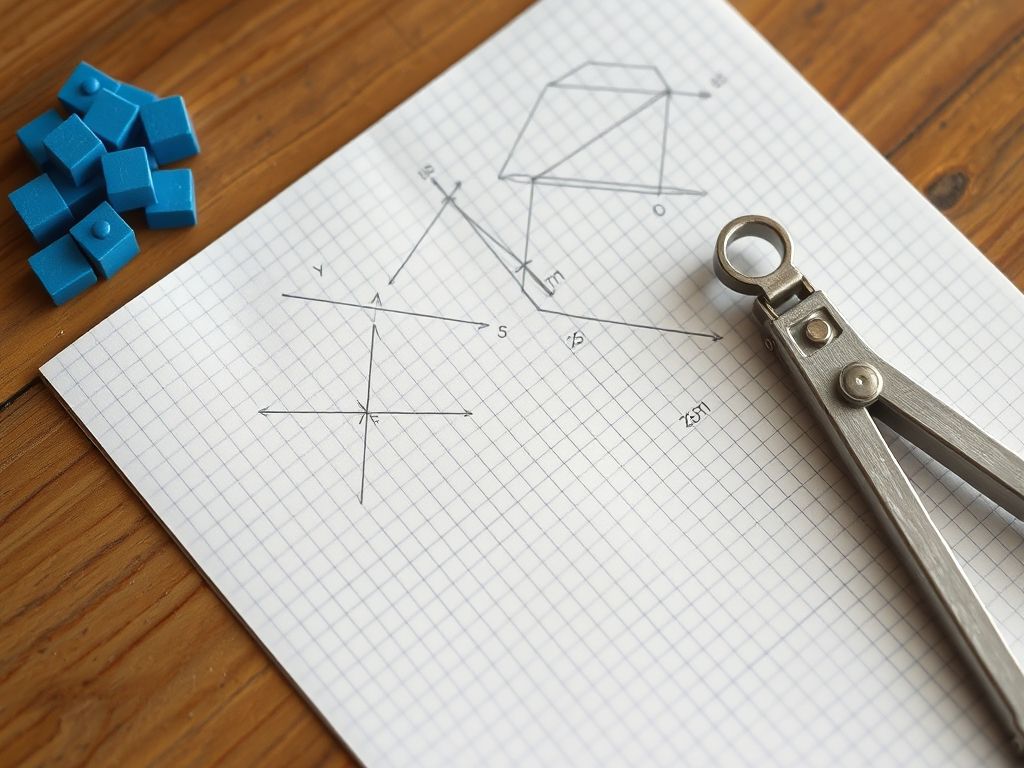
3. Complex Geometry: Shaded Regions and Compound Area
What it is: Overlapping squares, triangles and quarter-circles where you must find the shaded leftover.
Who it's best for: Visual learners who rush — precision matters more than speed here.
Standout strength: Rewards systematic working over cleverness.
Main drawback: One arithmetic slip wipes out 4-5 marks of good logic.
Why Students Struggle: They try to find the shaded shape directly instead of doing Big Shape minus Unshaded.
Step-by-Step Solution Breakdown: Square 10cm x 10cm = 100cm² with unshaded right-angled triangle base 10cm, height 6cm.
- Triangle = ½ x 10 x 6 = 30cm².
- Shaded = 100 - 30 = 70cm².
- With two triangles, calculate each separately and subtract the sum.
Top Strategy for the Exam: Label every length on the diagram first. CSSE loves to hide a side you need to infer (e.g., square side = triangle base).
4. Speed, Distance, and Time Hard CSSE Maths Questions with Unit Conversions
What it is: Two-leg journeys, late buses, average speed puzzles with minutes that must become decimals.
Who it's best for: Confident calculators who often forget units.
Standout strength: Tests real-world maths fluency under time pressure.
Main drawback: 45 minutes is not 0.45 hours. That single error is the biggest mark-killer.
Why Students Struggle: Mixing minutes and hours in the same calculation.
Step-by-Step Solution Breakdown: Train travels 60 miles in 45 minutes. What is speed in mph?
- Convert time: 45 mins = 45/60 = 0.75 hours.
- Speed = Distance ÷ Time = 60 ÷ 0.75 = 80 mph.
- For two legs: find total distance ÷ total time in hours for average speed.
Top Strategy for the Exam: Use the triangle: D on top, S x T below. Cover what you need. Convert everything to hours before you divide.
Pro Tip: Learn these cold: 15 mins = 0.25h, 30 mins = 0.5h, 45 mins = 0.75h, 20 mins = 1/3h.
5. Working Backwards with Reverse Operations
What it is: Classic tricky 11+ maths problems like: I think of a number, double it, add 12, divide by 4, subtract 5, I get 10. What was it?
Who it's best for: Logical thinkers who get lost in long word problems.
Standout strength: Once you learn the flowchart method, these become free marks.
Main drawback: Pupils work forwards and guess, wasting 3 minutes.
Why Students Struggle: They reverse the numbers but forget to reverse the operations (+ becomes -, x becomes ÷).
Step-by-Step Solution Breakdown:
- Start from end: 10.
- Reverse flow: +5 → 15, x4 → 60, -12 → 48, ÷2 → 24.
- Check forwards: 24→48→60→15→10. Correct.
Top Strategy for the Exam: Draw arrows left-to-right with operations, then work right-to-left underneath with opposites. Show it — CSSE awards method marks.
6. Combined Probability and Tree-Style Logic
What it is: Picking sweets, marbles or counters without replacement, then giving probability as fraction, decimal and percentage.
Who it's best for: Methodical pupils who will list outcomes neatly.
Standout strength: Only topic where clear layout guarantees accuracy.
Main drawback: Forgetting the total reduces after the first pick.
Why Students Struggle: They treat second pick as independent (e.g., 5/9 then 5/9 again).
Step-by-Step Solution Breakdown: Bag: 5 red, 4 blue. Pick two without replacement. P(both red)?
- First red: 5/9.
- Second red: 4/8 = 1/2 (only 8 left, 4 red left).
- Multiply: 5/9 x 1/2 = 5/18 ≈ 27.8%.
Top Strategy for the Exam: Write the new fraction after every pick. Cross out old totals.
7. Venn Diagrams and Set Theory Word Problems
What it is: 30 children like football/rugby/cricket, with overlaps like “8 like all three.” Fill the Venn and find “likes only one.”
Who it's best for: Pupils who misread small words under stress.
Standout strength: Almost pure reading comprehension disguised as maths.
Main drawback: Confusing only football with football total.
Why Students Struggle: They fill outer sections first and double-count the middle.
Step-by-Step Solution Breakdown:
- Always start in the centre (all three), then work outwards to pairwise overlaps.
- Subtract centre from pairwise numbers to get “just those two.”
- Add each circle to check against totals given.
Top Strategy for the Exam: Circle the words only, both, altogether in the question. They tell you exactly which region to use.
8. Volume, Surface Area, and 3D Net Folding
What it is: Cubes with missing blocks, counting hidden faces, or deciding which net makes which cube.
Who it's best for: Pupils who can rotate shapes in their head — or learn to draw views.
Standout strength: High marks for relatively little calculation.
Main drawback: Missing hidden cubes at the back of a 3D stack.
Why Students Struggle: They count what they see, not what holds it up.
Step-by-Step Solution Breakdown: 3x3x3 cube (27 small cubes) with centre cube of each face removed.
- Full volume = 27.
- Removed = 6.
- Left = 21. For surface area, each hole adds 4 new inner faces.
Top Strategy for the Exam: Count layer by layer: top view, middle view, bottom view. For nets, find the opposite faces first — they can never touch.
9. Mean, Median, Mode, and Range with Missing Data Points
What it is: Mean of 5 numbers is 12. Four numbers are 8, 11, 14, 15. Find the missing number.
Who it's best for: Pupils comfortable turning averages back into totals.
Standout strength: Tests inverse thinking examiners love.
Main drawback: Trying to guess the missing number instead of calculating the total.
Why Students Struggle: They forget Mean x Count = Total Sum.
Step-by-Step Solution Breakdown:
- Total = 12 x 5 = 60.
- Known sum = 8+11+14+15 = 48.
- Missing = 60 - 48 = 12.
Top Strategy for the Exam: Write TOTAL first in big letters. Every mean question in CSSE starts there.
10. Money and Financial Mathematics with Percentages
What it is: Double discounts, 20% VAT, profit comparisons in pounds and pence.
Who it's best for: Every candidate — Essex papers love a realistic shop problem.
Standout strength: Easy to check with common sense (answer should be less than start if discounted).
Main drawback: £ vs pence slips and calculator-free percentage panic.
Why Students Struggle: Adding 15% + 10% as 25% instead of compounding, and doing 10% incorrectly under pressure.
Step-by-Step Solution Breakdown: Jacket £80, 20% off, then extra 10% off sale price.
- 10% of £80 = £8, so 20% = £16. Sale = £64.
- 10% of £64 = £6.40. Final = £57.60.
- Check: not £80 - 30% (£56). Sequential is different.
Top Strategy for the Exam: Find 10% first (divide by 10), then build 5%, 20%, etc. Convert to pence (£64.00 = 6400p) if decimals get messy.
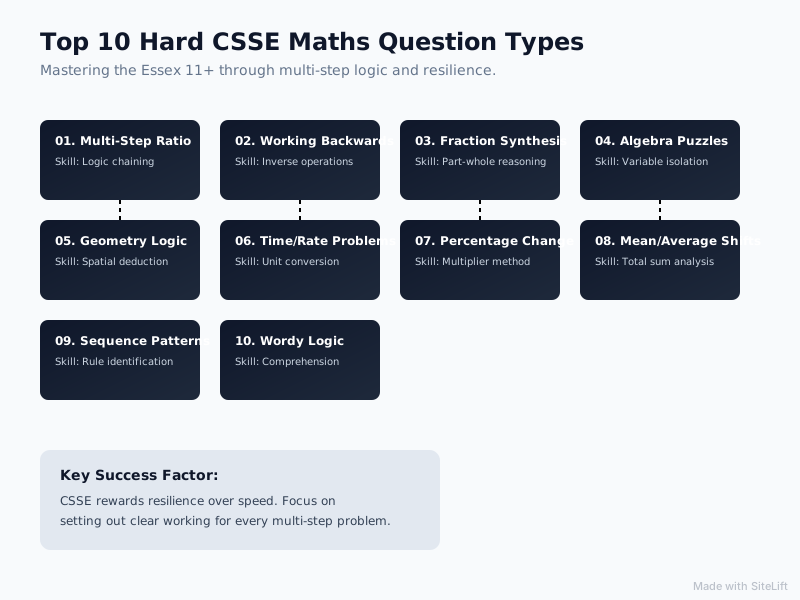
Infographic by SiteLift
CSSE Maths Difficulty Matrix: Question Types Compared
Here’s my quick prioritisation grid. If you’re short on time, revise high-frequency, high-mark topics first.
| # | Hard CSSE Maths Questions Type | Difficulty /5 | Typical Time | Frequency in Essex 11+ Maths Past Paper Questions |
|---|---|---|---|---|
| 1 | Multi-Step Ratio | 5 | 3-4 mins | Very High |
| 4 | Speed / Distance / Time | 5 | 3-4 mins | High |
| 5 | Working Backwards | 4 | 2-3 mins | High |
| 3 | Compound Area / Shaded | 4 | 3 mins | High |
| 9 | Averages with Missing Data | 4 | 2-3 mins | Medium-High |
| 10 | Money & Percentages | 3 | 2 mins | Very High |
| 2 | Sequences / nth Term | 4 | 2-3 mins | Medium |
| 7 | Venn Diagrams | 3 | 2-3 mins | Medium |
| 6 | Probability Without Replacement | 4 | 2-3 mins | Medium |
| 8 | Volume / Nets | 3 | 2 mins | Lower but growing |
Parents often ask me where the easy wins are. In my experience, working backwards and averages give the best return — learn the method once and you’ll bank 4-6 marks every paper. Ratio and speed are worth more overall, but they demand repeated timed practice.
For extension beyond the classroom, the UK Mathematics Trust Primary Mathematics Challenge uses a very similar style of advanced primary mathematics challenge questions and is brilliant extra stretch once CSSE basics are secure.
How Should Students Approach Hard CSSE Maths Questions in the Exam?
This is where I get a bit opinionated, because I’ve watched too many bright children lose 10 marks to panic, not maths.
First, use the Two-Pass Technique. Pass 1 (30 minutes): answer everything you can do in under 90 seconds. Circle the monsters and move on. Pass 2: return with a clear head and full method. CSSE gives method marks, so never leave a hard CSSE maths questions box blank — write your bar model, your reverse flowchart, your total sum. A tidy attempt can earn 1-2 marks even with a wrong final answer.
Second, normalise the weirdness. Non-standard layout is intentional. When your child freezes, teach the script: What am I given? What am I asked? Can I draw it? A quick sketch defuses anxiety faster than re-reading five times.
And honestly? Why working backwards is underrated: I think it’s the single most coachable skill on this list. Two evenings of practice and most Year 5s go from 0 to full marks. If confidence is low, start there.
Practise With Exam-Authentic CSSE Questions
Generic worksheets won’t cut it for this paper. You need the exact CSSE phrasing, answer boxes and timing — otherwise the real day feels foreign.
That’s why I recommend practising on Essex 11+ Maths Practice for the CSSE Exam — style-matched relaxed papers and full mocks built to match the real exam, with instant marking and a topic-by-topic breakdown that flags whether ratio or speed is costing you. Start free, then check flexible pricing plans from £9.99/month if you want full access through September.
Final Verdict: How to Choose What to Revise First
If you only have four weeks: master money percentages, working backwards and averages first for quick wins. If you have a full term: attack ratio and speed weekly under timed conditions, with one Venn and one probability set each weekend. Leave volume/nets for light relief — important, but less frequent.
The through-line for all hard CSSE maths questions? Draw it, write the total, show every step. Examiners reward clear thinkers, not just fast calculators.
— essex11mathspractice.co.uk
FAQ
What makes CSSE maths questions harder than regular Key Stage 2 SATs?
SATs test the national curriculum to an expected standard. CSSE tests how far beyond that a child can reason. Questions are open-ended, multi-step and often combine two topics — for example, fractions inside ratio, or percentages inside speed. There’s also no multiple choice to fall back on, and timing is tighter per reasoning step.
How many marks are typically required on the CSSE Maths paper to qualify for Essex grammar schools?
It varies yearly by cohort, age standardisation and school cut-off (Colchester and Chelmsford are usually highest). As a rough guide, most successful candidates score 65-75%+ raw on maths, with English balancing the total standardised score around 303-310+. Always check the official Consortium of Selective Schools in Essex site for the latest admissions data rather than relying on rumour.
Should my child guess if they run out of time on difficult CSSE maths questions?
Yes — but guess smartly. There’s no negative marking, so never leave a blank. Write any partial working for method marks, then put a sensible estimate. For example, if a probability must be less than 1/2, don’t write 7/5. Eliminate silly answers first.
How can I help my child prepare for non-standard math questions that aren't taught in primary school?
Use short, focused exposure little and often: one past-style problem a day, not hour-long drills. Teach visual tools schools rarely cover in depth — bar modelling for ratio, flowcharts for working backwards, layer-counting for volume. Timed mocks on an exam-authentic platform will make the strange feel familiar by September.