The Ultimate Year 5 Maths Timeline for Essex 11+ Exam Preparation
The Ultimate Year 5 Maths Timeline for Essex 11+ Exam Preparation

Navigating the 11+ journey in Essex can feel like a high-stakes balancing act. Between regular schoolwork, extracurricular commitments, and keeping your child's stress levels in check, building an effective Year 5 maths revision timeline is the single best step you can take to make the process manageable.
According to entry statistics from the Department for Education, selective grammar schools in the East of England are typically oversubscribed by roughly 4 to 5 applicants per place. In Essex specifically, the competition is intense, making early, structured preparation vital.
Having helped hundreds of pupils navigate the unique requirements of the Consortium of Selective Schools in Essex (CSSE) paper, I can assure you that cramming in the summer before Year 6 rarely works. Success comes from steady, incremental mastery across Year 5. This detailed guide maps out month-by-month targets, official application deadlines, and practical strategies to take your child from Key Stage 2 baseline skills to peak exam readiness.
Key Takeaways
| Phase / Term | Core Revision Focus | Target Weekly Hours | CSSE Application Milestones |
|---|---|---|---|
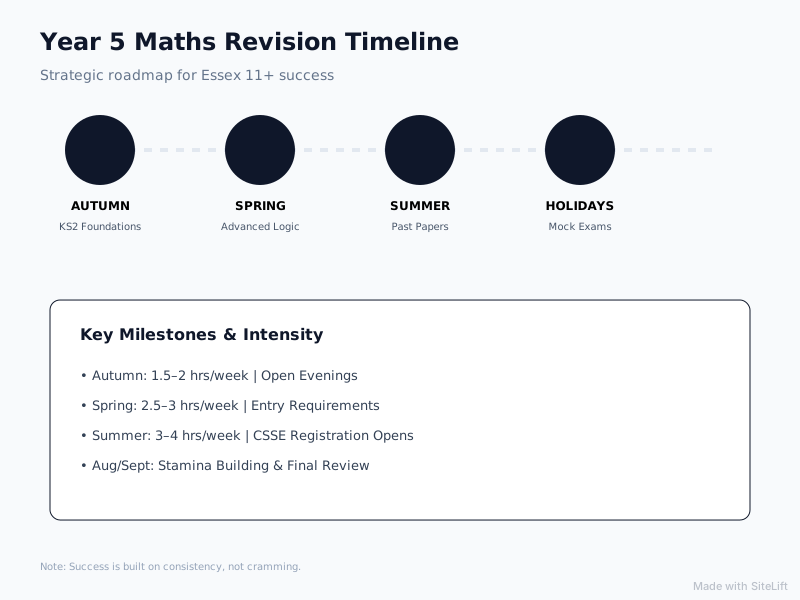
| Autumn (Sept–Dec) | KS2 Foundations (Fractions, Decimals, Four Operations) | 1.5 – 2 hours | Explore school open evenings |
| Spring (Jan–Apr) | Advanced Problem-Solving, Algebra & Ratios | 2.5 – 3 hours | Review test entry requirements |
| Summer Term (May–July) | Timed Past Papers & CSSE Question Styles | 3 – 4 hours | May/June: CSSE Registration Opens |
| Summer Hols (July–Aug) | Mock Exams, Error Logs & Stamina Building | 3 – 4 hours (tapering late Aug) | Receive test centre allocation |
| September | Light Review & Confidence Building | 1 hour | Mid-Sept: Sit the CSSE 11+ Exam |
Year 5 Maths Revision Timeline: When Should You Start Preparing for the Essex 11+?
The short answer is September of Year 5. Starting at the beginning of Year 5 provides a smooth 12-month runway to build exam stamina without inflicting study burnout on a nine-year-old.
Research published by The Sutton Trust indicates that over 70% of successful UK grammar school applicants receive private tutoring or structured exam preparation before sitting the 11+. However, structured preparation does not mean drilling exam papers from day one. Instead, it requires a clear, term-by-term progression.
+-------------------------------------------------------------------+
|                     YEAR 5 REVISION RUNWAY                        |
+-------------------------------------------------------------------+
|  AUTUMN TERM   |  Solidify KS2 Core (Fractions, Place Value)     |
|  SPRING TERM   |  Introduce CSSE Styles, Ratios & Multi-Step Word |
|  SUMMER TERM   |  Full Past Papers, Timed Practice & Error Audits  |
|  SUMMER HOLS   |  Mock Exams, Speed Building & Confidence Taper    |
+-------------------------------------------------------------------+
Autumn Term (Sept–Dec): Establishing Core Key Stage 2 Foundations
During the first term of Year 5, your sole priority should be cementing the standard Key Stage 2 national curriculum. The CSSE maths paper does not test university-level logic; it tests advanced, applied understanding of Primary curriculum topics.
Focus heavily on arithmetic speed, formal written methods, fractions, decimals, percentages, and basic place value. If a child hesitates on 7 × 8 or struggles to find a common denominator, they will bleed vital time on complex CSSE multi-step word problems later on. Aim for 1.5 to 2 hours of supplementary maths work per week, split into short, 20-minute daily slots alongside regular school homework.
Spring Term (Jan–Apr): Transitioning to Advanced CSSE Problem Solving
By January, your child should be comfortable with Year 5 classroom maths. Now begins the transition from standard numerical fluency to complex multi-step reasoning.
Introduce topics that primary schools often leave until Year 6, such as simple linear algebra, ratios, proportions, mean/median/mode problems, and perimeter/area of compound shapes. Increase your study quota slightly to around 2.5 to 3 hours per week. This is also the ideal window to determine when to start 11+ maths tutoring or introduce targeted self-paced revision platforms if your child encounters persistent conceptual roadblocks.
Summer Term & Holidays (May–Aug): Timed Mock Exams and Weak Spot Revision
From May onwards, the focus shifts from learning concepts to exam execution. This phase requires sitting authentic mock papers under timed conditions.
During the summer holidays, aim for 3 to 4 hours of revision per week. However, guard against over-testing. A common error parents make is giving children paper after paper without reviewing the underlying errors. Spend double the time analyzing an incorrect answer as you did taking the test.
What is the Official Essex Grammar School Application Timeline for 11+ Candidates?
Official administrative deadlines run parallel to your academic plan. Missing a registration deadline will invalidate months of hard revision.
The admissions process for selective schools across Essex—including King Edward VI Grammar School (KEGS), Colchester Royal Grammar School (CRGS), Southend High Schools for Boys and Girls, and Westcliff High Schools—is administered by the Consortium of Selective Schools in Essex. Data from the Consortium of Selective Schools in Essex (CSSE) shows that over 5,000 pupils compete annually for approximately 1,000 grammar school places across Essex.
       MAY / JUNE              JULY / AUGUST           SEPTEMBER            OCTOBER
  +------------------+     +------------------+    +---------------+    +---------------+
  | CSSE Registration| --> | Test Centre      | -> | CSSE Exam     | -> | 11+ Results   |
  | Window Opens     |     | Allocations Sent |    | Sat (Mid-Sept)|    | Released      |
  +------------------+     +------------------+    +---------------+    +---------------+
May–June: CSSE Test Registration Opens
Registration for the CSSE 11+ exam typically opens in mid-May and closes in late June or early July. You must register your child directly on the CSSE portal during this window; registering with your local authority for primary school transfers does not automatically register you for the 11+ test.
July–August: Test Centre Allocations & Summer Intensive Practice
In July, CSSE issues test centre allocations (usually one of the grammar schools or a secondary test centre near your home address). Use the summer holidays to familiarize your child with the test venue logistics to minimize morning-of anxiety.
September–October: Sitting the CSSE Exam and Results Notification
The CSSE paper is traditionally sat in mid-September of Year 6. Results are posted to parents in mid-October—well before the Common Application Form (CAF) deadline on 31st October, allowing you to make an informed choice on your school preferences.
How to Structure Your Month-by-Month Year 5 Maths Revision Timeline
To keep your child's progress steady and measurable, break Year 5 down into three distinct operational phases.
Infographic by SiteLift
Phase 1 (Sept–Jan): Topic Mastery in Fractions, Decimals, Percentages & Algebra
The first five months lay the bedrock. Do not jump straight into past papers. Build core conceptual understanding block by block:
- September: Master long multiplication, long division, and rapid recall of multiplication tables up to 12×12.
- October: Simplify, add, subtract, multiply, and divide proper fractions, mixed numbers, and top-heavy fractions.
- November: Decimal operations and converting seamlessly between fractions, decimals, and percentages.
- December: Fundamentals of perimeter, area of compound shapes, and volume of cubes/cuboids.
- January: Introduction to simple algebraic equations, function machines, and pattern sequences.
Phase 2 (Feb–May): Multi-Step Word Problems and Applied Mathematical Reasoning
Once topic fundamentals are secure, train your child to decode word-heavy questions that test multiple concepts simultaneously:
- February: Ratios, direct proportion, and scale drawing calculations.
- March: Data interpretation (pie charts, line graphs, bar charts) and calculating mean, median, mode, and range.
- April: Advanced spatial reasoning, reflection, rotation, net diagrams, and coordinate grid transformations.
- May: Time, speed, distance problems, and currency conversions involving multi-step arithmetic.
Phase 3 (June–Sept): Past Papers, Time Management, and Error Auditing
The final phase transforms mathematical knowledge into score-maximizing exam performance:
- June: First full untimed CSSE-style past papers. Focus entirely on layout, method marks, and clear handwriting.
- July: Transition to strictly timed past papers. Introduce test strategy: skipping stuck questions and returning to them later.
- August: Comprehensive error auditing using an "Error Logbook" to re-test tricky topic gaps.
- Early September: Tapering. Short, 15-minute quick-fire quizzes to maintain confidence without causing fatigue.
Pro Tip: Maintain an 'Error Logbook'. Every time your child gets a question wrong, paste it into a dedicated notebook. Re-visit these exact questions two weeks later. A topic isn't truly mastered until your child can explain the correct solution back to you in their own words.
When to Start 11+ Maths Tutoring vs Using Self-Paced Practice Tools?
Deciding between 1-on-1 tutoring, group tuition, or self-guided revision platforms depends heavily on your child's baseline ability, self-motivation, and your own availability to guide them.
                       IS YOUR CHILD ON TRACK?
                                  |
            +---------------------+---------------------+
            |                                           |
   [Needs Core Concept Help]                 [Solid KS2 Foundation]
            |                                           |
            v                                           v
  1-on-1 / Group Tutoring                     Self-Paced Practice
  (Focused Teaching & Gaps)                  (Targeted Mocks & Speed)
Assessing Your Child's Baseline Level with Diagnostic Practice
Before committing to expensive private tuition, administer a diagnostic practice test at the start of Year 5. If your child scores below 60% on standard Key Stage 2 material, they likely need structured, taught instruction to bridge core skill gaps. If they score above 75%, self-paced tools and targeted practice work exceptionally well.
The Role of Structured Practice Platforms vs Weekly Tutoring
While private tutors offer personal accountability, they only spend 1 hour a week with your child. Daily, authentic practice is where real score improvements happen.
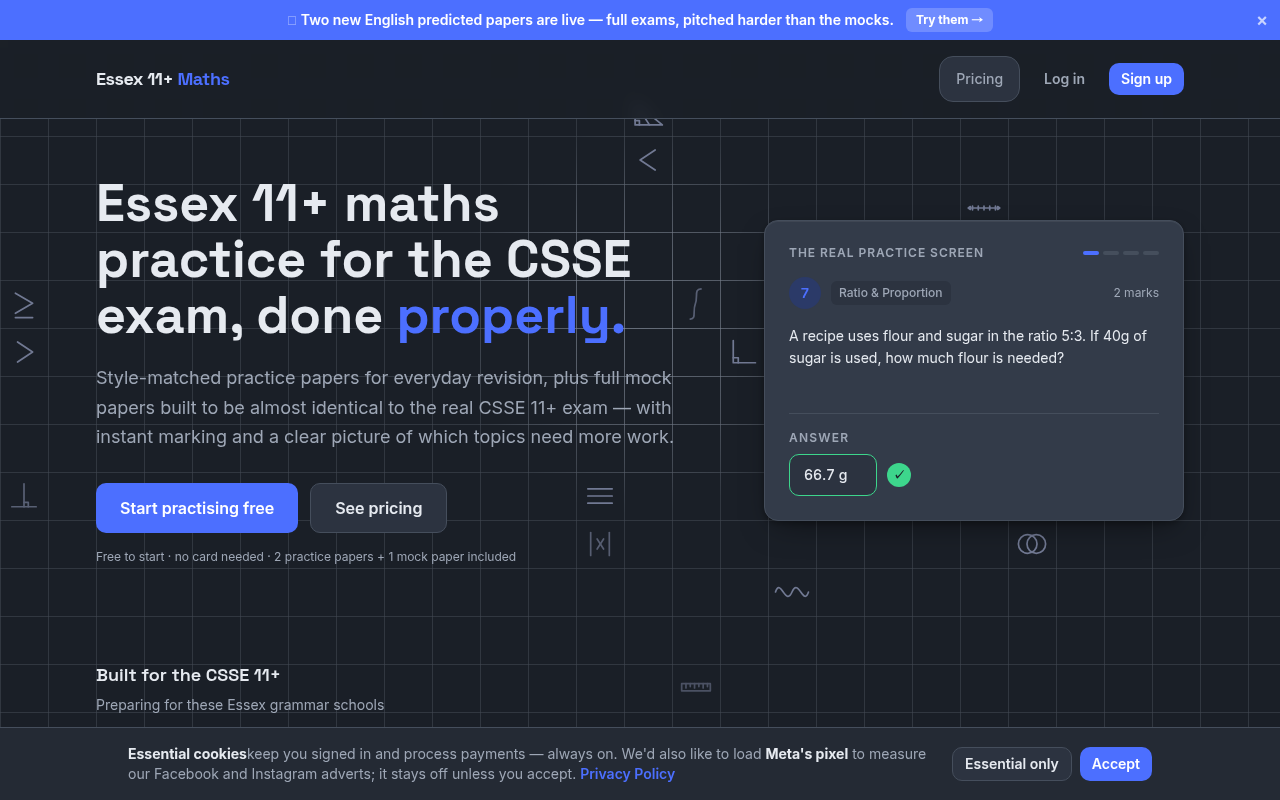
Using dedicated, exam-authentic platforms like Essex 11+ Maths Practice for the CSSE Exam allows you to run targeted, topic-by-topic diagnostic sessions between tuition hours. Instant feedback, step-by-step worked solutions, and automated progress tracking ensure that home revision directly mirrors the style and difficulty of the actual exam.
Preventing Study Fatigue in 9 and 10-Year-Olds
Burnout is a genuine risk during a 12-month revision timeline. Look out for red flags: sudden drops in calculation accuracy, tearfulness during study sessions, or total loss of motivation.
Protect their routine by keeping revision sessions short (20–30 minutes), scheduling dedicated study-free days every week, and maintaining sports or musical hobbies right up until exam week.
My Editorial Take: Why Method-Mark Mastery Is Underrated in CSSE Prep
In my experience advising Essex families through the 11+ journey, the biggest trap parents fall into is treating the CSSE paper like a standard GL Assessment test.
Most nationwide 11+ prep materials focus heavily on multiple-choice formats where guessing offers a 20% chance of success and method steps are completely ignored. The CSSE paper is completely different: it is an open-ended, free-response paper that heavily rewards explicit, organized method work.
"Many pupils calculate the correct final figure in their head but lose up to 40% of available marks on multi-step questions simply because they omitted their working out. In the CSSE exam, clear working is your safety net."
If a child makes a simple arithmetic error on line three of a 4-mark question but clearly demonstrates the correct multi-step method, the CSSE mark scheme will often award 2 or 3 method marks. Conversely, an incorrect answer with a blank working box yields zero.
I strongly advise families to insist on full, step-by-step written calculations from day one of Year 5 revision. Treat neat layout and clear mathematical presentation as non-negotiable skills—they are often the difference between securing a grammar place and just missing out.
How Do You Tailor Revision Specifically for the CSSE Maths Paper Format?
The CSSE paper presents unique challenges that standard school homework does not prepare pupils for.
+-----------------------------------------------------------------------+
| GL ASSESSMENT FORMAT                | CSSE (ESSEX) FORMAT             |
+-------------------------------------+---------------------------------+
| Multiple-choice answer sheets       | Open-ended, free-response boxes |
| Computer marked                     | Human marked (method counts)    |
| Standard KS2 word problems          | Applied, highly non-standard    |
| Fast-paced, lower time per question | Deep problem-solving focus      |
+-----------------------------------------------------------------------+
Understanding CSSE Open-Ended Questions vs Standard Multiple-Choice
Unlike multiple-choice papers used in other regions, the CSSE paper requires students to construct their own answers from scratch. There are no options to eliminate or work backwards from. Revision must focus on clear layout, precise writing, and explicit mathematical notation inside the provided answer boxes.
Mastering Speed and Accuracy in Applied Arithmetic
The CSSE paper tests applied arithmetic under tight time constraints. Children must learn to quickly spot numerical shortcuts—such as recognizing prime numbers, simplifying fractions before multiplying, or using factors to break down complex division—rather than relying solely on brute-force written methods.
The Final 4-Week Sprint Strategy Before Exam Day
During the final month before the test in September:
- Taper the intensity: Stop teaching brand-new topics 3 weeks before the exam. Focus entirely on refining existing strengths.
- Simulate realistic conditions: Have your child sit at least two full mock exams at the exact time of day as the real test (usually Saturday morning) without interruptions.
- Build exam day confidence: Review past successes, double-check stationery supplies (HB pencils, clear ruler, rubber), and focus on maintaining a positive, stress-free mindset.
Pro Tip: In the final two weeks, train your child on the 'Two-Pass Strategy'. On their first pass through the CSSE paper, they should answer every question they know instantly. On the second pass, they tackle the harder, multi-step word problems. This guarantees they secure all 'easy' marks before time pressure sets in.
Level Up Your CSSE Prep with Authentic Practice
Generic practice worksheets often fail to replicate the exact wording, layout, and open-ended difficulty of the CSSE maths paper.
At Essex 11+ Maths Practice for the CSSE Exam, we provide topic-by-topic diagnostic modules, instant marking, detailed worked solutions, and full-length mock papers engineered specifically for Essex grammar school entrance. Whether you are building core foundations in Autumn or running timed mock exams in August, our platform gives you the exact tools needed to track weak spots and measure progress.
Explore our flexible pricing plans to kickstart your child's Year 5 preparation today with our free tier.
Frequently Asked Questions
When should my child start Year 5 maths revision for the Essex 11+?
The optimal time to start structured revision is September at the beginning of Year 5. Starting early allows you to cover Key Stage 2 foundations thoroughly before introducing advanced CSSE-style multi-step problem solving in the spring term, avoiding unnecessary stress and burnout.
How does the CSSE 11+ maths paper differ from standard Key Stage 2 maths?
While the CSSE paper covers Key Stage 2 national curriculum topics, it presents them through non-standard, open-ended word problems that require multi-step logical reasoning. Unlike standard multiple-choice exams, the CSSE paper requires children to write out their method, awarding partial marks for clear working even if the final calculation is incorrect.
How many hours a week should a Year 5 pupil spend on 11+ maths practice?
In the Autumn term of Year 5, aim for 1.5 to 2 hours per week split into short, daily sessions. Increase this to 2.5 to 3 hours in the Spring term, and 3 to 4 hours per week during the Summer term and summer holidays as you introduce timed past papers and mock exams.
When do CSSE 11+ registration and open days usually take place in Essex?
Registration for the CSSE 11+ exam typically opens in mid-May and closes in late June or early July of Year 5. Open evenings for Essex grammar schools (such as KEGS, CRGS, Southend High, and Westcliff High) generally take place throughout June and July.
What score is typically required on the CSSE maths paper to qualify for an Essex grammar school?
There is no fixed pass mark, as scores are standardized based on the cohort's age and overall difficulty of the paper. However, historically, pupils securing a standardized score equivalent to 75–80%+ in the maths section put themselves in a strong position for a place at top Essex grammar schools.
— essex11mathspractice.co.uk