Symmetrical Lines Made Simple: How to Spot and Draw Them for KS2
Symmetrical Lines Made Simple: How to Spot and Draw Them for KS2
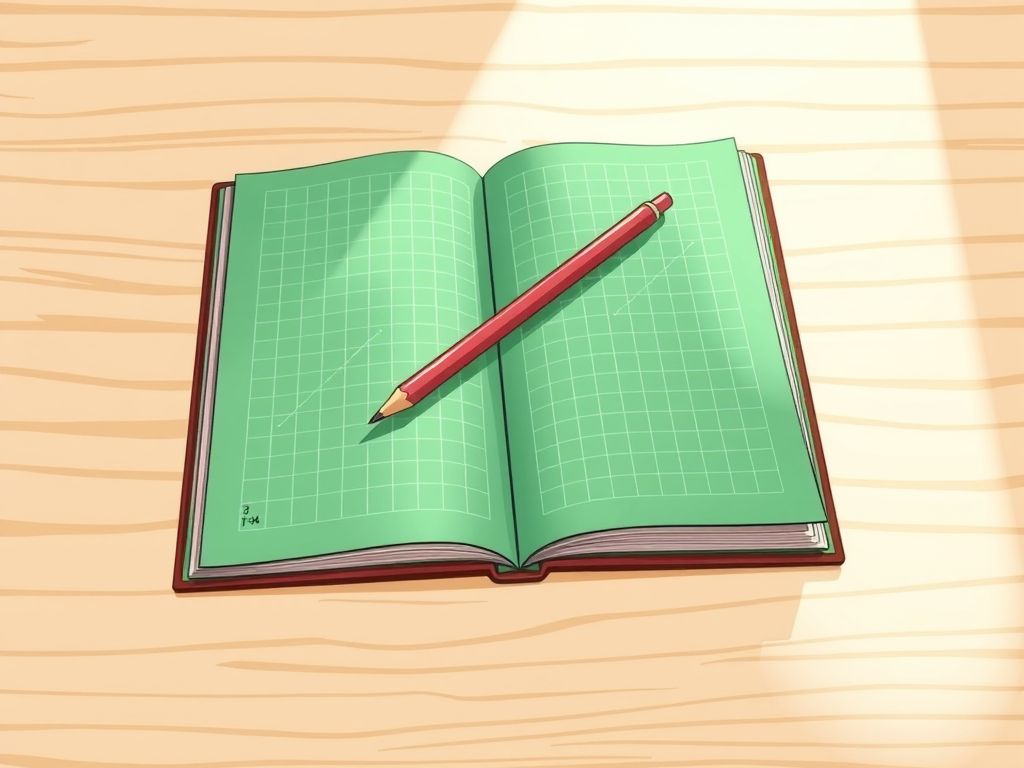
Few geometry topics cause as much unexpected confusion in primary school as symmetrical lines. On paper, symmetry sounds delightfully simple: fold a shape in half, and both sides match. Yet every year, capable Year 4 and Year 5 pupils lose easy marks across classroom tests and selective school entrance exams because a diagonal line threw them off or an irregular polygon looked deceptively balanced.
According to the Department for Education 2024 Key Stage 2 results, 73% of pupils in England reached the expected standard in mathematics. While that shows solid national progress, mastering spatial reasoning remains a key differentiator. Whether your child is preparing for school assessments or tackling competitive grammar school papers, understanding how to spot, draw, and reflect across symmetrical lines builds foundational confidence that carries through Key Stage 2 and beyond.
Here is a practical, step-by-step guide to mastering lines of symmetry at home, complete with classroom-tested methods, common pitfalls, and selective exam insights.
What Will Your Child Need Before Learning Symmetrical Lines?
Before diving into lines of symmetry, it helps to ensure your child is comfortable with basic geometric terminology. Jumping straight into complex reflection tasks without solid foundations usually leads to guessing rather than calculating.
KS2 Prerequisites for Year 4 and Year 5 Symmetry
Under the DfE Key Stage 2 mathematics programmes of study, spatial reasoning progresses systematically:
- Year 3 & 4 foundations: Pupils must recognise 2D shapes, count sides and vertices, spot horizontal and vertical orientations, and identify right angles. In Year 4, the curriculum expects pupils to identify lines of symmetry in 2D shapes presented in different orientations.
- Year 5 progression: Pupils move from passive identification to active transformation. They must complete reflections of shapes across a mirror line on coordinate grids or squared paper.
Simple Kit List for Practising at Home
You do not need fancy equipment to teach geometry well, but having the right physical tools makes spatial concepts tangible:
- Centimetre-squared grid paper: Essential for accurate counting and drawing.
- A 30 cm clear ruler: Transparent plastic allows children to see the underlying shape while aligning edges.
- A sharp HB pencil and eraser: Clean, thin lines prevent half-square measuring errors.
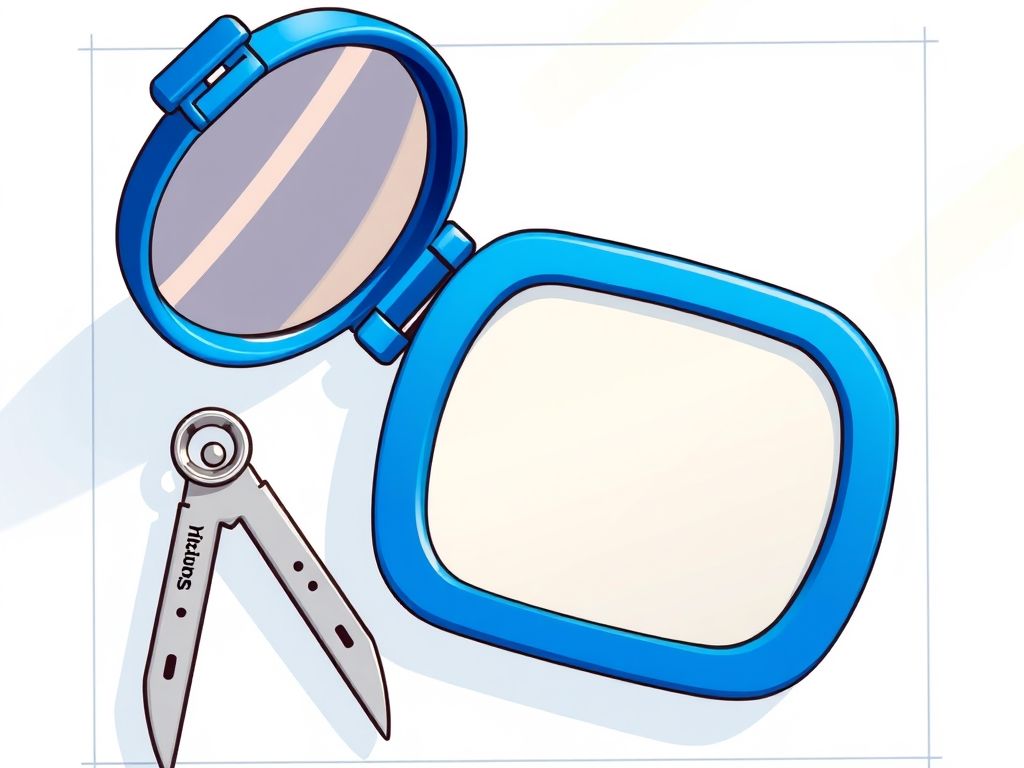
- A small acrylic safety mirror or Mira (semi-transparent mirror): The quickest way to provide instant visual feedback.
- Tracing paper: Indispensable for self-marking and kinaesthetic learners who need to physically fold a shape.
What Are Symmetrical Lines in KS2 Maths?
Child-Friendly Definition of a Line of Symmetry
If you ask a Year 4 child, what is a symmetrical line?, the easiest explanation is to describe it as an invisible "mirror" or "fold line".
A line of symmetry is a straight line drawn through a shape or pattern that divides it into two identical halves. If you were to fold the shape along that line, both halves would match up edge-to-edge with no overlap. We refer to the matching sides as having bilateral symmetry (or line symmetry).
Symmetrical lines can cut across shapes in three orientations:
- Vertical: Straight up and down (like dividing the letter M down the middle).
- Horizontal: Straight across from left to right (like splitting the letter B across its waist).
- Diagonal: Slanted at an angle (like cutting from one corner of a square to the opposite corner).
Symmetrical vs Asymmetrical: Everyday Examples in the UK
Helping children spot symmetry in the real world trains their eyes to notice balance without relying on prompts.
- Butterflies and oak leaves: Classic examples of natural vertical symmetry.
- UK Road Signs: A circular "No Entry" sign has both a vertical and a horizontal line of symmetry. A triangular "Give Way" sign has one vertical line of symmetry. A curved arrow "Turn Left" sign, however, is asymmetrical (it has zero lines of symmetry).
- The Union Flag: A brilliant trick question! Many adults assume the UK flag has four lines of symmetry. Look closely at the red diagonal saltires (St Patrick's cross); they are deliberately offset (counterchanged) against the white saltire (St Andrew's cross). The Union Flag actually has rotational symmetry, but zero lines of reflectional symmetry.
Step 1: How Do You Spot Symmetrical Lines in 2D Shapes?
Spotting symmetry requires active verification rather than passive glancing. Here is our three-check method for finding every hidden line of balance.
The Fold Test and Mirror Test Method
When your child encounters a shape, teach them to run this 3-step mental audit:
- Mentally fold: Pick an imaginary fold line. Would corner $A$ land directly on corner $B$?
- Measure distance: Does every vertex on the left sit the exact same distance from the fold line as its twin on the right?
- Verify orientation: Does the reflection point in the opposite direction? (A true mirror flips direction; it does not simply slide).
If your child struggles to visualise this, place a pocket mirror directly along the proposed line. If the combined reflection and visible half recreate the exact original shape, they have found a genuine line of symmetry.
How Many Symmetrical Lines Do Common Shapes Have?
Regular polygons (shapes where all sides and internal angles are equal) follow a handy mathematical rule: a regular polygon has the same number of symmetrical lines as it has sides. Irregular polygons, however, break this rule.
| Shape | Number of Symmetrical Lines | Orientation of Lines | Tricky Details to Watch |
|---|---|---|---|
| Equilateral Triangle | 3 | From each vertex to the midpoint of the opposite side | All sides are equal |
| Isosceles Triangle | 1 | Vertical (from apex to base midpoint) | Base angles must match |
| Scalene Triangle | 0 | None | No equal sides |
| Square | 4 | 1 vertical, 1 horizontal, 2 diagonal | Regular 4-sided polygon |
| Rectangle (non-square) | 2 | 1 vertical, 1 horizontal | Diagonals are NOT lines of symmetry |
| Rhombus | 2 | 2 diagonal (joining opposite vertices) | Does not have horizontal/vertical symmetry unless a square |
| Parallelogram | 0 | None | Cuts area in half, but halves do not fold onto each other |
| Kite | 1 | 1 diagonal (down the main axis) | Only the main line between equal angles |
| Regular Hexagon | 6 | 3 through vertices, 3 through midpoints of sides | Regular 6-sided polygon |
| Circle | Infinite | Any straight line passing through the centre | Must pass through the exact centre point |
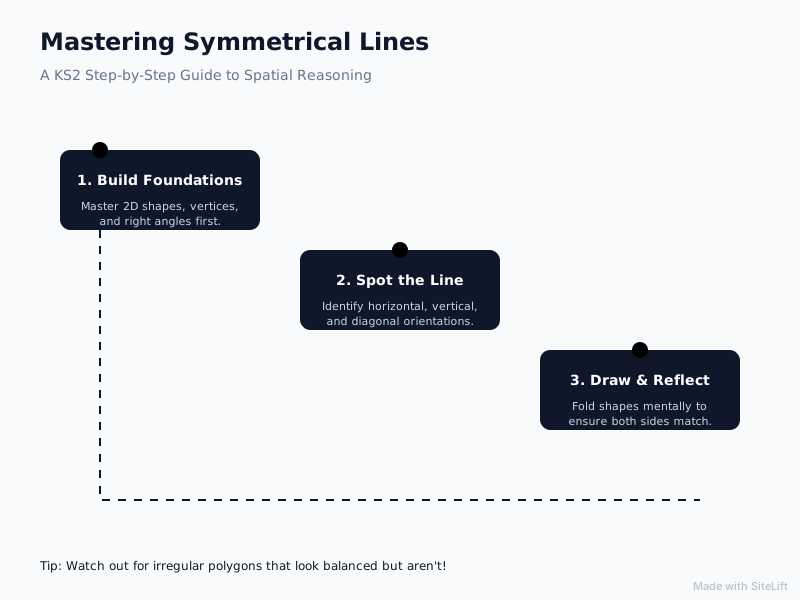
Infographic by SiteLift
Pro Tip: Always highlight the rectangle trap early. Children almost universally assume that cutting a rectangle from corner to corner creates a line of symmetry because it produces two identical triangles. Remind them: if you physically fold along that diagonal, the corners point out in opposite directions like cat ears!
Step 2: How Do You Draw Symmetrical Lines Accurately for KS2?
Once your child can identify lines, they must learn precise execution. When drawing symmetrical lines KS2 marking criteria are strict: lines that deviate from vertices or drift off-centre will be marked wrong.
Drawing Symmetrical Lines KS2 Step-by-Step Tutorial
- Identify twin vertices or midpoints: Before picking up the ruler, place faint pencil dots at the exact entry and exit points of the line. For example, on a regular pentagon, find a vertex and locate the exact midpoint of the opposite side.
- Anchor the ruler: Place the pencil lead on the first point, slide the ruler against the pencil, then pivot the ruler until it aligns with the second point. Press down firmly with the non-writing hand spread wide across the ruler to prevent slipping.
- Draw a clean dashed line: In UK primary maths and exam papers, lines of symmetry are traditionally marked using a neat, dashed line (e.g.,
- - - - -). - Extend slightly beyond the perimeter: Draw the line so it passes completely through the shape from edge to edge, extending a millimetre or two beyond. This makes it unambiguous to the marker.
       A
      /|\
     / | \
    /  |  \
   /   |   \
  B----|----C
       |
  (Dashed line passes cleanly through apex A and midpoint of BC)
Have your child practise this technique on capital letters. Letters like A, M, and T feature vertical lines; B, C, and E have horizontal lines; while H, I, and X possess both vertical and horizontal symmetry.
Step 3: How Do You Complete a Mirror Image Across a Symmetrical Line?
Reflecting a shape across a mirror line is a cornerstone of symmetry Year 5 maths. This step transitions children from basic geometry into coordinate-style spatial reasoning.
Counting Squares to Reflect Shapes in Year 5 Maths
Never guess where the opposite side lands. Teach your child the perpendicular counting method:
- Identify key vertices: Label the corners of the shape to be reflected ($A$, $B$, $C$).
- Count to the mirror line at $90^\circ$: Pick vertex $A$. Count how many grid squares it sits away from the mirror line along a straight perpendicular path.
- Count the exact same distance past the line: Continue moving in that exact same direction beyond the mirror line by the same number of squares. Make a sharp pencil point and label it $A'$.
- Repeat for all vertices: Do the same for $B$ and $C$.
- Connect the dots with a ruler: Join $A'$ to $B'$, $B'$ to $C'$, and $C'$ to $A'$.
Original Shape          Mirror Line          Reflected Shape
     |                       |                      |
   (A)--- 2 squares --->     |     --- 2 squares ->(A')
     |                       |                      |
Reflecting Patterns, Shading and Letters
A staple question format in 11+ papers involves shading squares on a grid to make a whole pattern symmetrical across one or two lines.
To solve these reliably:
- Work row-by-row or column-by-column rather than jumping across the grid at random.
- If a square is shaded 3 units to the left of the vertical mirror line, immediately shade the square 3 units to the right in the same horizontal row.
- If the mirror line is diagonal, remember that squares reflect diagonally: count diagonal grid steps or turn the paper $45^\circ$ so the mirror line sits vertically in front of your eyes.
Why Diagonal Symmetry Is the Ultimate 11+ Differentiator
In my experience tutoring pupils across Essex, almost every child masters horizontal and vertical mirror lines with ease. But when an exam question tilts the mirror line at a $45^\circ$ angle, accuracy rates plummet.
Children naturally want to count left-to-right, even when the line runs diagonally. When reflecting diagonally, horizontal movements turn into vertical movements. If your child learns to tilt the test paper so the diagonal line faces them vertically, the mental load drops by half. It is a remarkably simple trick, yet it consistently saves 3 to 4 marks on competitive papers.
According to Ofsted's 2023 mathematics subject report Coordinating Mathematical Success, strong spatial reasoning and geometry help pupils connect concepts across the wider maths curriculum. Investing ten minutes to master diagonal reflections pays dividends well beyond symmetry questions alone.
Common Mistakes with Symmetrical Lines and How to Fix Them
Troubleshooting Diagonal Lines and Near-Misses
- The "Halving Area" Confusion: Children frequently confuse lines of symmetry with lines that simply bisect area. A diagonal line across an ordinary parallelogram cuts it into two equal-area triangles, but folding along that line does not result in an exact match. Remind your child: Equal areas do not guarantee symmetry.
- Parallelogram Paralyis: Children often mark two diagonal lines on a standard parallelogram. Use tracing paper to prove that rotating is not the same as folding.
- Wobbly Freehand Lines: In timed conditions, children rush and sketch lines freehand. Examiners and automated scanning systems will penalise lines that do not pass precisely through the intended vertices.
Exam Pitfalls in CSSE Symmetry Questions
The Consortium of Selective Schools in Essex sets challenging mathematics papers for schools such as King Edward VI Grammar School, Colchester County High School for Girls, and Southend High School for Boys. In CSSE symmetry questions, tests frequently incorporate multi-step spatial challenges:
- Dual-line shading: Questions often provide a $4 \times 4$ or $6 \times 6$ grid with pre-shaded squares and ask: "What is the minimum number of extra squares that must be shaded so the grid has two lines of symmetry?" Children often shade for one line and forget the second.
- Double-counting lines: When counting lines of symmetry on regular polygons, pupils sometimes count both ends of the same line twice (e.g., counting a hexagon's 6 lines as 12).
- Miscounting grid distances: Rushing leads to dropping a square near grid borders. Always teach pupils to recount distances from the mirror line outward before moving to the next question.
Pro Tip: During practice sessions, have your child use a coloured pencil to trace the mirror line itself before answering. Making the reference line pop out visually prevents their eyes from wandering to the outer edges of the grid.
What Does Mastery Look Like? Try These CSSE-Style Symmetry Questions
To verify that your child can confidently spot and draw symmetrical lines, try this quick 5-minute diagnostic assessment together:
- Spot the Count: How many lines of symmetry does a regular octagon have? What about an isosceles trapezium? (Answers: Octagon = 8; Isosceles trapezium = 1)
- The Letter Challenge: Write down the capital letters in the word M A T H S. Which letters have at least one line of symmetry? (Answer: M [vertical], A [vertical], T [vertical], H [both vertical and horizontal]. S has rotational symmetry of order 2, but 0 lines of symmetry).
- The Grid Reflection: Draw a $5 \times 5$ square grid on paper. Draw a vertical mirror line down the central column. Shade two squares on the far left. Ask your child to shade the exact reflections on the right in under 30 seconds.
- The Diagonal Tilt: Draw a square with a diagonal line running from bottom-left to top-right. Place a small dot near the top-left corner. Ask your child to plot the reflected dot accurately. (Answer: It should sit near the bottom-right corner).
If your child completed all four tasks in under five minutes with crisp lines and zero counting mistakes, they have achieved solid Year 5 mastery.
Sharpen 11+ Spatial Reasoning with Dedicated Practice
Selective school exams test speed, spatial precision, and resilience under pressure. The National Centre for Excellence in the Teaching of Mathematics highlights that consistent, deliberate practice with visual representations embeds mathematical fluency far better than passive memorisation.
For families preparing specifically for the Essex 11+ entrance exams, generic worksheets often miss the mark. They rarely replicate the exact layout, question nuances, and time constraints of authentic grammar school papers. At essex11mathspractice.co.uk, we provide style-matched revision papers, instant marking, and comprehensive worked solutions tailored specifically to the CSSE maths exam format. By isolating tricky topics like spatial reasoning and symmetry grids, pupils can target their weaknesses and build the exam technique needed to excel on test day.
— essex11mathspractice.co.uk
FAQ
What is a symmetrical line in simple terms for kids?
A symmetrical line (often called a line of symmetry or mirror line) is a straight line drawn through a shape that cuts it cleanly in half. If you fold the shape along this line, both sides will match up perfectly on top of each other.
How many symmetrical lines does a square, rectangle and triangle have?
A square has 4 lines of symmetry (1 vertical, 1 horizontal, 2 diagonal). A non-square rectangle has 2 (1 vertical, 1 horizontal—its diagonals are not lines of symmetry). The count for triangles depends on the type: an equilateral triangle has 3, an isosceles triangle has 1, and a scalene triangle has 0.
How do you draw symmetrical lines accurately on squared paper?
Always use a sharp pencil and a clear ruler. Identify the midpoints or matching vertices on opposite sides of the shape, align your ruler precisely across these points, and draw a straight dashed line passing edge-to-edge through the shape. Double-check your line by counting the grid squares from the line to opposite corners.
What is the difference between symmetry in Year 4 and Year 5 maths?
In Year 4, pupils focus on identifying and drawing lines of symmetry within 2D shapes in different orientations. In Year 5, children build on this by completing reflections of shapes across a mirror line, using squared grids and coordinate points to draw mirror images accurately.
Do symmetrical lines appear in the CSSE 11+ maths exam for Essex?
Yes. CSSE maths papers frequently include symmetry and reflection questions. Common formats include determining lines of symmetry on complex 2D polygons, reflecting composite shapes across horizontal, vertical, or diagonal mirror lines, and shading squares on grids to create double-line symmetry.