Ratio and Proportion for CSSE Success: Step-by-Step Methods That Click
Ratio and Proportion for CSSE Success: Step-by-Step Methods That Click

Mastering ratio proportion questions is often what separates candidates who secure a grammar school place from those who just miss out. In the Consortium of Selective Schools in Essex (CSSE) 11+ examination, arithmetic isn't just about regurgitating times tables; it demands nimble mathematical reasoning under tight time constraints.
According to data published by the Consortium of Selective Schools in Essex, roughly 6,000 candidates sit the 11+ entrance test annually for approximately 1,000 available places across the county's selective grammar schools, including King Edward VI Grammar School (KEGS), Colchester Royal Grammar School (CRGS), and the Westcliff and Southend grammar schools. In a competitive field where a single mark can alter a child's rank by dozens of places, ratio questions represent fertile ground for picking up decisive marks.
Unlike generic regional tests that rely on multiple-choice formats, the CSSE maths paper requires children to write out numerical working and open-ended answers. If a student understands only the mechanical tricks without grasping the underlying structure, multi-step ratio word problems will trip them up every single time.
In this step-by-step tutorial, I break down 11+ ratio and proportion into logical, repeatable methods that eliminate confusion and build exam-day confidence.
Prerequisites: What Core Knowledge Is Needed Before Tackling 11+ Ratio and Proportion?
Before diving into complex word problems, your child needs a secure mathematical foundation. Attempting advanced ratio questions without sound basic arithmetic is like trying to build a brick wall without mortar—it invariably crumbles under exam pressure.
What You Need
- Core Skills: Rapid recall of multiplication tables up to $12 \times 12$, fluent mental addition and subtraction, and comfort simplifying fractions.
- Tools: Squared paper (5mm or 7mm grid), a sharp HB pencil, a 30cm ruler, and an eraser. (Calculators are strictly prohibited in the CSSE maths paper.)
- Time Required: Approximately 45 minutes of focused study per step, followed by 15 minutes of independent practice.
Understanding Ratio vs Proportion: The Essential Distinction
One of the most persistent hurdles in ratio Year 6 maths is confusing part-to-part with part-to-whole comparisons. While classroom explanations on revision hubs like BBC Bitesize provide an accessible starting point for Key Stage 2, the CSSE exam frequently exploits subtle misunderstandings of these terms.
- Ratio (Part-to-Part): Compares one distinct group directly to another. If a fruit bowl contains 3 apples and 5 bananas, the ratio of apples to bananas is written as $3:5$.
- Proportion (Part-to-Whole): Compares a single group to the total sum of all groups. In that same fruit bowl, the proportion of apples is 3 out of 8, expressed as the fraction $\frac{3}{8}$ or $37.5%$.
Mixing up the colon notation ($:$) with fraction notation ($\frac{a}{b}$) leads directly to wrong calculations when sharing amounts. When a question asks what fraction of a mixture is red syrup, writing down the part-to-part ratio instead of the part-to-whole fraction instantly throws away two marks.
Key KS2 Arithmetic Foundations: Multiplication Tables and Fractions
Speed is paramount. The CSSE maths paper allocates roughly one minute per question, meaning candidates cannot afford to spend 20 seconds working out $7 \times 8$ or finding the highest common factor of 48 and 72.
According to the Department for Education (DfE) Key Stage 2 national curriculum assessments report, while 73% of pupils in England met the expected standard in mathematics, performance dipped significantly on complex, multi-step reasoning items. In my tutoring experience across Essex, the candidates who excel are not necessarily mathematical prodigies; they are simply children whose mental recall of division facts, equivalent fractions, and factors operates on auto-pilot, freeing up cognitive bandwidth to untangle worded questions.
Step 1: How Do You Simplify Ratios and Build Core Ratio Proportion Fluency?
Simplifying a ratio means writing it in its lowest possible whole-number terms. Just like simplifying fractions, you divide each part of the ratio by a common factor until no further whole-number division is possible.
The Highest Common Factor (HCF) Method
To master simplifying ratios 11+ questions, teach your child to identify the Highest Common Factor (HCF) immediately rather than dividing by 2 repeatedly.
Action:
- Write down the ratio clearly.
- Identify the HCF shared by every number in the ratio.
- Divide each term by that factor.
Example 1: Simplify $36 : 48$.
- Both numbers share common factors (2, 3, 4, 6, 12).
- The HCF is 12.
- Divide 36 by 12 = 3.
- Divide 48 by 12 = 4.
- Simplified Ratio: $3 : 4$.
36 : 48 --(divide both by 12)--> 3 : 4
Common Mistake to Avoid: Stopping too early. For instance, dividing $36 : 48$ by 6 gives $6 : 8$. If a candidate leaves $6 : 8$ on the answer line of a CSSE paper, they forfeit the mark because the terms still share a common factor of 2. Make sure your child always scans the final numbers to confirm they are co-prime (sharing no common factor other than 1).
Dealing with Three-Part Ratios
The CSSE paper often steps beyond standard two-part ratios and introduces three-part expressions:
Example 2: Simplify $24 : 36 : 60$.
- Identify the HCF across all three numbers. While 6 divides into all three, the HCF is actually 12.
- Divide each term by 12:
- $24 \div 12 = 2$
- $36 \div 12 = 3$
- $60 \div 12 = 5$
- Simplified Ratio: $2 : 3 : 5$.
Every single term must be divided by the exact same number. You cannot divide the first two terms by 6 and the third by 10.
Dealing with Mixed Units and Decimals
CSSE papers routinely test whether pupils notice mismatched units. A classic trap looks like this: "Express 40p to £1.20 in its simplest form."
Action:
- Convert all values to the smallest unit in the problem to eliminate decimals.
- Drop the unit symbols once the units match.
- Simplify using the HCF method.
Example 3: Simplify $40\text{p} : £1.20$.
- Step 1: Convert £1.20 into pence $\rightarrow 120\text{p}$.
- Step 2: Set up the ratio without units $\rightarrow 40 : 120$.
- Step 3: Divide both sides by the HCF (40) $\rightarrow 1 : 3$.
What if the question includes decimals, such as $1.5 : 2.5$?
- Multiply both numbers by 10 to clear the decimal point: $15 : 25$.
- Divide by the HCF (5): $3 : 5$.
If fractions appear within a ratio—such as $\frac{1}{2} : \frac{3}{4}$—multiply all terms by the lowest common denominator (in this case, 4): $$\left(\frac{1}{2} \times 4\right) : \left(\frac{3}{4} \times 4\right) = 2 : 3$$
Step 2: How Do You Share a Quantity in a Given Ratio Using the Bar Model?
Sharing an amount into a given ratio is the most frequent ratio question on the Essex paper. The most dependable method relies on three crisp steps: Add $\rightarrow$ Divide $\rightarrow$ Multiply.
Calculating Total Parts and Single-Unit Value
When an amount is split into a ratio, each number in the ratio represents a set number of "shares" or "parts".
- Add the parts together to find the total number of parts.
- Divide the total quantity by the total number of parts to find the value of one part.
- Multiply the value of one part by each number in the original ratio.
Worked Example: Share £180 between Arthur, Beatrice, and Charlie in the ratio $2 : 3 : 4$.
- Step 1 (Add parts): $2 + 3 + 4 = 9\text{ parts in total}$.
- Step 2 (Find 1 part): $\text{£}180 \div 9 = \text{£}20\text{ per part}$.
- Step 3 (Multiply):
- Arthur: $2 \times \text{£}20 = \text{£}40$
- Beatrice: $3 \times \text{£}20 = \text{£}60$
- Charlie: $4 \times \text{£}20 = \text{£}80$
Check: $\text{£}40 + \text{£}60 + \text{£}80 = \text{£}180$. The working is confirmed.
Visualising Problem Structures with Bar Models
In my experience tutoring for the CSSE test, the bar model is dramatically underrated by parents. Many adults prefer abstract algebra, but under exam stress, a 10-year-old child armed with a simple visual diagram rarely makes structural errors.
Represent each part of the ratio as an identical rectangular box:
Arthur   [ £20 ][ £20 ]                     = £40
Beatrice [ £20 ][ £20 ][ £20 ]              = £60
Charlie  [ £20 ][ £20 ][ £20 ][ £20 ]       = £80
Total:   9 identical boxes = £180
         1 box = £180 ÷ 9 = £20
Visualising the problem this way prevents candidates from dividing £180 by 3 (the number of people) instead of 9 (the total number of parts).
Difference Problems: When You Are Not Given the Total
Where examiners catch pupils out is by giving the difference between shares rather than the grand total:
"Maya and Leo share marbles in the ratio $3 : 7$. Leo receives 28 more marbles than Maya. How many marbles does Leo receive?"
Watch what happens when a student draws a bar model here:
Maya [ ] [ ] [ ]
Leo  [ ] [ ] [ ] [ ] [ ] [ ] [ ]
                 |<- 28 marbles ->|
- Maya has 3 boxes, Leo has 7 boxes.
- The difference is $7 - 3 = 4\text{ boxes}$.
- Those 4 extra boxes equal 28 marbles.
- Therefore, 1 box $= 28 \div 4 = 7\text{ marbles}$.
- Leo receives $7 \times 7 = 49\text{ marbles}$.
If you had attempted this without a visual diagram, you might have tried dividing 28 by 10 (the sum of the parts), generating an impossible fractional marble. The bar model makes the relationship instantly self-evident.
Step 3: How Do You Solve Direct and Inverse Ratio Proportion Problems?
Proportion questions describe how changes in one variable affect another. In the CSSE exam, these appear as recipe adjustments, exchange rates, or worker-time calculations.
Direct Proportion: Scaling Recipes and Conversion Graphs
In direct proportion, as one quantity increases, the other increases at the exact same rate. If you double the ingredients, you double the number of cakes produced.
The standard tool here is the unitary method for proportion problems KS2: calculate the amount needed for one single item, then scale up to the target quantity.
Example 1: A recipe for 12 scones requires 300g of flour. How much flour is needed for 20 scones?
- Step 1 (Find 1 unit): Flour for 1 scone $= 300\text{g} \div 12 = 25\text{g}$.
- Step 2 (Scale up): Flour for 20 scones $= 20 \times 25\text{g} = 500\text{g}$.
Alternatively, look for common scaling factors. Notice that both 12 and 20 are multiples of 4:
- Divide by 3 to find flour for 4 scones: $300\text{g} \div 3 = 100\text{g}$.
- Multiply by 5 to find flour for 20 scones: $100\text{g} \times 5 = 500\text{g}$.
This alternative scaling-factor technique is often faster on the CSSE paper because it avoids messy long division when the single-unit value is a repeating decimal.
Inverse Proportion: Worker and Time Calculations
Inverse proportion trips up unprepared candidates every year. In inverse proportion, as one value goes up, the other goes down.
If more workers paint a fence, the job takes fewer days, not more.
The golden rule of inverse proportion is: The product of the two values remains constant.
$$\text{Workers} \times \text{Time} = \text{Total Work Units}$$
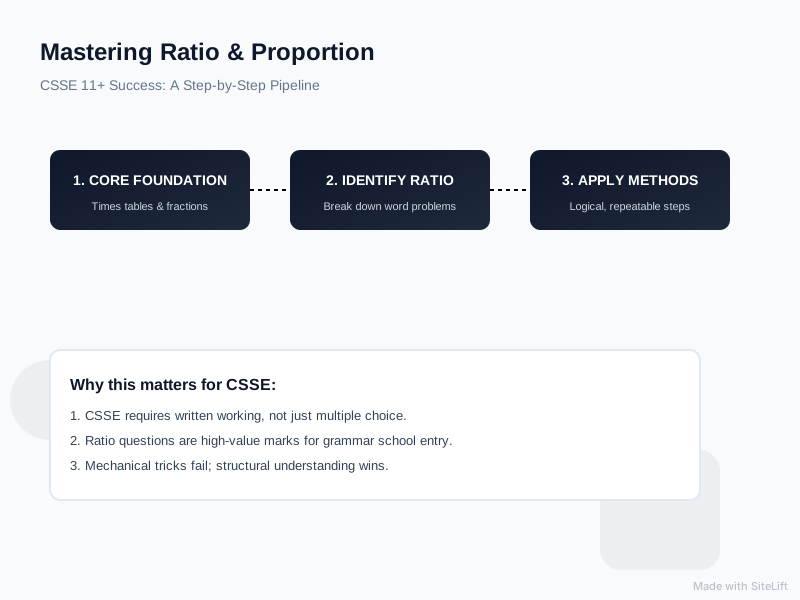
Infographic by SiteLift
| Problem Type | Relationship | Golden Rule | Typical CSSE Context |
|---|---|---|---|
| Direct Proportion | As $A$ increases, $B$ increases ($\frac{A}{B} = k$) | Find the value of 1 unit, then multiply. | Recipes, currency conversions, map scales. |
| Inverse Proportion | As $A$ increases, $B$ decreases ($A \times B = k$) | Calculate total work (man-hours/days), then divide. | Builders on a job, pipes filling a tank, speed and travel time. |
Worked Example: If 4 builders take 6 days to build a brick wall, how long would it take 3 builders working at the exact same pace?
- Step 1 (Find total work units): $$4\text{ builders} \times 6\text{ days} = 24\text{ builder-days of work}$$
- Step 2 (Divide by the new team size): $$24\text{ builder-days} \div 3\text{ builders} = 8\text{ days}$$
Common Mistake to Avoid: Applying direct proportion blindly. A child who sets up $4 \rightarrow 6$, therefore $1 \rightarrow 1.5$, therefore $3 \rightarrow 4.5$ days will forfeit the entire question. Always ask your child: "Should the answer be bigger or smaller than the starting number?" If fewer people are working, the task must take more time.
Step 4: How Do You Solve Advanced CSSE Ratio Word Problems (Change of Ratio)?
The most demanding questions on the CSSE maths paper involve a "change of ratio"—scenarios where items are added, removed, or transferred from one person to another, altering the relationship between the quantities.
Performance analyses published in national Key Stage 2 test reports by the Standards and Testing Agency show that multi-step word problems combining fractions, decimals, and ratios consistently rank among the most frequently dropped marks for Year 6 pupils across England. Furthermore, problem-solving resources from Cambridge University's NRICH project demonstrate that success in advanced ratio questions relies on identifying what remains invariant throughout the question.
In 11+ exams, change-of-ratio questions generally fall into two categories:
- One quantity stays the same (someone gains or loses items, while the other person's stash is untouched).
- The total quantity stays the same (items are transferred internally between people).
Before and After Problems: One Quantity Stays the Same
Let's walk through a classic CSSE-style challenge:
The ratio of red counters to blue counters in a bag is $3 : 4$. When 10 red counters are added to the bag, the new ratio becomes $5 : 6$. How many blue counters are in the bag?
Notice the critical clue: The number of blue counters has not changed. Only red counters were added.
Step-by-Step Solution:
- List the before and after ratios:
- Before: $\text{Red} : \text{Blue} = 3 : 4$
- After: $\text{Red} : \text{Blue} = 5 : 6$
- Make the unchanged quantity (Blue) match in both ratios:
- Find the lowest common multiple of the blue parts (4 and 6), which is 12.
- Scale the "Before" ratio by multiplying by 3: $$3 : 4 \rightarrow 9 : 12$$
- Scale the "After" ratio by multiplying by 2: $$5 : 6 \rightarrow 10 : 12$$
- Compare the red parts:
- Red parts increased from 9 parts to 10 parts.
- Increase $= 10 - 9 = 1\text{ part}$.
- Equate the change in parts to the physical quantity:
- $1\text{ part} = 10\text{ red counters}$.
- Answer the question:
- How many blue counters are there?
- Blue $= 12\text{ parts} = 12 \times 10 = 120\text{ blue counters}$.
Pro Tip: Always verify the answer against the original narrative. If there are 120 blue counters, then before the change there were 90 red counters ($90:120 = 3:4$). Adding 10 red counters makes 100 red counters. The new ratio is $100:120 = 5:6$. The numbers match perfectly.
Total Quantity Remains Constant: Transfer Problems
In transfer problems, counters, marbles, or cards move from one child to another. The total number of items does not change.
Jack and Daisy have stickers in the ratio $7 : 5$. Jack gives 6 stickers to Daisy. Now they have an equal number of stickers ($1 : 1$). How many stickers did Jack have originally?
Step-by-Step Solution:
- Calculate the total parts before and after:
- Before: Jack : Daisy $= 7 : 5 \rightarrow \text{Total parts} = 12$.
- After: Jack : Daisy $= 1 : 1 \rightarrow \text{Total parts} = 2$.
- Make the total parts identical:
- Since no stickers entered or left the room, the total parts must be identical.
- Scale the "After" ratio up so its total parts equal 12:
- Multiply $1 : 1$ by 6: $$\text{After} = 6 : 6\text{ (Total parts } = 12\text{)}$$
- Inspect the change in Jack's parts:
- Jack went from 7 parts down to 6 parts.
- Loss $= 7 - 6 = 1\text{ part}$.
- Find the value of 1 part:
- Jack gave away 6 stickers, so $1\text{ part} = 6\text{ stickers}$.
- Answer the question:
- Jack had 7 parts originally: $7 \times 6 = 42\text{ stickers}$.
By keeping the total parts balanced, multi-stage CSSE ratio word problems become accessible without resorting to intimidating algebraic equations.
Troubleshooting: What Are the Most Common Ratio Pitfalls in the CSSE Exam?
Even mathematically capable students drop marks when they fall into established exam traps. When revising with your child, run through this specific troubleshooting checklist:
1. Dividing by the Ratio Terms Instead of the Total Sum
- The Pitfall: The question asks to share £60 in the ratio $1 : 4$. The student calculates $60 \div 4 = 15$.
- The Correction: Remind your child that the ratio represents all the parts combined. The divisor must be $1 + 4 = 5$. One share is $60 \div 5 = \text{£}12$.
2. Unit Conversion Omissions
- The Pitfall: The question compares 250g of butter to 1.5kg of flour. The student writes $250 : 1.5$ and attempts to simplify from there.
- The Correction: Never allow numbers into a ratio until their units of measurement match. $1.5\text{kg} = 1500\text{g}$. The ratio is $250 : 1500$, which simplifies cleanly to $1 : 6$.
3. Writing Ratios in the Wrong Order
- The Pitfall: The question asks for the ratio of girls to boys, but the text mentions boys first. The candidate writes the numbers in the order they read them.
- The Correction: Train your child to label the columns with initial letters before writing numbers: $$\text{G} : \text{B}$$ $$\text{underneath: } 14 : 11$$
4. Premature Rounding
- The Pitfall: In direct proportion calculations with intermediate decimal values, rounding off mid-calculation distorts the final integer answer.
- The Correction: Keep values as unrounded improper fractions until the final step.
Expected Outcome: Mastering Speed, Accuracy, and Checking Work
With systematic practice using the unitary method and bar models, candidates typically move from hesitancy to complete mastery of ratio and proportion within four to six weeks of targeted revision.
Target Completion Speed for CSSE Ratio Questions
- 1-mark simplifying or direct scaling questions: Under 45 seconds.
- 2-mark standard sharing problems: Under 75 seconds.
- 3-mark change-of-ratio word problems: Under 120 seconds.
The Reverse-Calculation Check
In the final 10 minutes of the exam, candidates should check their ratio answers using a simple verification rule: Add the calculated values back together.
If a child shares 150 sweets in the ratio $2 : 3 : 5$ and gets answers of 30, 45, and 75, their check is immediate: $$30 + 45 + 75 = 150$$ If the sum does not match the starting total, the calculation error is caught and corrected right away.
Practice with Exam-Authentic CSSE Materials
Generic Key Stage 2 worksheets do not replicate the vocabulary, multi-step twists, or strict timing found in the CSSE 11+ mathematics test. To build true exam readiness, students need exposure to style-matched papers that challenge their problem-solving stamina.

At Essex 11+ Maths Practice, our questions are designed specifically around the distinct quirks of the Essex 11+ syllabus. Whether your target school is KEGS, Colchester County High School for Girls, or Westcliff, working through authentic questions with instant step-by-step solutions ensures your child spots ratio traps instantly.
You can explore our structure on the Essex 11+ (CSSE) Maths & English overview, or review our flexible membership options, which include a completely free starter tier with no time limits.
— essex11mathspractice.co.uk
Frequently Asked Questions
What is the difference between ratio and proportion in Year 6 maths?
Ratio describes a part-to-part relationship (comparing one subgroup directly to another, such as 3 red marbles to 4 blue marbles, written as $3:4$). Proportion describes a part-to-whole relationship (comparing a subgroup to the total amount, such as 3 red marbles out of 7 total marbles, written as $\frac{3}{7}$). In Year 6 and 11+ exams, questions frequently require pupils to convert between the two, such as deducing the fraction of an entire group from a given two-part ratio.
How does the unitary method work in 11+ proportion questions?
The unitary method involves breaking down a problem to find the value of a single unit ($1$) before multiplying to find the required quantity. For example, if 8 books cost £24, you divide £24 by 8 to find the cost of 1 book (£3), and then multiply by 5 to find the cost of 5 books (£15). It serves as the most dependable mental strategy for recipe adjustments, currency exchanges, and scale drawings.
How do CSSE ratio questions differ from standard Key Stage 2 SATs questions?
Standard Year 6 SATs ratio questions typically involve single-step sharing or simple recipe scaling where numbers divide evenly. In contrast, CSSE 11+ ratio questions frequently include multiple stages, such as change-of-ratio problems, mismatched units (e.g., millimetres to metres), or hidden inverse proportions where the relationship between time and workforce must be deduced without prompts. CSSE papers also require candidates to set out their mathematical reasoning cleanly in limited answer spaces.
What visual method is best for helping children understand ratio word problems?
The bar model (or strip diagram) is widely regarded as the most effective visual tool for 11+ ratio questions. By drawing equal-sized rectangular blocks to represent each part of a ratio, students can visually track relationships, identify changes between "before" and "after" scenarios, and calculate the value of a single unit without becoming overwhelmed by algebraic symbols.
Can my child use a calculator or rough paper during the CSSE maths paper?
No, calculators are strictly prohibited in the CSSE 11+ examination. All working must be completed mentally or written down in pencil directly in the answer booklet. Candidates are provided with space alongside each question to show their working, and partial credit can be awarded for clear, correct mathematical methods even if a final calculation error occurs.