Online 11+ Practice vs. Traditional Workbooks: Which Actually Works Better?
Online 11+ Practice vs. Traditional Workbooks: Which Actually Works Better?

If you are a parent in Essex preparing your child for the grammar school entrance exams, you have likely stared at a towering stack of revision books. But as digital learning platforms grow in popularity, many families are asking whether traditional study guides are still the best route, or if online 11+ maths practice offers a more efficient way to secure a passing score.
The journey to a grammar school place is highly competitive. In Essex, the Consortium of Selective Schools in Essex (CSSE) exam is a unique beast. Unlike standard national exams, it requires a deep understanding of multi-step mathematical problem-solving and clear written workings.
Choosing the right preparation method can make the difference between a confident child on exam day and one who is completely overwhelmed. Let's break down how traditional paper workbooks compare to modern digital platforms so you can build the ultimate preparation strategy.
At-a-Glance: Paper vs. Digital Prep
Before we dive into the details, here is a high-level comparison of how traditional workbooks stack up against modern online revision platforms.
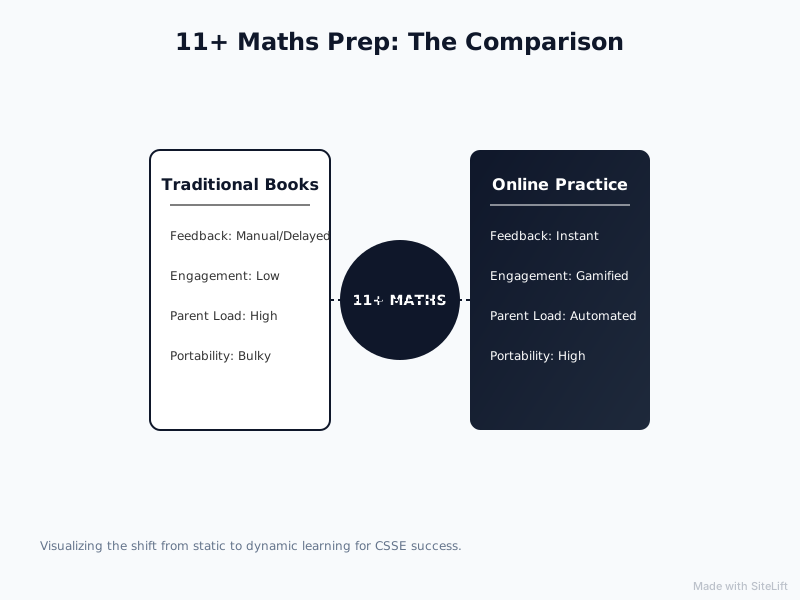
Infographic by SiteLift
| Feature | Traditional Workbooks | Online 11+ Maths Practice |
|---|---|---|
| Feedback Loop | Delayed (requires manual marking by a parent) | Instant (immediate correction & step-by-step solutions) |
| Engagement Level | Low to moderate (can feel like repetitive homework) | High (gamified elements, interactive dashboards) |
| CSSE Alignment | Often generic (GL/CEM style); rarely matches Essex specifically | High (when using niche, style-matched local platforms) |
| Parent Workload | High (constant marking, tracking progress, finding weak spots) | Low (automated tracking and performance analytics) |
| Portability | Bulky (carrying multiple heavy books and answer booklets) | High (accessible on any tablet, laptop, or phone) |
| Best For | Final timed exam simulation and handwriting practice | Concept building, daily revision, and targeted weak-spot fix |
How Do We Evaluate 11+ Prep Methods? (Our Comparison Criteria)
To determine which method actually works best, we need to look past flashy marketing and evaluate how children actually learn. We use four core metrics to compare paper workbooks and digital platforms:
1. Engagement and Student Motivation
The 11+ preparation process is a marathon, not a sprint. If a study method feels like a chore, children quickly burn out. We look at how well each method maintains a child's interest over several months of study.
2. Feedback Speed and Accuracy
In mathematics, practice does not make perfect; perfect practice makes perfect. If a child practices the wrong method ten times, they simply solidify a bad habit. We evaluate how quickly and accurately each method corrects mistakes.
3. Alignment with the Essex CSSE Exam Format
The Consortium of Selective Schools in Essex (CSSE) sets its own unique exam papers. These exams do not use standard multiple-choice formats. Instead, they require free-text answers and multi-step calculations. Any prep method must match this specific style to be effective.
4. Cost-Effectiveness and Parent Workload
Parents are busy. We must consider not only the financial cost of the resources but also the "time tax" on parents who have to mark papers, track progress, and explain difficult concepts.
Traditional 11+ Workbooks: The Classic Paper-Based Approach
For decades, physical workbooks from publishers like Bond, CGP, and Schofield & Sims have been the default choice for 11+ preparation.
The Benefits of Physical Paper Practice
There is one undeniable advantage to traditional workbooks: they match the physical medium of the real exam.
The actual CSSE 11+ exam is a paper-based test. Children must write their answers by hand, show their working out clearly in the spaces provided, and manage their time without a digital clock on a screen. Working on physical paper helps build essential fine motor skills, spatial awareness on the page, and realistic handwriting speed.
Additionally, paper resources mean zero screen-time distractions. There are no browser tabs to click, no battery levels to worry about, and no notifications popping up mid-sum.
The Drawbacks: Delayed Marking and Static Content
While paper has its place, the traditional workbook model has major limitations when used as a primary learning tool.
The biggest issue is the delayed feedback loop. When a child completes a page in a workbook, they usually have to wait for a parent to mark it. If you are busy cooking dinner or working, that marking might not happen until the next day. By then, the child has forgotten their thought process, and the opportunity for immediate learning is lost.
Furthermore, workbooks are static. If a child gets a question wrong, the answer key at the back of the book often provides only the final answer (e.g., "14") without explaining how to get there. This leaves the parent with the job of reverse-engineering the maths problem to explain it to their child—a task that can cause significant household stress.
Pro Tip: Never use traditional workbooks to teach new mathematical concepts. Only use them to test concepts your child has already mastered online or with a tutor.
Online 11+ Maths Practice: The Modern Interactive Alternative
Modern educational technology has transformed how children prepare for competitive exams. Dedicated platforms for online 11+ maths practice are designed to solve the exact pain points that make traditional workbooks so frustrating.
"Digital technology can add an average of 4 additional months of progress when used for targeted, interactive learning."
— Education Endowment Foundation (EEF)
The Benefits of Instant Marking for 11+
The single greatest advantage of digital learning is the benefits of instant marking for 11+. According to research by the National Foundation for Educational Research (NFER), immediate formative feedback is one of the most effective interventions for improving primary-level mathematics outcomes.
When a child submits an answer online and gets immediate feedback, their brain is primed to learn. If they are correct, the instant validation boosts confidence. If they are incorrect, they can immediately view a step-by-step worked solution while the problem is still fresh in their mind. This prevents mathematical misconceptions from becoming deeply ingrained habits.

Interactive 11+ Revision Tools and Personalised Tracking
Traditional workbooks cannot adapt to your child's unique needs. If a book has ten pages of algebra, your child must work through them all, even if they mastered the topic on page one.
Conversely, interactive 11+ revision tools use smart tracking to identify exactly where a child is struggling. If a digital platform detects that your child is answering ratio questions quickly but stalling on decimal word problems, it will automatically adjust. It highlights these weak areas on a parent dashboard, allowing you to focus your revision time where it will yield the highest score increase.
This data-driven approach keeps children highly motivated. A survey by the British Educational Suppliers Association (BESA) found that over 80% of UK teachers believe interactive digital tools significantly increase student engagement compared to traditional worksheets. The gamified elements of digital platforms—such as earning badges, seeing progress bars fill up, and beating personal bests—turn dry maths practice into an engaging challenge.
Accessing Digital CSSE Past Papers and Style-Matched Questions
One common criticism of online prep is that it is too generic, often focusing on national GL or CEM assessment styles. However, modern platforms now offer highly specialized resources, including digital CSSE past papers and style-matched questions.
These resources mimic the exact structure of the Essex grammar school exams. They present the same style of multi-step word problems, algebraic reasoning, and spatial puzzles that appear on the real CSSE papers. This ensures your child is not wasting time practicing question formats they will never see on exam day.
Why Online 11+ Maths Practice Beats Paper Workbooks on Key Features
Let's look closely at how these two methods perform when put head-to-head on the features that matter most for long-term preparation.
Active Recall and Spaced Repetition
To pass the CSSE maths exam, your child must retain information over many months. Digital platforms excel at this through the principles of active recall and spaced repetition.
While a paper workbook is usually completed once and thrown away, an online platform can reintroduce difficult questions at calculated intervals. This systematically strengthens the neural pathways associated with those maths concepts, ensuring they are locked into your child's long-term memory by exam day.
Reducing Exam Anxiety
Exam anxiety often stems from a fear of the unknown. Interactive revision tools reduce this anxiety by making the practice environment feel safe and familiar. Because online platforms allow children to practice in short, low-stakes sessions, they build confidence gradually. By the time they face realistic exam papers, the format feels like a natural extension of their daily routine.
Pro Tip: To reduce exam-day nerves, have your child practice online in the same room they plan to do their final paper mock exams. Familiarity breeds confidence.
My Editorial Opinion: Why the "Paper-Only" Mindset is a Trap for Essex Parents
As an educator who has watched hundreds of families navigate the Essex 11+ system, I often see parents fall into the trap of thinking that because the final exam is on paper, the preparation must be entirely on paper too.
This is a mistake.
While paper mock exams are essential in the final weeks of preparation, relying solely on workbooks for the entire 12-month journey is incredibly inefficient. It places an immense marking burden on parents, often leading to friction at the kitchen table when correcting mistakes.
More importantly, it robs your child of the rapid, interactive feedback loop that builds mathematical confidence. In my view, the most successful students are not those who did the most paper worksheets, but those who used smart digital tools to master concepts quickly, using paper only to polish their exam technique.
Which Option Actually Works Better for CSSE Success?
The truth is, you do not have to choose just one. The ultimate strategy for passing the Essex CSSE exam is a hybrid approach that combines the strengths of both methods.
             THE ULTIMATE HYBRID STUDY PLAN

   [ Early to Mid-Stage Prep ]     --->     [ Late-Stage Prep ]
   - 80% Online Practice                    - 40% Online Practice
   - 20% Paper Handouts                     - 60% Paper Mock Exams
   - Focus: Concept Mastery & Speed         - Focus: Exam Stamina & Writing
When to Use Online 11+ Maths Practice
- During the learning phase (Months 1-9): Use digital platforms to learn new topics, build calculation speed, and receive instant feedback.
- For daily revision: Short, 15-minute online sessions are much easier to fit into a busy school week than pulling out multiple heavy workbooks.
- For targeted weak-spot targeting: Use digital dashboards to find exactly which maths topics (e.g., fractions, algebra, area) need attention.
When to Use Traditional Workbooks
- During the final preparation phase (Months 10-12): Transition to physical papers to build stamina for the 60-minute exam.
- For handwriting and layout practice: Ensure your child can write their working out legibly within the designated boxes on a physical page.
- For realistic exam-day simulations: Sit your child at a quiet desk with a pencil, a physical clock, and a paper mock exam to simulate real test conditions.
Elevate Your CSSE Prep with Essex 11+ Maths Practice
If you want to implement this highly effective hybrid strategy, you need a digital platform built specifically for the local Essex curriculum.
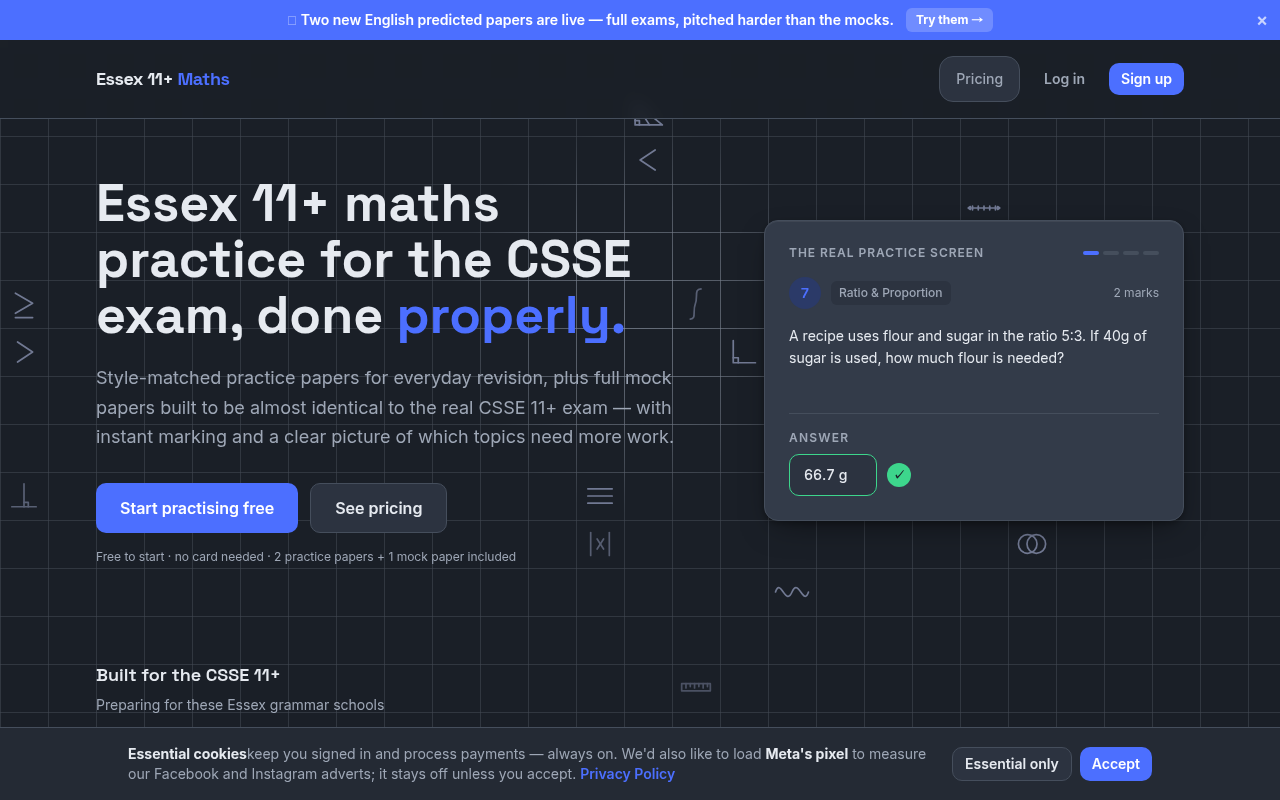
Essex 11+ Maths Practice for the CSSE Exam offers style-matched maths questions, relaxed practice papers, and full mock exams built specifically to match the real CSSE test. With instant marking, worked solutions, and detailed topic tracking, it takes the guesswork out of preparation.
Best of all, you can get started without spending a penny. Our platform features a free-to-start tier, allowing you to experience the benefits of instant feedback before committing. When you are ready to unlock our full suite of tools, our Pricing | Essex 11+ Maths Practice plans are highly affordable, starting from just £9.99/month—a fraction of the cost of a private tutor or a stack of physical workbooks.
Give your child the advantage of immediate feedback, and make your 11+ journey smoother, faster, and much less stressful.
— essex11mathspractice.co.uk
FAQ
Is the actual Essex CSSE 11+ exam paper-based or online?
The official CSSE 11+ exam administered in Essex grammar schools is entirely paper-based. Students must write their answers and show their mathematical working by hand on physical question papers.
How does online 11+ maths practice improve my child's speed?
Online platforms use timed questions and interactive feedback to help children process calculations more quickly. By mastering mental arithmetic and problem-solving patterns digitally, they can apply these fast-thinking skills directly to their paper exams.
Can online tools fully replace traditional 11+ workbooks?
While online tools are superior for learning concepts, tracking progress, and rapid revision, they should not completely replace paper. A balanced approach uses online tools for daily practice and physical paper papers for final, timed exam simulations.
What are the main benefits of instant marking for 11+ maths preparation?
Instant marking ensures that children learn from their mistakes immediately while the problem is fresh in their minds. It prevents them from repeating incorrect methods and significantly reduces the marking workload for busy parents.
How do I know if my child is ready for digital CSSE past papers?
Once your child has built a solid foundation in core primary school mathematics (fractions, decimals, percentages, and basic algebra), they are ready to begin practicing with style-matched digital CSSE questions to adapt to the exam's unique format.