Mastering the CSSE Essex 11+ Maths Exam: A Parent's Complete Blueprint
Mastering the CSSE Essex 11+ Maths Exam: A Parent's Complete Blueprint

If your child is aiming for a grammar school place in Essex next September, the CSSE Essex 11+ maths exam will make or break their application. I’ve seen bright, confident Year 5 pupils come unstuck not because they can’t do maths, but because they prepared for the wrong test.
Essex doesn’t use the multiple-choice GL Assessment paper you read about on national tutoring blogs. Ours is tougher, stranger, and entirely written. This guide breaks down exactly how the paper works, what to revise, and how to plan the year so September feels manageable rather than frantic.
Key Takeaways: The CSSE Maths Paper at a Glance
| What You Need to Know | The Short Answer |
|---|---|
| Exam board | Consortium of Selective Schools in Essex (CSSE) – one English paper + one maths paper |
| Maths format | 60 minutes, 60 marks, largely free-response / written answers, no calculator |
| Difficulty split | First ~40 marks = solid Year 5/6 KS2; final ~10-15 marks = early KS3 logic and multi-step reasoning |
| Competition | Over 6,000 children register annually for roughly 1,000 selective places |
| Pass benchmark | Standardised total of 303-340 out of ~400 across both papers, varies by school and catchment |
| Biggest trap for parents | Using generic multiple-choice 11+ books; Chelmsford County High School for Girls (CCHS) does not use CSSE |
| Best preparation | Style-matched written practice, timed mocks, and an error log with full worked solutions |
What is the CSSE Essex 11+ maths exam and How is it Structured?
The Consortium of Selective Schools in Essex runs its own independent 11+ – it’s not GL and it’s not CEM. Every child sits two papers on the same morning in September of Year 6: English (60 minutes including a continuous writing task) and mathematics.
For CSSE mathematics preparation, forget ticking A, B, C or D. Your child gets a question booklet and blank space. They have to work it out and write the answer in.
The Exam Format: Timing, Total Marks, and Free-Response Layout
The Essex grammar school maths test is typically:
- 60 minutes for 60 marks – in theory, a mark a minute
- 20-30 questions, many with multiple parts (a, b, c)
- Mostly open-answer: write the number, fraction, measurement or explanation in the box
- No calculator, no formula sheet
- No negative marking – a wrong answer loses nothing extra
Questions start friendly – place value, simple addition, reading a timetable – then climb quickly. Working space matters. Examiners can award method marks for a correct process even if the final arithmetic slips.
Pro Tip: Train your child to always show two lines of working, even for “easy” questions. That habit alone can rescue 3-4 marks on a bad day.
You can check the current year’s timings, registration window and arrangements on the official CSSE portal for test information.
Participating Schools: Which Essex Grammar Schools Use the CSSE?
This is where national guides get it wrong. These schools currently use the CSSE 11+:
- King Edward VI Grammar School (KEGS), Chelmsford – boys
- Colchester Royal Grammar School (CRGS) – boys, with co-ed sixth form
- Colchester County High School for Girls – girls
- Westcliff High School for Boys
- Westcliff High School for Girls
- Southend High School for Boys
- Southend High School for Girls
- St Bernard’s High School (selective places)
- St Thomas More High School (selective places)
- Shoeburyness High School (selective places)
Catchment and priority areas matter enormously for Southend and Westcliff. Read the Essex County Council secondary admissions guide carefully before you list preferences – an out-of-catchment score needs to be significantly higher.
And the big exception: Chelmsford County High School for Girls (CCHS) does NOT use the CSSE paper. CCHS sets its own separate entrance test in English and maths. If CCHS is your first choice, do not rely solely on CSSE past papers.
Standardisation Explained: How the Mathematics Paper is Scored
Raw marks out of 60 are converted to a standardised score that accounts for age and cohort difficulty. A summer-born child gets a small uplift versus an autumn-born child who answered the same number correctly.
The maths standardised score is then added to the English standardised score for a total out of roughly 400.
- According to the Consortium of Selective Schools in Essex (CSSE), over 6,000 pupils register annually for roughly 1,000 selective places. That’s about 6:1 overall, tighter in catchment hotspots like Colchester and Chelmsford.
- Data from Essex grammar schools indicates that standardised pass marks generally fall between 303 and 340, depending on school, gender entry, catchment and year difficulty.
In practice, that usually means high 70s to 80s in raw percentage across both papers, with maths often needing 45+/60 for the most competitive out-of-catchment places. Don’t chase a fixed “pass mark” – aim to be safely in the top 15-20% of the cohort.
What is Covered in the 11+ Maths Syllabus for Essex Grammar Schools?
There is no published CSSE syllabus list. The paper is built on the National Curriculum for Key Stage 2 mathematics, then stretched. According to the Department for Education (DfE), Key Stage 2 expected standards require fluent mental and written arithmetic under time pressure, yet CSSE extension questions regularly pitch at Upper Key Stage 2 and early Key Stage 3 reasoning.
Think of the 11+ maths syllabus Essex parents need as three layers.
Core Key Stage 2 Mastery: Arithmetic, Fractions, Decimals, and Percentages
Your child must be automatic at:
- Four operations with large numbers, including long multiplication (4-digit x 2-digit) and long division
- Fractions, decimals and percentages – equivalence, ordering, adding/subtracting mixed numbers, finding percentages of amounts, percentage increase/decrease
- Place value to 10,000,000, rounding, negative numbers in context
- Factors, multiples, primes to 100, squares and cubes
- Simple BODMAS / order of operations
If long division isn’t fluent by Easter of Year 5, everything else wobbles. CSSE loves to hide a straightforward calculation inside a wordy two-step problem.
Higher-Order Topics: Algebra, Ratio, Proportion, and Sequences
This is what separates Essex from generic 11+ work:
- Algebra: finding unknowns, balancing equations like 3a + 5 = 29, simple substitution and forming expressions
- Ratio and proportion: sharing in a ratio, scaling recipes, best-buy problems
- Speed, distance and time, and other compound measures
- Sequences and nth-term thinking: 3, 7, 11, 15… what’s the 20th term? Explain the rule
- Venn diagrams, Carroll diagrams and basic probability – increasingly common in CSSE papers
- Multi-step fraction-of-an-amount problems working backwards
I regularly see questions like: “A train leaves Colchester at 08:47 and arrives at 09:23. If the return journey takes 15% longer, when does it arrive?” That’s reading time, duration, percentages and time conversion in one.
Spatial Reasoning, Measurement, and Data Interpretation
- Area and perimeter of composite shapes, including triangles and parallelograms
- Volume of cubes and cuboids, often with unit conversion
- Angles on straight lines, in triangles and around a point; coordinates in four quadrants, translations and reflections
- Converting cm-m-km, g-kg, ml-l, minutes-hours, and 24-hour clock
- Interpreting line graphs, pie charts, timetables and two-way tables – then calculating from them
The trap isn’t knowing the formula for area. It’s spotting that one length is in centimetres and the other is in metres.
Why is the CSSE Essex 11+ maths exam Uniquely Challenging?
Parents often tell me: “She’s top set for maths, she’ll be fine.” Then they try a CSSE past paper and get a shock. Classroom maths rewards knowing a method. The CSSE Essex 11+ maths exam rewards applying it when the question looks unfamiliar.
The Open-Answer Format vs Multiple-Choice Testing
Unlike GL Assessment tests, there are no options to eliminate and no lucky guesses. In an Essex grammar school maths test, your child must:
- Decode what the question is actually asking
- Choose the method themselves
- Execute it accurately
- Present the answer in the correct units/format
That’s far closer to GCSE problem-solving than to primary SATs. Generic 11+ workbooks full of multiple-choice circles simply don’t build that muscle.
The Dreaded 'Final 10 Marks': Multi-Step Lateral Logic Problems
Every CSSE paper follows a rhythm. Questions 1-15 feel doable. Questions 16-22 get wordy. The last page – usually worth 8-12 marks – is deliberately different.
Recent years have included nets of cubes with opposite-face logic, coded number puzzles where letters stand for digits, and multi-stage “think of a number” chains that need working backwards. They aren’t taught directly in Year 5. They test whether a child can hold three pieces of information, try a systematic approach, and stay calm.
Those final marks decide grammar places. Most children vying for KEGS or Colchester County High aren’t dropping the first 40 marks. They’re separated by who can pick up 5 of the last 10.
Pro Tip: Don’t drill the final-page puzzles daily. Do one “weird” problem twice a week with no timer, talk it through out loud, then write the solution neatly. Familiarity kills fear.
Pacing and Time Pressure: Solving a Mark a Minute
Sixty marks in sixty minutes sounds generous until you factor in reading, thinking and checking. Strong candidates often spend 35 minutes on the first 40 marks and then run out of steam.
Poor time allocation is the silent killer. I’ve marked mocks where a capable child spent seven minutes perfecting a 3-mark ratio question and never turned the page to find four easy 1-mark calculations at the end.
Negative marking is not used, so every blank is a wasted opportunity.
How to Revise for CSSE Maths: A Parent's Step-by-Step Preparation Timeline
How to revise for CSSE maths without burning out your 9-year-old? Think layers, not marathons. Little and often beats Sunday cramming.
Year 4 to Autumn Term of Year 5: Securing Calculation Fluency and Confidence
Goal: no wobbles on basics. 20-30 minutes, 4 times a week is plenty.
- Times tables to 12x12 instant recall, plus division facts
- Formal column addition/subtraction, short and long multiplication, short division moving to long division
- Fraction-decimal-percentage equivalents (1/2, 1/4, 3/4, 1/5, 1/8, etc.)
- Telling time, converting units, reading scales
Use low-stakes quizzes, not full papers. If your child hates it, shorten the session, not the frequency. Confidence now pays off later.
Spring to Summer Term of Year 5: Transitioning to Style-Matched Exam Questions
Now switch from “classroom maths” to CSSE style. This is where most families go wrong by buying generic books.
You need written, multi-part questions that look and feel like Essex papers, with full worked solutions – not just an answer key. When you start style-matched CSSE 11+ maths practice with instant marking, focus on topic-by-topic sets first: a week on fractions, a week on algebra, a week on area/perimeter.
Keep an error log in a simple notebook:
Date | Topic | What I got wrong | Why? | Retry score
Patterns emerge fast: “always forgets to convert minutes to hours” or “adds numerators and denominators.” Fix the pattern, not just the question.
Aim for 2 x 30-minute topic sessions + 1 x 45-minute relaxed paper per week in summer term.
The Final Stretch (July to September): Timed Past Papers, Error Analysis, and Mock Exams
From the summer holidays, go exam-realistic:
- One full timed 60-minute paper per week under exam conditions – desk clear, no help, kitchen timer on
- Mark immediately with worked solutions. For every lost mark, ask: Was it knowledge, method, misread, or time?
- Re-do every missed question 48 hours later without looking. If it’s still wrong, that topic goes back into weekday practice
- Sit at least 2 formal mocks away from home if you can – hall, unfamiliar invigilator, nerves
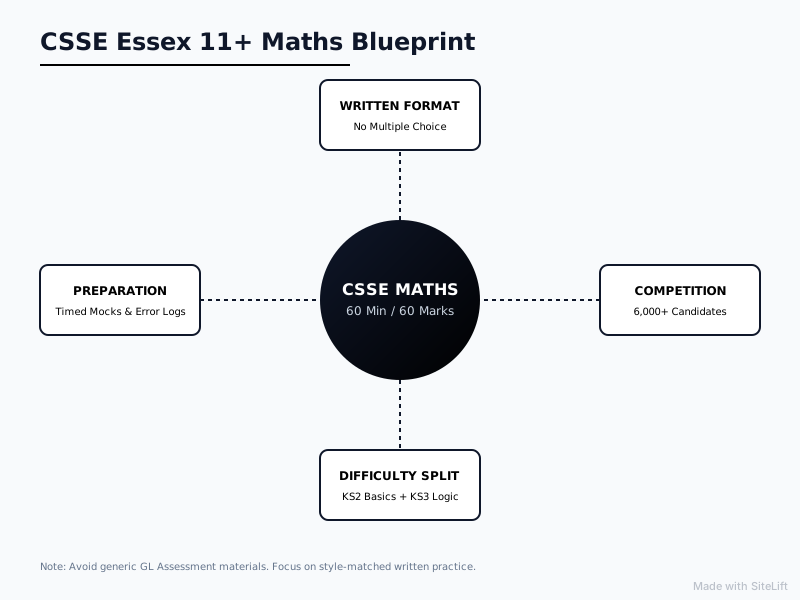
Infographic by SiteLift
In the last two weeks, stop learning new content. Revisit your error log, rehearse unit conversions and times tables, and prioritise sleep. A tired 10-year-old loses more marks to misreading than to missing knowledge.
If budget is a concern, start free and upgrade only if you need full mocks and tracking – you can see free-to-start 11+ maths and English plans and full access pricing to decide what fits your timeline.
What Proven Exam-Day Strategies Maximise Marks on the CSSE Paper?
Technique can add 5-7 raw marks with no extra maths knowledge. Rehearse these until they’re automatic.
Method Marks: Why Showing Clear Working is Essential
CSSE examiners can give partial credit. Even if the final answer box is wrong, neat intermediate steps can earn a mark.
Teach this layout:
- Underline key numbers and units in the question
- Write each step on a new line, keep equals signs aligned
- Box or circle the final answer with correct units
Messy, cramped working in the margin earns nothing and makes checking impossible.
The Two-Pass Strategy: Banking Banker Marks First
Tell your child: you get two passes through the paper.
Pass 1 (35-40 mins): Answer everything you can do in under 90 seconds. If you stare blankly, circle the number and move on. Bank all the easy marks.
Pass 2 (15 mins): Return to circled questions with fresh eyes. Often the method clicks second time round.
Final 5 mins: Check units, check you’ve answered every part (a, b and c), fill any blanks with a sensible guess – there’s nothing to lose.
This stops the classic disaster of leaving a page of straightforward 1-markers untouched.
Spotting Unit Traps, Conversion Pitfalls, and Careful Reading
CSSE setters love these three traps:
- Mismatched units: area in cm² when one side was given in metres; time answers needing hours and minutes
- Multi-part dependencies: part (b) uses your answer from part (a) – if (a) was wrong, still show correct method in (b) for follow-through consideration
- Wordy distractors: timetables, pie charts and “explain your reasoning” prompts where the maths is simple but the reading is dense
My rule: read the question twice, underline the actual instruction (“give your answer in grams”, “write down the missing angle”, “explain how you know”), then calculate.
My Honest Take: Why Written Practice Beats Workbooks Every Time
I’ll be blunt because I wish someone had been blunt with me when I first started helping families with Essex entry.
Most of what’s sold as “11+ maths” in big bookshops isn’t Essex maths. It’s multiple-choice GL content repackaged with a Union Jack on the cover. It teaches children to spot the odd-one-out and shade a bubble. Then they walk into a silent hall in September, open a CSSE booklet, see blank space and a five-line word problem about train times and perimeters, and freeze.
I personally think the open-answer format is a good thing – it rewards real mathematical thinking, not exam trickery. But it means preparation has to match. A child who has done 200 style-matched written questions with proper worked solutions will always outperform a child who has done 1,000 generic multiple-choice clicks, even if the second child is “better at maths” at school.
That’s also why I’m fussy about marking. An answer key that just says “c) 240cm³” teaches nothing. A worked solution that shows why you convert to cm first, how you lay out length x width x height, and where most children slip – that’s what closes the gap between classroom confidence and CSSE resilience.
If you do one thing differently from next week, make it this: ditch one generic worksheet session and replace it with 25 minutes of proper Essex-style written problems, marked together, error logged. Less volume, more depth. It’s slower, it’s occasionally painful, and it works.
Practise Like It’s the Real Thing
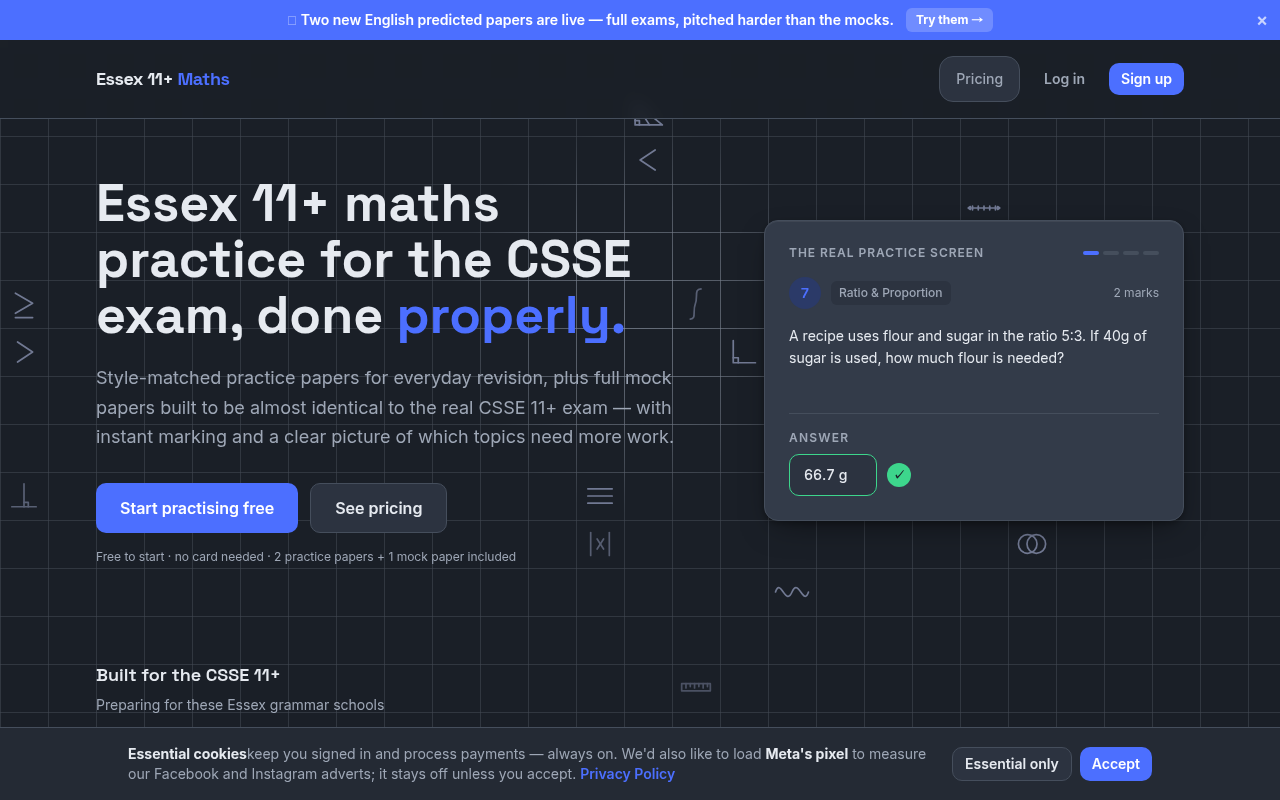
Reading about the paper helps, but maths improves by doing maths that looks like the real paper. That’s exactly why essex11mathspractice.co.uk was built – style-matched CSSE 11+ maths questions, relaxed practice and full mocks with instant marking and topic tracking so you can see whether fractions or speed problems are actually costing the marks.
Start with the free tier, build the error log, and only add timed mocks when fluency is secure. You don’t need five different book series. You need the right format, repeated consistently, with solutions you both understand.
— essex11mathspractice.co.uk
FAQ
Is the CSSE Essex 11+ maths exam multiple-choice?
No. The CSSE Essex 11+ maths exam is largely free-response and written. Children must calculate and write their own answers with working shown, unlike GL Assessment papers which are predominantly multiple-choice. There is no option to guess from A-E.
What raw score is typically required to pass the CSSE mathematics paper?
It varies by year, school and catchment, but as a rule of thumb competitive grammar places often require around 75-85% overall across English and maths. For maths alone, that usually means 44-52 out of 60 for in-catchment applicants and higher for out-of-catchment places at schools like KEGS, CRGS and Colchester County High. Scores are age-standardised, so younger children need slightly fewer raw marks.
Does Chelmsford County High School for Girls (CCHS) use the CSSE 11+ maths paper?
No. Chelmsford County High School for Girls runs its own independent entrance exam, separate from the CSSE consortium. If you are applying to CCHS, check their school website directly for sample materials and dates – CSSE past papers alone won’t fully prepare your daughter.
When should my child begin serious CSSE mathematics preparation?
Light fluency work in Year 4 to Year 5 autumn, focused CSSE-style topic practice from spring of Year 5, and timed papers and mocks from July before the September test in Year 6. Starting serious, style-matched work 12-9 months before the exam gives time to fix gaps without pressure. Cramming in August rarely works for the final logic questions.
Are calculators allowed in the CSSE Essex 11+ maths test?
No, calculators are not allowed, and no formula sheet is provided. Children must rely on mental methods and formal written methods for all calculations, including long multiplication and division, fractions and unit conversions.