Kent Exam Explained: Format, Timings and How It Compares to CSSE Essex 11+
Kent Exam Explained: Format, Timings and How It Compares to CSSE Essex 11+

If you live in Essex but are keeping an eye on Kent grammars — or you have just moved between counties — the kent exam can feel confusing at first. I hear from parents every year who know the CSSE Essex 11+ inside out, then discover Kent does things completely differently.
This guide breaks it all down: what the Kent Test is, the exact Kent Test format and timings, Kent exam dates you cannot miss, and a straight CSSE vs Kent Test comparison for maths, English and reasoning.
Key Takeaways: Kent Exam at a Glance
| Feature | Kent Exam Essentials |
|---|---|
| What it is | The Kent Test 11+ selection test for entry to Kent grammar schools in Year 7, set by GL Assessment and administered by Kent County Council |
| Who sits it | Year 6 pupils, including Kent residents and out-of-county applicants |
| Papers | Paper 1: English (comprehension) + Maths; Paper 2: Verbal, Non-Verbal & Spatial Reasoning; plus unscored writing task |
| Timings | Paper 1: ~1 hour (25 mins English + 25 mins Maths + practice); Paper 2: ~1 hour including practice; Writing: 40 mins |
| Pass mark | Aggregate standardised score around 332, with no single score below 107 |
| Key dates | Register June to early July in Year 5, test early September in Year 6, results mid-October |
| Biggest difference vs CSSE | Kent is fast, multiple-choice and reasoning-heavy; CSSE is slower, written-answer and depth-heavy |
In short: if CSSE rewards deep problem-solving, the Kent Exam rewards speed, accuracy and reasoning familiarity.
What Is the Kent Exam and Who Needs to Take It?
The Kent Exam — almost always called the Kent Test — is the 11+ selection test used by Kent’s grammar schools. It is coordinated by Kent County Council and the papers themselves are set by GL Assessment, the same board behind many 11+ tests nationally.
It is taken in Year 6 by children hoping for a Year 7 grammar school place the following September. You do not need to live in Kent to sit it, which is why it matters for Essex families considering a move or applying across the border.
Which schools use the Kent Test for admission?
Kent runs the largest selective system in England. According to the House of Commons Library, there are 163 grammar schools in England, with Kent operating by far the biggest share.
According to Kent County Council, there are 32 grammar schools in Kent that use the Kent Test for admission. Well-known names include Dartford Grammar School, Dartford Grammar School for Girls, Tonbridge Grammar School, The Judd School, Skinners’ School, and Invicta Grammar School in Maidstone.
Unlike Essex, where the CSSE covers a small group of schools, a pass in the Kent Test can be used for multiple Kent grammars, though you still need to meet each school’s individual oversubscription criteria on distance, siblings and catchment.
Who is eligible to sit the Kent Exam?
Any child in Year 6 who will be moving to secondary school the next September can register, whether they attend a Kent primary, an independent school, or live outside Kent entirely.
Kent primary pupils usually sit the test in their own school. Out-of-county applicants are invited to a test centre in Kent, typically on a Saturday. There is also a late-sitting arrangement for illness or for families who move into the area after the main test day.
You can check eligibility rules and in-county versus out-of-county arrangements in the official Kent Test admissions hub.
What Is the Kent Test Format and Timings?
The Kent Test format catches a lot of CSSE parents out. Where Essex has two long, written papers, Kent has two short, sharp multiple-choice papers plus a writing exercise.
All the main papers are multiple-choice. Children mark answers on a separate answer sheet, which demands real care — one slipped line and a whole block can shift.
Paper 1: English and Maths – What to expect?
Paper 1 lasts about 1 hour in total and is split into two sections:
- English: 5 minutes practice time plus 25 minutes test time. This is comprehension-based, with questions on vocabulary, inference and understanding of short passages.
- Maths: 5 minutes practice plus 25 minutes test time. Expect around 25-30 questions covering the full Key Stage 2 curriculum.
Kent 11+ maths practice therefore looks very different from Essex practice. There is no space to show working for marks. It is one mark per correct answer, no calculator, and roughly a minute per question. Topics include fractions, decimals, percentages, ratio and proportion, basic algebra, area and perimeter, angles, and multi-step word problems phrased in GL style.
Pro Tip: Practise with the answer sheet, not just the question booklet. Kent pupils lose easy marks by circling answers in the booklet and running out of time to transfer them.
Paper 2: Reasoning – Verbal, Non-Verbal and Spatial Reasoning
Paper 2 also takes about 1 hour including practice sections and short breaks between sub-tests. It is divided into:
- Verbal Reasoning: code sequences, word relationships, letter logic and vocabulary reasoning
- Non-Verbal Reasoning: shapes, series, odd-one-out, matrices
- Spatial Reasoning: folding nets, 3D cubes, rotations and reflections
This is the section Essex children find most alien. The CSSE does not have a dedicated reasoning paper — reasoning is woven into English and maths. In Kent, reasoning counts as a full third of the final score.
You can read more about GL-style question types on the GL Assessment 11+ familiarisation pages.
Is there a writing task in the Kent Exam?
Yes, but it is not marked in the same way. After the two main papers, children complete a 40-minute writing task, including 10 minutes planning time.
The writing is not given a standardised score and does not count towards the 332 pass total. It is only looked at if parents go to a headteacher assessment or appeal — for example, if a child narrowly misses the pass mark and the panel wants evidence of writing ability.
Do not skip preparation for it, but do not let it eat into reasoning and maths time either. A clear, planned piece with varied sentences and accurate punctuation is enough.

When Are the Kent Exam Dates and Key Deadlines?
Kent exam dates follow almost the same rhythm every year, which makes planning easier once you know the pattern.
When does registration open for the Kent Test?
Online registration usually opens at the start of June when your child is in Year 5 and closes in early July. This is done via Kent County Council, not via individual schools.
If you miss the main window, you can often still register as a late sitter, but you may get a later test date and your results could arrive after the secondary application deadline — stressful and best avoided.
Pro Tip: Put both counties in your calendar. CSSE registration also closes in early July, so if you are considering both tests, register for both at the same time and sort out logistics later.
For the official timetable, including late testing and results dates, always confirm on the Kent County Council Kent Test dates page.
When is Kent Test day and when are results sent?
A typical timeline looks like this:
- Early September, Year 6: Main Kent Test days. In-county primaries test on a weekday; out-of-county applicants usually test on the following Saturday.
- Late September: Late sitters and catch-up sessions for illness or absence.
- Mid-October: Results emailed to parents. You get three standardised scores — English, Maths and Reasoning — plus the aggregate and a pass/fail decision.
- 31 October: National deadline for secondary school applications via your home local authority, explained in the official guidance on applying for school places.
That mid-October results date is deliberate. You know your Kent outcome before you have to submit your school preferences.
How Does CSSE vs Kent Test Compare?
This is where Essex parents need clarity. CSSE vs Kent Test is not just a different logo on the paper — it is a different skill set.
The CSSE Essex 11+ has two standard-format papers, each 60 minutes long: English (comprehension, vocabulary, applied verbal reasoning and continuous writing) and Maths (multi-step problem solving where working matters). Full details are in the CSSE exam format and familiarisation guidance.
Kent, by contrast, is all about pace and breadth across three scored areas.
| Feature | Kent Test (Kent Exam) | CSSE Essex 11+ |
|---|---|---|
| Provider | GL Assessment | CSSE board, papers set for Essex grammars |
| Papers | 2 multiple-choice papers + unscored writing | 2 written papers: English 60 mins + Maths 60 mins |
| Duration | ~25 mins per section, ~2 hours total with breaks | 2 hours testing, 60 mins per paper |
| Question style | Multiple-choice, 1 mark each, separate answer sheet | Written answers, method and working can earn credit |
| English | Comprehension and vocabulary only in scored paper | Comprehension + vocabulary + grammar + continuous writing (marked) |
| Maths | Rapid KS2 coverage, ~1 min per question | Fewer, deeper multi-step problems, 2-3 mins per question |
| Reasoning | Dedicated Verbal, Non-Verbal and Spatial paper = 1/3 of score | No separate paper; reasoning applied within English and Maths |
| Writing | 40-min task, only used for appeals | Continuous writing is scored and counts |
| Scoring | Standardised: ~332 aggregate, none below 107 | Standardised by age, English and Maths weighted equally |
How do timings, marking and pass criteria differ?
In Kent, standardisation gives you three scores — English, Maths and Reasoning. According to Kent County Council guidance, the pass is usually an aggregate of 332 with no score under 107, though the exact threshold is confirmed each year after testing.
CSSE standardises English and Maths separately and ranks by total, with cut-offs varying sharply by school and year — Colchester and Chelmsford grammars often need much higher scores than the Kent pass threshold implies.
In practice: Kent punishes a weak area more. You can be brilliant at maths, but if reasoning drops to 105, you do not pass automatically and need a headteacher review.
Can a pupil prepare for both tests at once?
Yes, and many do, especially families on the Essex/Kent border or considering relocation. The trick is to treat CSSE depth as your engine and Kent speed as your gears.
CSSE maths teaches you to stick with a hard problem for three minutes. Kent maths teaches you to drop a hard problem after 60 seconds and come back. Both skills help in both tests if you practise switching deliberately.
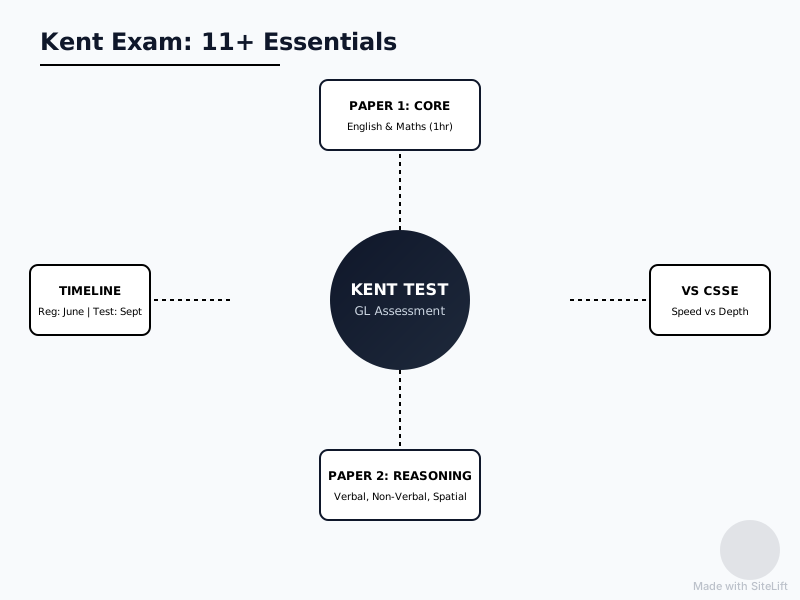
Infographic by SiteLift
How Should You Prepare for Kent 11+ Maths Practice if You Are Used to CSSE?
If your child is already doing CSSE work, you are not starting from scratch. About 80% of the maths content overlaps. What changes is how you answer.
What maths topics overlap between Kent and CSSE?
Both tests assume secure Year 5 and early Year 6 Key Stage 2 maths:
- Fractions, decimals and percentages and converting between them
- Ratio, proportion and basic algebra
- Four operations with large numbers, factors and multiples
- Area, perimeter, volume, angles and coordinates
- Measurement, time and money problems
- Worded problem-solving with two or three steps
Where they diverge is presentation. CSSE might give you a shape problem with space to draw and explain. Kent will give you five answer options and 60 seconds.
Our Kent 11+ (Kent Test) Maths Practice portal is built around that GL multiple-choice style, while our Essex 11+ (CSSE) Maths & English Practice keeps the written depth CSSE examiners expect.
How to adapt from CSSE working-out to Kent speed and accuracy?
I tell pupils to keep their CSSE working — just shrink it. Use the white space in the booklet for a two-line jotting, circle key numbers, and eliminate obviously wrong options first.
Three habits make the biggest difference:
- Pace in blocks. In a 25-minute Kent maths section, aim for 8-9 questions per 8 minutes. If you hit two hard ones in a row, move on.
- Learn GL wording. GL loves “which is the odd one out”, “what is the value of”, and reverse word problems. Familiarity saves 10 seconds a question.
- Practise no-calculator accuracy. Times tables to 12x12, fraction-decimal equivalents and percentage shortcuts must be instant.
Add one dedicated reasoning session a week from the spring of Year 5. Non-verbal and spatial reasoning are learnable, but CSSE-only children often meet nets of cubes and letter codes for the first time in September — far too late.
Best practice routine for dual preparation
For families doing both, here is a routine that works without burnout:
- 2x maths per week: One CSSE-style deep set (45-60 mins, show working) + one timed Kent set (25 mins, multiple-choice)
- 2x English per week: One CSSE comprehension + writing task, one Kent-style vocabulary and quick comprehension
- 1x reasoning per week: 20 mins verbal, 20 mins non-verbal/spatial, always timed
- Monthly: One full mock under exam conditions for whichever test is closer
Track topics, not just scores. If percentages are weak in both formats, fix the concept once and then practise it in both styles. That is exactly why our platform uses detailed topic tracking — you spot that ratio is costing you marks in Kent speed tests and CSSE long problems.
Check Pricing if you want both portals — dual access is built for families in exactly this position.
My Honest Take: Why I Rate CSSE Maths for Kent Success
I will be straight with you: I prefer the CSSE maths paper as a piece of exam design. It lets a bright child think.
But here is what I have learned after watching hundreds of children prepare: that depth is a superpower in Kent, if you add speed on top.
Kent maths is not harder in content — in fact, most CSSE pupils tell me the questions look easy. The difficulty is doing 25 easy-looking questions in 25 minutes without a silly slip, while bubbling an answer sheet correctly and keeping your nerve when the invigilator calls “five minutes left”.
Research from the Sutton Trust has consistently found that pupils who get structured preparation and tutoring are more likely to secure grammar places than equally able peers who do not. I see that play out less as “coaching tricks” and more as familiarity — children who have seen GL answer sheets, practised spatial nets, and learned when to guess and move on walk in calmer.
So my advice to Essex parents eyeing Kent? Do not dumb down your CSSE work. Keep the hard multi-step problems, keep showing working, keep writing properly. Then layer on short, sharp Kent drills twice a week from Easter of Year 5. You will walk into both tests with something single-test candidates lack: range.
If you only remember one thing from this Kent Exam guide, make it this: CSSE gives you stamina, Kent gives you speed. Train both, and your child is dangerous in the best way.
Where to Get Exam-Authentic Practice Next
Reading about the format is one thing. Feeling that 25-minute pressure is another.
Start with free timed sets that mirror the real papers, with instant marking and worked solutions so you can see why an answer was wrong, not just that it was wrong. That feedback loop matters far more than doing hundreds of generic worksheets.
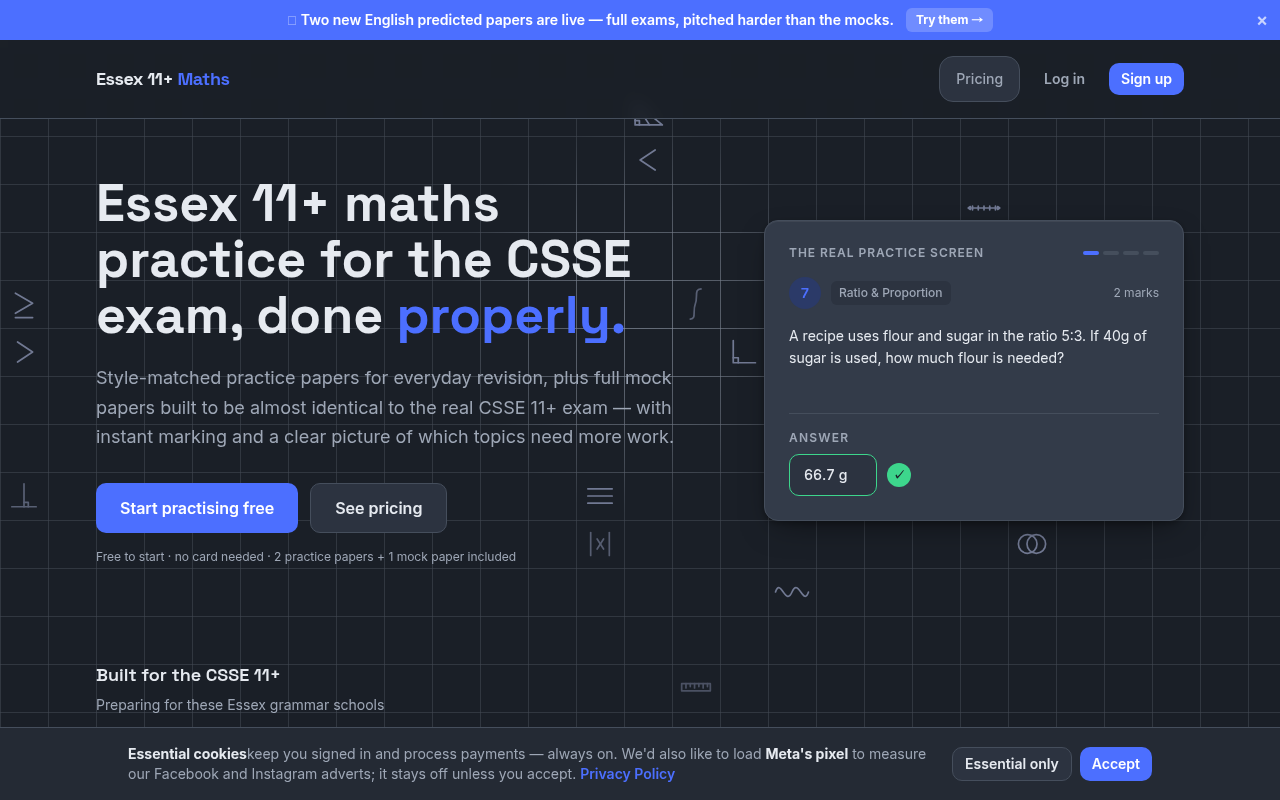
At essex11mathspractice.co.uk we built our CSSE mocks to look and feel like the real Essex papers — predicted papers, animated lessons, comprehension and writing practice, plus a weekly report for parents. We have now added Kent Test-style maths practice in the same system, so you can switch between CSSE depth and Kent speed without learning a new platform.
Try a free Kent maths set this week, timed, no calculator, answer sheet ready. Then try a CSSE set at the weekend. You will know within two sessions which style your child needs more work on.
FAQ
What is the Kent Exam?
The Kent Exam is the Kent Test 11+ used for Year 7 entry to Kent’s 32 grammar schools. Set by GL Assessment, it tests English, Maths and Reasoning in multiple-choice papers, plus an unscored writing task used only for appeals.
What is the Kent Test format and how long is each paper?
Paper 1 covers English and Maths (25 minutes each plus practice). Paper 2 covers Verbal, Non-Verbal and Spatial Reasoning (about 1 hour with practice). A separate 40-minute writing task includes 10 minutes planning time.
When are the Kent exam dates for this year?
Registration typically opens in June of Year 5 and closes in early July. Testing is in early September of Year 6, with results in mid-October before the 31 October school application deadline. Always confirm exact dates with Kent County Council.
Is the Kent Test harder than the CSSE Essex 11+?
Neither is objectively harder — they test different skills. CSSE demands deeper written problem-solving and marked creative writing. Kent demands faster multiple-choice accuracy and dedicated reasoning, which many CSSE pupils find unfamiliar at first.
What score do you need to pass the Kent Test?
You usually need an aggregate standardised score of around 332 across English, Maths and Reasoning, with no individual score below 107. Thresholds are confirmed yearly. Pupils who narrowly miss can be considered via a headteacher assessment.
— essex11mathspractice.co.uk