How to Simulate Real CSSE Exam Conditions at Home for 11+ Success
How to Simulate Real CSSE Exam Conditions at Home for 11+ Success
Every year, thousands of families across Essex prepare for selective school entrance exams. To give your child a competitive edge, running realistic CSSE mock exams at home is the single most effective strategy. According to the Department for Education, selective school admissions in high-demand authorities like Essex routinely see ratios of up to six applicants per single Year 7 place. With over 6,000 candidates competing for approximately 1,000 places across the Consortium of Selective Schools in Essex (CSSE), raw academic ability is only half the battle.
To secure a place at top-tier schools like King Edward VI Grammar School (KEGS) or Colchester Royal Grammar School (CRGS), your child must perform under intense pressure. Replicating the test environment is the single most effective way to bridge the gap between casual revision and the high-stakes reality of exam day.
By replicating the exact environment, timings, and psychological constraints of the actual test, you can transform a highly stressful event into a familiar, manageable routine. This step-by-step guide will show you exactly how to run an authentic mock exam that delivers accurate performance data and builds unshakable exam-day confidence.
Why Simulate CSSE Exam Conditions at Home?
Bridging the Gap Between Revision and Exam Day
Many students perform brilliantly during relaxed, untimed study sessions at the kitchen table, only to see their scores plummet on exam day due to a lack of timed 11+ maths practice. This performance drop is rarely due to a lack of knowledge; rather, it stems from cognitive overload and unfamiliar sensory inputs.
Research published by the British Psychological Society demonstrates that high test anxiety can reduce examination performance by more than 10 to 15 percentile points if coping strategies and environmental acclimatisation are not practiced. When a child is accustomed to the quiet, structured, and strictly timed environment of an exam hall, their brain can focus entirely on solving the problems in front of them, rather than panicking about the ticking clock.
The Specific Demands of the CSSE Format
Unlike generic 11+ exams administered by GL Assessment or CEM, the CSSE exam has a highly specific format. It does not use multiple-choice answer sheets where children simply shade in a box. Instead, the CSSE papers require written, free-response answers.
In the CSSE maths paper, children must write out their calculations in designated working spaces. Marks are explicitly awarded for logical, step-by-step working out, even if the final calculation contains a minor arithmetic slip. Furthermore, the CSSE demands a high level of reading comprehension and written stamina across a strict, non-negotiable 60-minute window. Generic online tests simply cannot replicate these physical and mental demands.
Prerequisites: What You Need Before Running a Home CSSE Mock
Before you begin, you must gather the correct materials. Using incorrect stationery or non-style-matched papers will compromise the validity of your mock exam results.
| Equipment / Resource | Approved for CSSE? | Specification / Notes |
|---|---|---|
| Style-Matched Papers | Yes | Must be paper-based, free-response format (not multiple-choice). |
| HB Pencils & Eraser | Yes | Standard wooden or mechanical pencils; high-quality eraser. |
| Ruler | Yes | Standard 15cm or 30cm clear plastic ruler. |
| Analogue Clock | Yes | Clear face, silent mechanism, placed in direct line of sight. |
| Calculators / Smartwatches | No | Strictly prohibited. All wearable tech must be removed. |
| Mobile Phones | No | Must be switched off and left outside the exam room. |
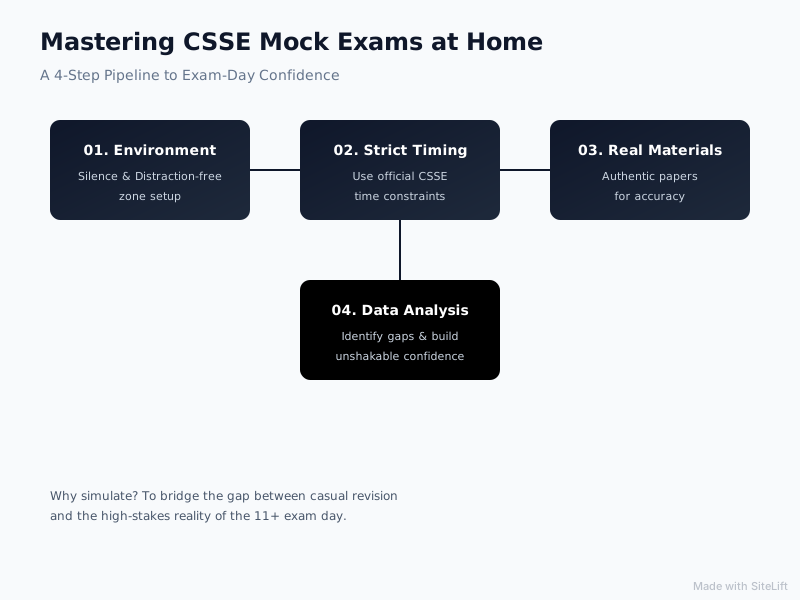
Infographic by SiteLift
Step 1: Source Authentic Papers for Your CSSE Mock Exams at Home
Avoiding Generic Multiple-Choice Worksheets
The most common mistake parents make is purchasing generic 11+ practice bundles online. These materials are frequently designed for multiple-choice formats where students "bubble in" their answers.
If your child practices exclusively on multiple-choice sheets, they will struggle on the actual CSSE paper, which requires them to structure and write out multi-step mathematical solutions. To prevent this, utilizing realistic Essex grammar school mock tests is essential.
Selecting Style-Matched Materials
To get a true reflection of your child's current level, you need resources designed specifically for the Essex syllabus. Using high-quality, exam-authentic resources is vital.
For targeted, realistic preparation, you can access style-matched maths papers through Essex 11+ Maths Practice for the CSSE Exam. These materials are meticulously engineered to mirror the difficulty, layout, and free-response style of the real CSSE mathematics paper, ensuring your child is never surprised by the formatting on exam day.
- Actionable Step: Download and print a fresh, unseen CSSE-style paper. Do not let your child see the questions beforehand.
- Expected Result: Your child faces genuine, unfamiliar questions, providing an accurate benchmark of their current abilities.
- Common Mistake to Avoid: Re-using a paper your child has already looked at or worked through in previous study sessions.
Step 2: Create an Authentic, Exam-Ready Environment
Eliminating Domestic Distractions
Your kitchen table is a hub of familiar family activity, which makes it a terrible place for a realistic mock exam. To simulate the sterile, unfamiliar environment of a grammar school hall, you must strip away these domestic comforts.
Choose a quiet room that is not your child’s bedroom. Keep siblings, pets, and smart home devices completely out of the space.
Setting Up the Physical Desk Space
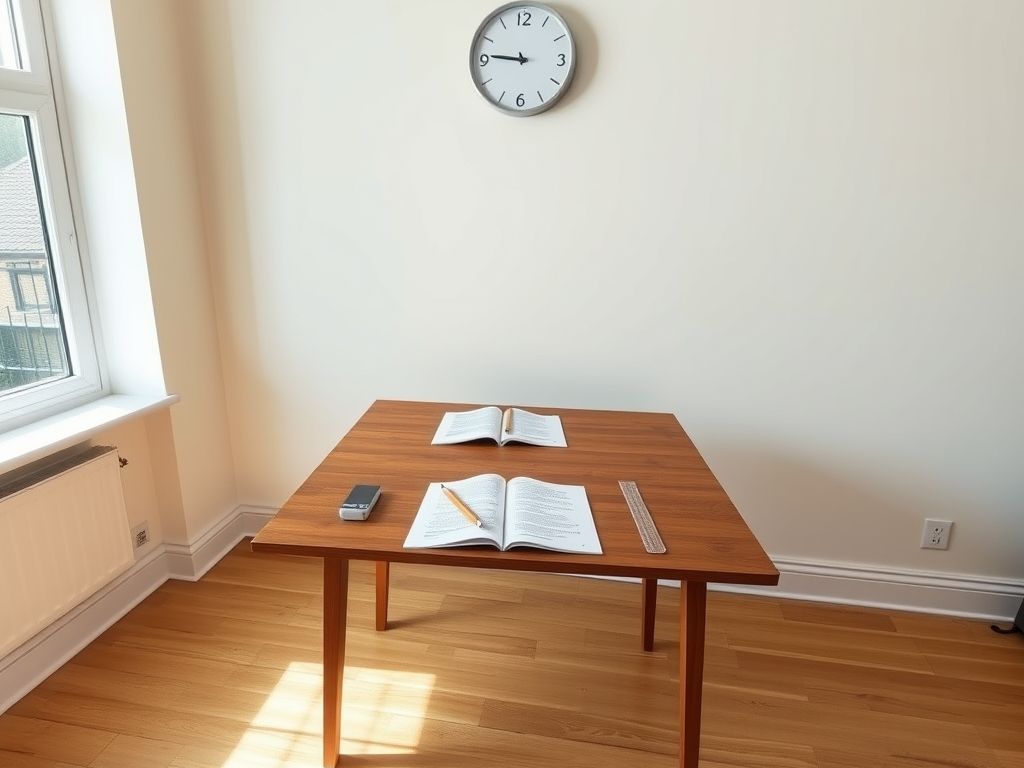
Clear the desk of all revision guides, posters, and stray papers. The only items permitted on the desk are the exam paper, two HB pencils, a high-quality eraser, and a ruler.
Ensure the chair and table are set up to promote good posture. Place a silent analogue clock on the table or wall directly in front of your child. Do not use a digital countdown timer, as the real exam halls only provide standard analogue wall clocks.

- Actionable Step: Set up a single desk in a quiet room, facing away from windows or personal belongings. Ensure the room is well-lit and maintained at a comfortable, slightly cool temperature.
- Expected Result: The physical isolation triggers a mental shift in your child, signaling that this is a formal assessment rather than a casual homework session.
- Common Mistake to Avoid: Allowing your child to have a snack, juice box, or music playing in the background while the exam is in progress.
Step 3: Implement Strict Timings for CSSE Mock Exams at Home
Adhering to the Exact 60-Minute Maths Window
The CSSE mathematics paper is notoriously tight on time. You must enforce the 60-minute limit with absolute, unyielding precision.
Do not pause the clock for bathroom breaks, questions, or moments of frustration. If your child stops working, the clock must keep running. This is crucial for teaching them how to manage their time and handle the pressure of a ticking clock.
Invigilator Role: Remaining Detached and Impartial
During the mock, your role shifts from supportive parent to neutral invigilator. This can be incredibly difficult. You must sit quietly at the back of the room or nearby, out of your child's direct line of sight.
Do not offer any guidance, hints, or reassuring nods. If your child asks for help with a word or a question, you must reply with a neutral: "I cannot help you with the paper. Do the best you can."
Pro Tip: Give standard verbal time warnings at designated intervals: "You have 30 minutes remaining," "You have 10 minutes remaining," and "Pencils down, close your booklets." This familiarises your child with the vocal cues they will hear in the real exam hall.
- Actionable Step: Start the test exactly on the hour. Write the start and finish times on a piece of paper or whiteboard visible to your child.
- Expected Result: Your child learns to monitor their own pacing, discovering how long they can afford to spend on each section.
- Common Mistake to Avoid: Granting "just an extra two minutes" to finish a final question. This distorts their true score and builds a false sense of security.
Step 4: Simulate Exam Day Pressure and Psychological Stressors
Overcoming the 'Stuck on Question 15' Panic
In almost every CSSE maths paper, there will be a highly complex, multi-step word problem designed to test the limits of the top candidates. These questions often carry 4 to 5 marks.
A common pitfall is when a child gets stuck on one of these problems and spends 10 valuable minutes trying to solve it, leaving several easier questions at the end of the paper untouched. You must teach your child the "triage" method. If they cannot identify the starting step of a problem within 60 seconds, they must circle the question, move on to secure easier marks, and return to it at the end.
Building Resilience with Unfamiliar and Multi-Step Questions
When preparing for exam day pressure and the nervous energy of the exam hall, schedule your mock session for a Saturday morning at 9:00 AM—the exact time of the real CSSE assessment. This disrupts the comfortable weekend routine and introduces a mild, constructive level of psychological stress.
Teach your child simple grounding techniques, such as taking three deep, slow diaphragmatic breaths if they feel their heart rate rising or their mind going blank.
- Actionable Step: Deliver a brief, formal pre-exam briefing before handing over the paper, reminding them of the rules and what to do if they get stuck.
- Expected Result: Your child builds psychological resilience, learning to manage the physical sensations of adrenaline and performance anxiety.
- Common Mistake to Avoid: Reassuring your child too much right before the test starts. Keep your tone calm, professional, and structured.
Step 5: Conduct Rigorous Marking and Methodical Gap Analysis
Marking with Realistic CSSE Criteria and Partial Credit
Once the 60 minutes are up, collect the paper immediately. When marking the paper, you must resist the urge to be lenient. If the handwriting is illegible, or if your child wrote the correct number but omitted the required units (e.g., writing "15" instead of "15cm" or "£15"), you must mark it as incorrect.
However, pay close attention to the working out. If your child used the correct mathematical method but made a simple arithmetic error halfway through, award the appropriate partial method marks as outlined in the mark scheme.
Categorising Errors: Conceptual vs Careless vs Time-Pressure
Once marked, do not simply look at the final percentage and move on. You must conduct a thorough post-mortem of the paper. Create a simple error log categorising every lost mark into one of three distinct buckets:
                  ┌───────────────────────────────┐
                  │      Categorising Errors      │
                  └───────────────┬───────────────┘
                                  │
         ┌────────────────────────┼────────────────────────┐
         ▼                        ▼                        ▼
┌─────────────────┐      ┌─────────────────┐      ┌─────────────────┐
│   Conceptual    │      │    Careless     │      │  Time-Pressure  │
│  (Topic Gap)    │      │  (Misreading)   │      │ (Rushed/Blank)  │
└─────────────────┘      └─────────────────┘      └─────────────────┘
- Conceptual Errors: The child genuinely did not understand how to solve the problem (e.g., struggling with the properties of 3D shapes or Venn diagrams).
- Careless Errors: The child understood the concept but misread the question, made a basic addition slip, or failed to write down the units.
- Time-Pressure Errors: The child left questions blank at the end of the paper or rushed through them, leading to unforced errors.
- Actionable Step: Transfer the identified weak areas into a structured revision plan for the following week, focusing heavily on the topics that caused conceptual errors.
- Expected Result: Your revision sessions become highly targeted, saving time and rapidly boosting your child's score on the next mock.
- Common Mistake to Avoid: Simply showing your child the correct answer without making them physically rewrite the calculation and solve it correctly themselves.
Why "Exam Endurance" is Underrated in the CSSE Exam
In my experience helping families navigate the Essex grammar school admissions process, I have observed a consistent trend: parents spend roughly 90% of their time focusing on syllabus content and only 10% on exam endurance. This is a critical strategic error.
The CSSE exam is a test of cognitive stamina just as much as it is a test of mathematical ability. A child who is academically brilliant but tires easily will begin making careless arithmetic errors around the 45-minute mark.
By running regular, weekly CSSE mock exams at home, you are not just checking what your child knows. You are actively building their mental fitness.
Just like training for a long-distance run, your child’s brain needs to adapt to the grueling pace of sustained, high-intensity concentration. Do not treat mock exams as a occasional diagnostic tool to be used only in August; treat them as a core part of your weekly training schedule starting months in advance.
Common Pitfalls When Sitting CSSE Mock Exams at Home
Even with the best intentions, parents often introduce subtle biases that compromise the validity of home mock exams. Be on the lookout for these common errors:
- The 'Hovering Parent' Effect: Standing over your child's shoulder, sighing when they make a mistake, or pointing out a misread instruction while the exam is in progress. This completely destroys the realism of the invigilation.
- Ignoring Working Out and Presentation Standards: Allowing messy, chaotic working out because "you know what they meant." If a professional examiner cannot read the handwriting or follow the steps, they will award zero marks.
- Late-Evening Testing: Conducting mock exams after a long day at school. Fatigue severely distorts performance metrics, leading to an artificially low score that does not reflect your child's true potential.
- Over-Testing: Running multiple full mocks per week. This leads to burnout and a negative association with the 11+ process. One high-quality, fully invigilated mock exam per week is the ideal frequency.
Expected Outcomes: How Home Mocks Build 11+ Confidence
Tracking Progress Across Multiple Mock Sessions
As you implement a structured, weekly mock exam routine, you should expect to see a distinct trajectory in your child's performance. In the first few sessions, scores may be volatile, and your child might struggle to finish the paper. This is completely normal.
Over a 6 to 12-week cycle, however, you will notice their pacing improve, careless errors decrease, and their ability to handle difficult multi-step problems grow significantly.
Transitioning from Anxiety to Methodical Execution
The ultimate goal of this process is to remove the fear of the unknown. When your child walks into the actual CSSE exam hall on a Saturday morning in September, they should feel a sense of calm familiarity.
They will see the rows of desks, the analogue clock on the wall, and the paper-based booklets, and their brain will automatically transition into "exam mode." Because they have practiced this exact routine dozens of times at home, they can focus entirely on showcasing their hard-earned academic skills.
Take the Next Step in Your CSSE Preparation
Simulating realistic exam conditions at home is the most effective way to protect your child's hard work from being derailed by exam-day nerves. By sourcing authentic, style-matched materials and enforcing strict exam-room rules, you give your child the competitive edge they need to secure one of the highly coveted Essex grammar school places.
To start building your child’s exam endurance today, explore the style-matched resources and comprehensive mock papers available at Essex 11+ Maths Practice for the CSSE Exam. Designed to perfectly match the rigour and format of the actual Essex grammar school entrance exams, our platform helps you identify weak spots instantly and target your revision where it matters most.
For flexible preparation options that suit your schedule, check out our Pricing | Essex 11+ Maths Practice page to find the perfect plan for your child's 11+ journey.
— essex11mathspractice.co.uk
FAQ
How often should my child sit CSSE mock exams at home?
During the spring term of Year 5, one mock exam every 3 to 4 weeks is sufficient to establish a baseline. As you enter the summer term and the summer holidays, increase the frequency to once a week. Avoid running more than one mock exam per week to prevent burnout and ensure you have ample time for targeted revision between tests.
What is considered a good benchmark score on a CSSE home mock test?
Because CSSE papers are designed to be highly challenging, a score of 70% to 75% or above is generally considered a strong benchmark for securing a place at a selective Essex grammar school. However, because the raw scores are standardised each year based on cohort performance and age, you should focus on consistent, steady progress rather than a single fixed number.
Should I allow extra time if my child fails to finish the maths paper?
No. Unless your child has an officially approved special educational need (SEN) that grants them extra time in the actual exam, you must strictly enforce the 60-minute limit. Allowing extra time at home masks pacing issues, preventing you from addressing the root causes of their slow speed during your weekly revision sessions.
How do I mark CSSE maths questions if my child got the final answer wrong but showed working?
Review the specific mark scheme for the paper. If your child has shown a clear, mathematically correct method but made a simple calculation error (such as adding 7 and 5 to get 11), they are often eligible for 1 or 2 "method marks" (M marks). Be strict, but fair—only award these marks if their written working is legible and logically structured.
What time of day is best to conduct an 11+ mock test at home?
The best time to conduct a home mock exam is Saturday morning at 9:00 AM. This perfectly mirrors the timing and weekend setting of the official CSSE exam, helping your child adapt to working at peak cognitive capacity when they would normally be relaxing or playing.