How to Overcome Math Anxiety in Children Preparing for the 11+
How to Overcome Math Anxiety in Children Preparing for the 11+
If your Year 5 child suddenly cries over fractions they could do last term, freezes in timed papers, or says “I’m just rubbish at maths,” you are almost certainly dealing with child math anxiety 11+ families know all too well. It is not laziness and it is not lack of ability. It is a genuine stress response to high-stakes testing, and it peaks just as grammar school preparation ramps up.
I speak to Essex parents every week who describe the same pattern: a bright, capable child who loves puzzles but goes blank on CSSE-style word problems. The good news? With the right approach to building confidence for grammar school tests, most children can learn to manage those nerves and actually enjoy the challenge again.
Key Takeaways
| What You Need to Know | Quick Action for Parents |
|---|---|
| Math anxiety is common — affects up to 20% of primary pupils | Watch for avoidance, tummy aches, tearfulness, and blanking out |
| Mindset matters more than marks | Praise effort and strategy, not just scores |
| Fear of the unknown drives panic | Use style-matched CSSE/GL questions in short bursts |
| Metacognition boosts progress — up to 7 months extra progress | Teach children to plan, check, and reflect on each question |
| Parental calm is contagious | Keep routines steady and exam talk light |
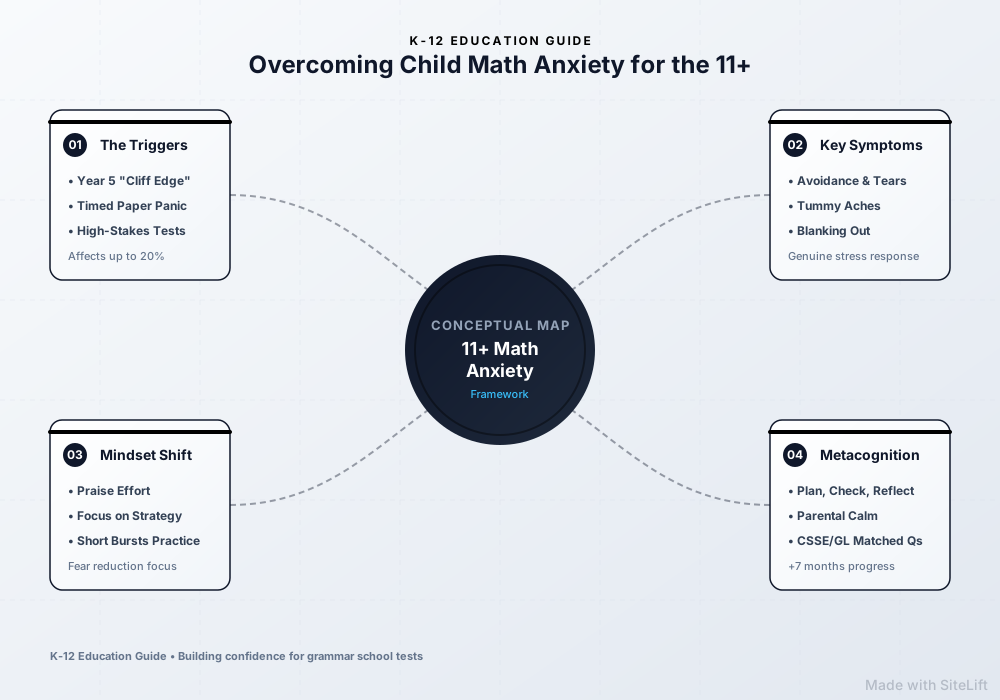
Infographic by SiteLift
What Causes child math anxiety 11+ in Children Preparing for Grammar School?
The Unique Pressures of Year 5 and Grammar School Entrance Exams
Year 5 feels like a cliff edge. One term your child is doing relaxed Key Stage 2 maths, the next they are hearing about pass marks, standardised scores, and Southend and Colchester grammar places. For many, child math anxiety 11+ starts here — not because the maths is impossible, but because the stakes suddenly feel huge.
The CSSE 11+ maths paper in Essex is particularly demanding. It rewards multi-step reasoning, unusual wordings, and efficient working under time pressure. Even confident mathematicians can feel wobbly when they first meet it.
Recognising the Physical and Emotional Signs of Test Stress
Math anxiety rarely looks like quiet dislike. Look out for:
- Tearfulness or anger specifically around maths homework
- Complaints of headaches or stomach aches before practice
- Rushing through papers to “get it over with” or refusing to start
- Saying “I can’t do it” before reading the question properly
- Suddenly forgetting methods they knew cold last week
According to research from the University of Cambridge, mathematics anxiety affects up to 20% of primary school children in the UK, with Cambridge University research on maths anxiety in primary schools showing it can directly impair working memory. In plain English: anxiety steals the mental space your child needs to calculate.
A survey by YoungMinds also found that over 80% of young people say exam pressure impacts their mental health, detailed in their YoungMinds guide for parents on supporting children through exam stress. Year 5s feel that pressure too, even if they cannot articulate it.
Why Time Pressure and Complex 11+ Maths Trigger Freeze Responses
Timed, non-routine problems create perfect conditions for cognitive overload. Your child must decode the wording, choose a method, calculate accurately, and watch the clock. When working memory overloads, the brain hits freeze — blank mind, racing heart, no answer.
That freeze is the core of child math anxiety 11+ preparation. It is not a knowledge gap, it is a panic response.
Pro Tip: If your child freezes, don’t explain the solution straight away. Ask: “What’s the first tiny step you could try?” Breaking the lock matters more than getting the right answer.
How Can Parents Reframe Revision to Build Lasting Confidence?
Shifting from a Fixed Mindset to a Growth Mindset in Maths
Language shapes belief. Swap fixed statements for growth ones:
- Instead of “I can’t do fractions” → “I haven’t cracked tricky fractions yet”
- Instead of “I’m slow” → “I’m learning to work faster with practice”
- Instead of “I got 12/30, I failed” → “I got 12 right and found 18 things to learn”
This is central to building confidence for grammar school tests. Children who believe ability can grow will attempt harder questions instead of avoiding them.
Data from the Education Endowment Foundation shows that metacognitive and self-regulation strategies can add up to 7 months of additional academic progress for primary pupils, as explained in the EEF teaching toolkit on metacognition and self-regulation. Teach your child to ask: What is this question really asking? What method fits? Does my answer make sense?
Using Positive Reinforcement for Exam Prep Without Over-Pressuring
Effective positive reinforcement for exam prep rewards process, not just outcome. Try:
- Praising strategy: “Great bar model — that was a smart way to organise it.”
- Praising persistence: “You stuck with that 3-step problem, well done.”
- Praising reflection: “Love how you spotted your own slip in step two.”
Avoid tying love, treats, or big promises to scores. “If you pass we’ll go to Disneyland” turns every practice paper into a high-stakes trial. Small, consistent encouragement builds resilience without performance anxiety.
Normalising Mistakes as Essential Learning Opportunities
In my experience, anxious children think mistakes mean they are not grammar school material. Flip that story.
Go through worked solutions together and label errors: misread, wrong operation, calculation slip, ran out of time. When a wrong answer becomes data, it stops feeling shameful. Keep an “oops book” where your child logs one useful mistake per session — it quickly becomes proof of progress.
What Practical Revision Techniques Help Reduce child math anxiety 11+ and Test Stress in Year 5?
Desensitising Time Pressure Through Low-Stakes Practice
Do not start with full 50-minute papers under exam conditions. That is like learning to swim in the deep end. For reducing test stress in Year 5, use gradual exposure:
- Untimed accuracy first: Let them solve 5 CSSE-style questions with no clock.
- Gentle timing: Same length next time, but with a visible timer just for awareness.
- Short sprints: 10 minutes for 6 questions, then stop. Celebrate calm working.
- Full mocks only later: Once accuracy is solid, add realistic conditions once a fortnight.
Familiarity kills fear. When children have seen the layout, instruction wording, and answer format dozens of times, exam day feels like “another practice.”
That is why style-matched material matters so much. Generic worksheets teach maths, but they do not teach the CSSE exam. Practising with Essex 11+ Maths Practice for the CSSE Exam — with relaxed practice papers and full mocks built to match the real exam — helps demystify the test and gives instant marking with a topic-by-topic breakdown.
Chunking Complex Word Problems into Manageable Steps
CSSE word problems often hide simple maths inside busy stories. Teach a 3-step chunk:
Underline – Draw – Check
- Underline the numbers and the actual question (not the fluff).
- Draw something quick: bar model, number line, table.
- Check with estimation: “Should the answer be bigger or smaller than 100?”
Practise this aloud. Children with child math anxiety 11+ worries often calm down when they have a repeatable routine to fall back on instead of staring at a wall of text.
Establishing a Balanced Year 5 Study Schedule
More hours do not equal less anxiety. Overtired children catastrophise more. Aim for:
- 15-20 minute focused bursts, 4-5 times a week, rather than a Sunday marathon
- One maths-free day each week
- Plenty of sleep, fresh air, and silly play — especially in the 6 weeks before the exam
- A visible plan so revision has an end time (“We finish at 5:20, then football”)
Pro Tip: End every session on a win. Keep two easy “confidence questions” in reserve so your child finishes feeling capable, not crushed.
If you want to see what that looks like without committing, starting with free 11+ Maths and English practice options can keep early Year 5 revision light and low-pressure.
How Can Parents Support Their Child on 11+ Mock and Exam Days?
Simple Calming and Breathing Techniques for 10-Year-Olds
Teach one technique well in advance, so it is automatic:
Box breathing: Breathe in for 4, hold for 4, out for 4, hold for 4. Trace a square on the desk while doing it. Practise during calm practice papers, not just in panic moments.
Other quick resets: wiggle toes in shoes, sip water, skip a scary question and circle back. Remind them: the paper is designed to be hard — no one is expected to finish everything perfectly.
Managing Parental Anxiety to Prevent Emotional Spillover
Children are emotional sponges. If we hover, sigh, or constantly talk about pass marks, their child math anxiety 11+ stress spikes.
Keep your voice steady, your face relaxed, and your post-paper questions light: “How did it feel?” beats “How many did you get?” Avoid post-mortems in the car. A hot chocolate and a walk do more for the next paper than rehashing question 14.
Creating a Stress-Free Morning Routine for Exam Day
Rehearse the morning once before a mock:
- Lay out uniform, pencils, water, and snack the night before
- Protein breakfast, leave early to avoid traffic panic
- No last-minute cramming — a familiar 5-minute warm-up is plenty
- Calm mantra: “Do your best, move on if stuck, check if time.”
Predictability is soothing. When the morning runs smoothly, your child walks in thinking about the paper, not the chaos.
My Honest Take: Stop Chasing Perfection, Start Chasing Composure
I’ll be blunt because I think Essex parents need to hear it: too much 11+ maths prep is obsessed with raw scores, and it is making child math anxiety 11+ worse.
I would far rather see a child score 65% calmly, skip sensibly, and check their work, than score 85% tearfully after two hours of pressure and parental hovering. Why? Because composure scales. The calm child will hold it together in a noisy exam hall in September. The perfection-chased child often falls apart on one nasty question 3 and never recovers.
In my view, confidence is not built by telling children “you’re so clever.” It is built by giving them dozens of small, exam-authentic wins — “I handled that time pressure,” “I fixed that fractions slip,” “I finished without panicking.” That is real building confidence for grammar school tests, and it lasts far beyond the 11+.
— essex11mathspractice.co.uk
How Targeted Practice Makes the 11+ Feel Familiar, Not Frightening
Fear of the unknown fuels most child math anxiety 11+ struggles. When children only use generic workbooks, the real CSSE paper feels like a foreign language.
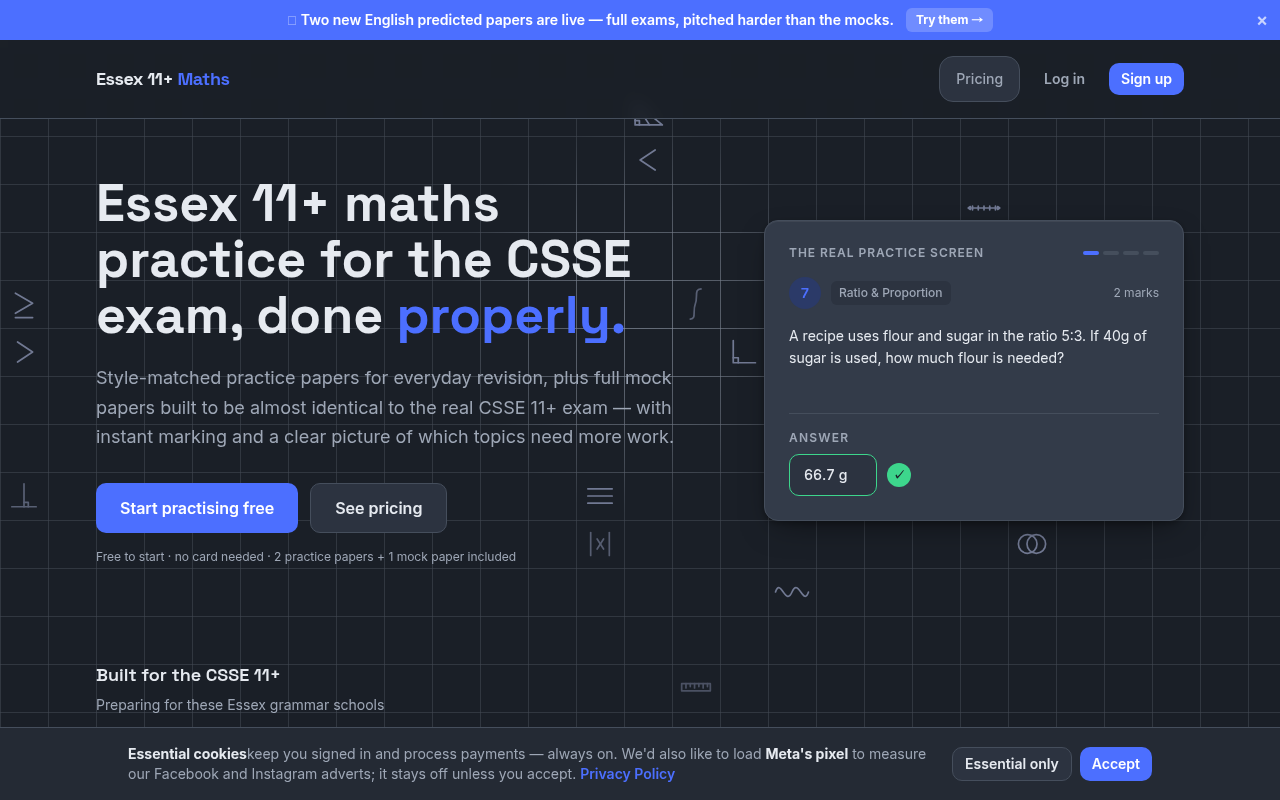
essex11mathspractice.co.uk was built to close that gap — style-matched CSSE maths questions, relaxed practice for skill-building, and full mocks for timed readiness, all with instant marking and worked solutions. You can see exactly whether fractions, ratio, or multi-step word problems trigger the wobble, then target that topic in short, calm bursts.
It is a practical way to keep reducing test stress in Year 5: less guessing, more clarity, and revision that ends with “I know what to expect.”
FAQ
How do I know if my child has math anxiety or just dislikes 11+ maths?
Dislike is passive — “maths is boring.” Anxiety is active distress: avoidance, tears, stomach aches before practice, rushing or freezing, and a sharp drop in performance under time even though they can do the work untimed. If stress only appears around timed child math anxiety 11+ practice and disappears with untimed puzzles, anxiety is likely driving it.
When should I start addressing test stress in Year 5?
Early, ideally in the spring term of Year 5. Do not wait until summer mocks. Start with untimed, style-matched questions, introduce gentle timing gradually, and teach one calming routine now. Early reducing test stress in Year 5 prevents bad habits from hardening before the autumn exam.
Can a child with math anxiety still pass the 11+ grammar school entrance exam?
Absolutely. Anxiety does not equal low ability — it often affects bright perfectionists most. Children who learn chunking strategies, timed exposure, and self-checking routines frequently outperform calmer peers because they work more systematically. Consistent use of positive reinforcement for exam prep and targeted practice makes a huge difference.
How do I help my child if they completely freeze during timed maths papers?
Stop the timer immediately. Normalise it: “Freezes happen, let’s reset.” Do box breathing together, then cover the paper and do just one question untimed. Ask them to talk through their thinking aloud. Once calm returns, restart with a much shorter sprint — 5 minutes only. Repeated low-stakes wins retrain the panic response.
Should I pause 11+ revision if my child becomes visibly distressed?
Pause that session, not the whole journey. End with empathy and a break: walk, snack, fresh air. Later, shorten sessions to 10-15 minutes, drop back to easier material, and rebuild. If distress persists for weeks, affects sleep or appetite, or spreads beyond maths, speak to their teacher and consider easing the grammar school pressure while you focus on wellbeing first.