Find Area of Triangle: The CSSE Method Every Essex Pupil Should Master
Find Area of Triangle: The CSSE Method Every Essex Pupil Should Master
When Year 6 pupils sit down to tackle the Consortium of Selective Schools in Essex (CSSE) 11+ paper, geometry questions often stand between a solid score and a grammar school offer. Learning how to find area of triangle quickly and accurately is not just a standard Key Stage 2 skill—it is a critical test of mathematical reasoning under timed exam conditions.
According to the Consortium of Selective Schools in Essex (CSSE), over 6,000 pupils sit the 11+ exam annually for approximately 1,000 grammar school places across Essex. With competition this fierce, losing marks on fundamental shapes is an error no applicant can afford. Furthermore, official statistics published by the Department for Education (DfE) show that approximately 73% of Year 6 pupils meet the expected standard in mathematics at KS2. However, the CSSE paper routinely pushes beyond standard classroom expectations, dressing simple formulas in complex compound diagrams.
This guide breaks down the exact multi-step approach your child needs to master triangle geometry, avoid deliberate exam distractors, and secure full marks on paper day.
Prerequisites: What You Need
Before jumping into complex exam diagrams, make sure your child has the basic toolset ready:
- Required Skills: Fluency in times tables up to 12×12, basic decimal division, and simple metric conversions (mm to cm).
- Target Level: Key Stage 2 / CSSE 11+ standard (Year 5 and Year 6).
- Recommended Time: 25–30 minutes of focused practice.
- Materials: HB pencil, rough scrap paper, and clear metric ruler.
Prerequisites: What Does a Year 6 Pupil Need Before Calculating Triangle Area?
Before a pupil can confidently find area of triangle shapes in a high-pressure exam setting, three foundational geometry concepts must be crystal clear. Skipping these basics usually leads to simple arithmetic blunders later on.
Understanding Units of Measurement (cm² vs mm² vs m²)
Area measures two-dimensional surface space, which means units are always squared. While standard lengths are measured in centimetres ($\text{cm}$) or millimetres ($\text{mm}$), area must always be stated in square units such as $\text{cm}^2$ or $\text{mm}^2$.
Exam writers frequently mix metric units within a single diagram. For instance, a question might give a base of $8\text{ cm}$ and a height of $40\text{ mm}$. Pupils who multiply these raw numbers without converting units first will arrive at an answer that is off by a factor of ten. Always convert dimensions into the requested answer unit before carrying out any multiplication.
Distinguishing Perpendicular Height from Slanted Side Length
The single biggest source of geometry confusion in Year 6 is the difference between a triangle's true perpendicular height and its slanted outer edges (side lengths).
- Perpendicular Height: The straight line distance measured at a exact $90^\circ$ right angle from the chosen base to the opposite corner (vertex).
- Slanted Side Length: The outer boundary edge of the triangle, which leans at an angle other than $90^\circ$.
Unless a side forms a $90^\circ$ right angle with the base, its length must never be used to calculate area.
Key Stage 2 Geometry Essentials
Pupils preparing for selective entrance tests should review basic shape properties using revision platforms like BBC Bitesize KS2 Maths to ensure they recognise:
- Right-angled triangles: One angle equals $90^\circ$.
- Isosceles triangles: Two equal sides and two equal base angles; altitude bisects the base.
- Equilateral triangles: Three equal sides and three $60^\circ$ angles.
- Scalene triangles: Three unequal sides and angles.
Step 1: How to Identify Base and Height to Find Area of Triangle
The first active step in solving any triangle geometry problem is locating the correct pair of perpendicular dimensions. CSSE papers often rotate shapes or add extra dimension lines to throw pupils off balance.
       Incorrect (Slanted Height)
          / | \
         /  |  \
        /   |   \  <-- Correct (Perpendicular Height at 90°)
       /____|____\
          Base
Spotting the Right Angle Symbol in Right-Angled Triangles
In an area of right angled triangle question, two of the outer sides already meet at a $90^\circ$ corner. Look for the small square box symbol in the corner. The two sides that intersect to form this square are your base and height. The third, longest side leaning opposite the right angle is called the hypotenuse. Ignore it completely when calculating area.
Pro Tip: If a triangle in an exam paper is printed upside down or tilted at an awkward angle, physically rotate the question paper until one side sits flat horizontally across the page. This makes identifying the upright perpendicular height intuitive.
Locating the Altitude in Isosceles and Equilateral Triangles
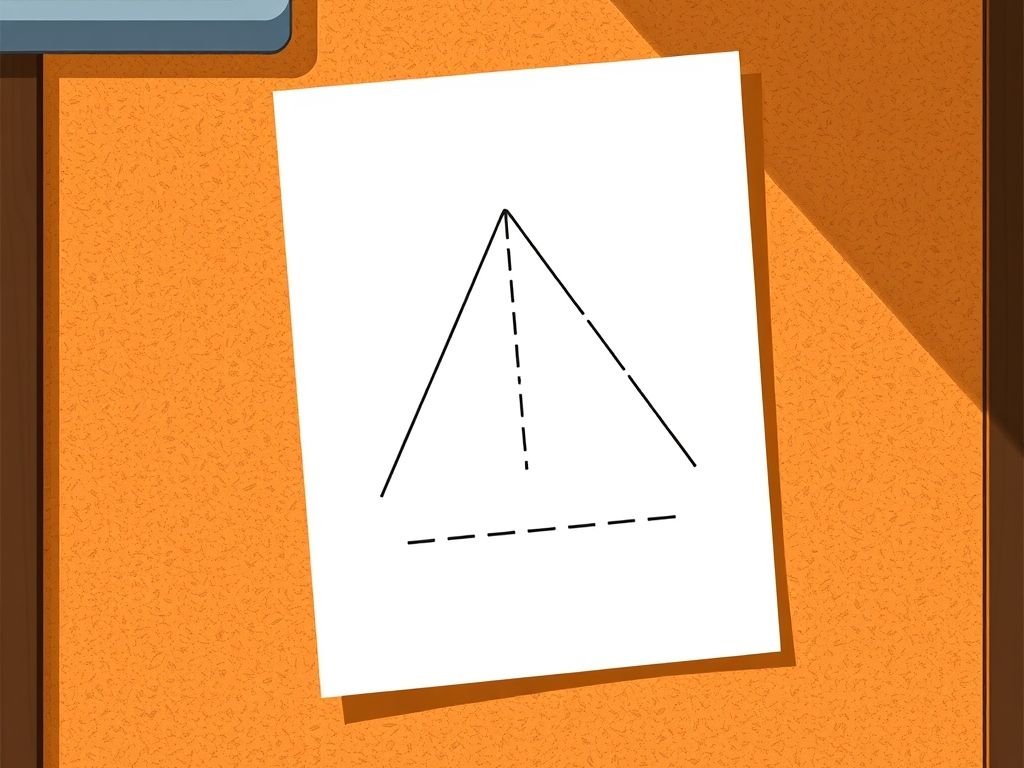
In symmetrical triangles, the perpendicular height (often called the altitude) is represented as a dashed line dropped from the top vertex straight down to the base line.
       /\
      / | \  <-- Altitude (Perpendicular Height)
     /  |  \
    /___|___\
      Base
Check that the dashed line meets the base line at a right-angle symbol. In an isosceles triangle, this height line splits the main triangle into two identical right-angled triangles, cutting the base exactly in half.
The CSSE Trap: Identifying External Heights in Obtuse Triangles
Obtuse triangles contain one angle larger than $90^\circ$. Because the top vertex sits far over to one side, the true vertical height actually lies outside the main body of the triangle.
            Vertex
           /|
          / |
         /  |
        /   |  <-- External Perpendicular Height
       /    |
      /_____|... (Extended base line)
      [Base]
Exam papers depict this using a dotted extension line continuing out from the base, along with a vertical dotted line dropping down from the highest point. The height is the vertical dotted line; the base is only the solid line section of the triangle itself. Do not include the dotted extension line in your base length measurement!
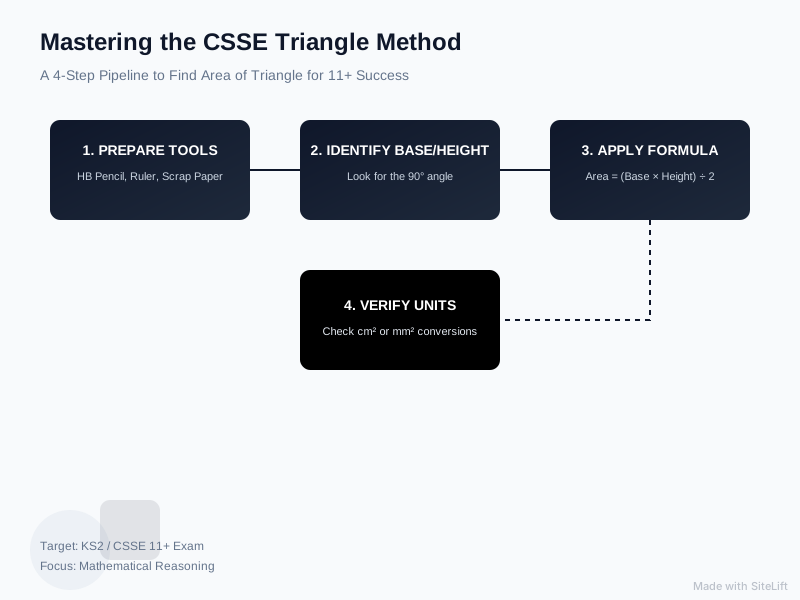
Step 2: How Do You Apply the Area of Triangle Formula KS2 Accurately?
Once you have identified the true base and perpendicular height, apply the standard mathematical rule taught across Key Stage 2 classrooms.
The Core Formula: Area = (Base × Height) ÷ 2
The universal area of triangle formula KS2 relies on one fundamental principle: any triangle occupies exactly half the space of a rectangle or parallelogram with the same base and height.
$$\text{Area} = \frac{\text{Base} \times \text{Height}}{2}$$
Written in short algebraic form:
$$A = \frac{1}{2} b h$$
| Dimension | Measured Value | Calculation Step |
|---|---|---|
| Base ($b$) | $12\text{ cm}$ | Measure horizontal solid base |
| Height ($h$) | $7\text{ cm}$ | Measure vertical perpendicular line |
| Product ($b \times h$) | $84\text{ cm}^2$ | Multiply base by height |
| Final Area ($A$) | $42\text{ cm}^2$ | Divide product by $2$ |
Why Halving the Even Dimension First is Underrated
Most textbooks teach children to multiply the base by the height first, and then divide the resulting number by two. While mathematically sound, this method creates unnecessarily large numbers during timed mental arithmetic.
My personal preference—and the strategy I consistently advise for CSSE success—is to halve the even number before multiplying.
Consider this problem: Base = $18\text{ cm}$, Height = $7\text{ cm}$.
- Standard Method: $18 \times 7 = 126$, then $126 \div 2 = 63\text{ cm}^2$. (Requires long multiplication or complex mental working).
- Shortcut Method: Halve $18$ first to get $9$. Then calculate $9 \times 7 = 63\text{ cm}^2$. (Solved in under three seconds using basic multiplication tables!).
If both dimensions are even, simply pick the larger number to halve first. If both dimensions are odd numbers (e.g., Base = $7\text{ cm}$, Height = $5\text{ cm}$), multiply them first ($35$) and then divide by two ($17.5\text{ cm}^2$).
Working with Decimals and Fractions in 11+ CSSE Papers
Advanced CSSE papers regularly test arithmetic accuracy by including fractional or decimal side lengths.
Example Question: A triangle has a base of $6.4\text{ cm}$ and a perpendicular height of $5\text{ cm}$. Calculate its area.
- Identify the even number: $6.4\text{ cm}$.
- Halve the even number: $6.4 \div 2 = 3.2\text{ cm}$.
- Multiply by height: $3.2 \times 5 = 16\text{ cm}^2$.
Step 3: How to Find Area of Triangle Shapes with Right Angles Fast
Right-angled triangles appear frequently in entrance examinations because they bridge basic single-shape questions and complex composite reasoning tasks.
Why Right-Angled Triangles Are Simple Halved Rectangles
Visually, every right-angled triangle is simply a grid rectangle cut cleanly in half along its diagonal corner line.
+-----------+
|`.         |
|  `.  Area |  <-- Triangle is exactly 1/2 of full rectangle
|    `.     |
+-------+---+
Because the two sides surrounding the right angle are naturally perpendicular to each other, one side serves directly as the base, and the other serves directly as the height. No additional height altitude lines need to be drawn or calculated.
Avoiding the Hypotenuse: The Most Common Exam Distractor
CSSE paper writers deliberately label all three sides of a right-angled triangle to test whether a candidate understands the concept of perpendicular lines.
       |\
       | \
   5cm |  \  13cm (Hypotenuse - IGNORE!)
       |   \
       |____\
        12cm
In the diagram above:
- Base = $12\text{ cm}$
- Perpendicular Height = $5\text{ cm}$
- Hypotenuse = $13\text{ cm}$
To solve correctly: $$\text{Area} = \frac{12 \times 5}{2} = 6 \times 5 = 30\text{ cm}^2$$
The length of $13\text{ cm}$ is a distractor. Including the hypotenuse in an area formula is a frequent cause of lost marks on Year 6 papers.
Step 4: How Do You Solve Compound CSSE Maths Geometry Questions?
Standard single-formula questions rarely carry high weightings on Essex grammar school papers. Instead, candidates face CSSE maths geometry questions featuring overlapping shapes, shaded regions, and coordinate planes.
Infographic by SiteLift
The 'Box-and-Subtract' Method for Coordinate Grids
When a triangle is drawn on a coordinate grid with diagonal, non-horizontal edges, measuring the base and height directly becomes difficult. The most reliable strategy is the Bounding Box (Box-and-Subtract) Method.
+------------+  1. Enclose the tilted triangle inside
|  /|  `.    |     a bounding rectangle aligned with grid axes.
| / |    `.  |  2. Calculate total area of bounding rectangle.
|/__|______`.|  3. Subtract outer right-angled triangles.
Step-by-Step Box-and-Subtract Technique:
- Draw a tight rectangle surrounding the outer vertices of the tilted triangle along grid line coordinates.
- Calculate the total area of this outer bounding rectangle ($\text{Length} \times \text{Width}$).
- Notice that the space between your triangle and the bounding box is made up of simple right-angled triangles.
- Calculate the area of each outer right-angled triangle using $A = \frac{b \times h}{2}$.
- Subtract the sum of these outer areas from the total rectangle area to leave the exact area of the inner enclosed triangle.
Triangles Embedded in Parallelograms and Trapeziums
Exam papers often show a shaded triangle enclosed inside a larger 2D polygon like a parallelogram or trapezium.
+-------------------+
|  / \              |
| /   \  Shaded     |  <-- Unshaded regions are outer triangles
|/_____\____________|
If a triangle shares the exact base and vertical height of an enclosing parallelogram, its area is precisely half the area of that parallelogram.
$$\text{Area of Parallelogram} = \text{Base} \times \text{Height}$$ $$\text{Area of Embedded Triangle} = \frac{\text{Base} \times \text{Height}}{2}$$
Shaded Region Problems: Subtractive Triangle Calculations
Another common question type asks pupils to find the area of a shaded region formed by removing a small triangle from a larger one.
Sample CSSE Problem: A large triangular sign has a base of $20\text{ cm}$ and a height of $14\text{ cm}$. A smaller triangular section with a base of $10\text{ cm}$ and height of $6\text{ cm}$ is cut out from the centre. What is the remaining shaded area?
- Area of Large Triangle: $(20 \times 14) \div 2 = 10 \times 14 = 140\text{ cm}^2$.
- Area of Small Cut-out: $(10 \times 6) \div 2 = 5 \times 6 = 30\text{ cm}^2$.
- Subtract Cut-out from Total: $140 - 30 = 110\text{ cm}^2$.
Troubleshooting: What Are the Most Common Pitfalls When Finding Triangle Area?
Internal testing analysis from selective 11+ mock providers indicates that omitting the division by two in triangle area calculations accounts for roughly 30% of geometry calculation errors under exam conditions.
To keep your child's work error-free, review this checklist of frequent mistakes:
Common Student Mistake            Correct Exam Strategy
----------------------            ---------------------
Multiplying Base × Slanted Side -> Always use line perpendicular (90°) to base
Forgetting ÷ 2 at the end       -> Double check units contain "halved product"
Mixing cm and mm measurements   -> Convert all dimensions to match question target unit first
Using Hypotenuse in Right △     -> Identify box symbol (90°); cross out longest side
Forgetting to Divide by 2 Under Timed Pressure
When pupils rush to complete the final sections of an 11+ paper, they often calculate $\text{Base} \times \text{Height}$ and move straight to the next question, effectively recording the area of a rectangle rather than a triangle.
Self-Correction Strategy: Encourage your child to write down the formula template $A = \frac{b \times h}{2}$ in pencil above every triangle question before writing numbers down. Crossing off the $/ 2$ step as they complete it acts as a mental safety lock.
Misidentifying the Base on Non-Horizontal Triangles
When a triangle's base is drawn diagonally across the page, children often struggle to identify which dimension line acts as the vertical height.
Correction Strategy: Remind your child that the "base" does not have to lie horizontally at the bottom of the shape. Any side of a triangle can act as its base, provided the height measurement used is perpendicular to that specific side line.
Overlooking Inconsistent Metric Units
If a question presents dimensions in mixed metric units (e.g., $1.2\text{ m}$ base and $45\text{ cm}$ height), performing $1.2 \times 45 \div 2$ yields an incorrect result.
Correction Strategy: Convert to the smaller unit ($1.2\text{ m} = 120\text{ cm}$), then complete the area equation: $(120 \times 45) \div 2 = 60 \times 45 = 2,700\text{ cm}^2$.
Expected Outcome: Mastering Triangle Area Practice Year 6 Exam Questions
Mastering these steps turns geometry from a potential weak spot into a dependable source of marks. Let's walk through a complete CSSE-style past paper question using our structured approach.
Worked CSSE Style Practice Question with Mark Scheme Walkthrough
                      (0, 10)
                         /\
                        /  \
                       /    \
                      /      \
                     / Shaded \
                    /  Region  \
                   /____________\
               (2, 2)          (8, 2)
Question: The diagram shows a coordinate grid containing a shaded isosceles triangle. The coordinates of its three vertices are $A (2, 2)$, $B (8, 2)$, and $C (5, 10)$. Calculate the area of the shaded triangle in square units.
Mark Scheme Walkthrough:
Step 1: Calculate Base Length (1 Mark) Look at the horizontal line joining point $A (2, 2)$ to point $B (8, 2)$. Since both $y$-coordinates are $2$, the base is a straight horizontal line. $$\text{Base} = 8 - 2 = 6\text{ units}$$
Step 2: Calculate Perpendicular Height (1 Mark) The top vertex is at point $C (5, 10)$. The vertical height drops from $y = 10$ straight down to the base line at $y = 2$. $$\text{Height} = 10 - 2 = 8\text{ units}$$
Step 3: Apply Area Formula (1 Mark) $$\text{Area} = \frac{\text{Base} \times \text{Height}}{2} = \frac{6 \times 8}{2}$$ Using our mental math shortcut, halve the even base first: $$3 \times 8 = 24\text{ square units}$$
Final Answer: $24\text{ square units}$ (Full 3/3 Marks).
Next Steps for 11+ Geometry Preparation
Once your child masters finding triangle areas in isolation, transition into mixed problem sets that combine shape properties with algebra and ratios. Mathematical reasoning collections like those published by the University of Cambridge NRICH project offer excellent extension challenges for high-scoring pupils.
For focused preparation matching the exact format, phrasing, and scoring standards of the Essex entrance papers, target structured triangle area practice Year 6 worksheets alongside realistic mock exams.
Pupils looking to sharpen their speed across all grammar school entry formats can also benefit from comparing these methods against Kent 11+ (Kent Test) Maths Practice resources, as spatial geometry remains a core topic across selective regions nationwide.
To access exam-style practice modules designed specifically around CSSE test papers, explore the topic-by-topic tracking tools and instant marking options available at Essex 11+ Maths Practice for the CSSE Exam.
FAQ
What is the KS2 formula used to find area of triangle?
The standard Key Stage 2 formula to find the area of a triangle is $\text{Area} = (\text{Base} \times \text{Height}) \div 2$, written mathematically as $A = \frac{1}{2}bh$. The base and height must always be perpendicular to each other, meeting at a $90^\circ$ right angle.
Why can't I use the slanted side to calculate the area of a triangle?
The slanted side (or slant height) measures an angled outer edge rather than the true vertical height between the base and the top vertex. Using a slanted edge overestimates the internal area of the shape. Only a line perpendicular ($90^\circ$) to the base accurately reflects vertical height.
How do I find the area of an obtuse triangle in the CSSE 11+ exam?
For an obtuse triangle, locate the vertical perpendicular height dropped outside the main body of the triangle. Measure this vertical line for height, and multiply it by the horizontal length of the solid base only. Do not include the external dotted line extension in your base measurement.
What is the difference between finding the area of a right-angled triangle and an equilateral triangle?
In a right-angled triangle, the two perpendicular sides forming the $90^\circ$ angle serve directly as the base and height, making calculations straightforward. In an equilateral triangle, no outer sides sit at $90^\circ$ to each other, so you must use a vertical line dropped straight down through the centre as your height measurement.
How can my Year 6 child avoid forgetting to divide by 2 in the 11+ maths exam?
Encourage your child to adopt the mental habit of halving the base or height before multiplying. For instance, rather than calculating $12 \times 7 = 84$ and forgetting to divide by 2 later, train them to halve $12$ first to get $6$, and then multiply $6 \times 7 = 42$. This builds the division directly into the first step of the problem.
— essex11mathspractice.co.uk