Decoding the Essex 11+ Score: What You Need to Know About Standardization
Decoding the Essex 11+ Score: What You Need to Know About Standardization

When you open your child’s 11+ exam results in October, you will not see a simple test mark like 85% or 45/50. Instead, you will see a transformed statistical figure known as a standardised score. For many parents, understanding Essex 11+ standardization feels like trying to crack an unnecessary secret code.
However, the statistical scaling used by the Consortium of Selective Schools in Essex (CSSE) exists to ensure complete fairness across thousands of candidates. Whether your child sits an unusually tough paper or happens to be the youngest student in their classroom, standardisation balances the scales. In this guide, we break down exactly how CSSE marks are calculated, how age adjustments work, and what historical cut-off scores mean for your child's grammar school applications.
Key Takeaways
| Key Aspect | Summary | Impact on Your Child |
|---|---|---|
| Raw Score vs. Standardised Score | Raw marks are total correct answers; standardised scores adjust for difficulty and age around a mean benchmark of 100 per paper. | A lower raw mark on a difficult paper can still produce a high standardised score. |
| Age Standardisation | Adjusts candidate scores to account for developmental differences across an 11-month birth gap. | Summer-born children are not disadvantaged when competing against older autumn-born peers. |
| Benchmark "Pass Mark" | Aggregated score threshold historically around 303. | Reaching 303 indicates selective eligibility, though high-demand schools require higher scores. |
| Catchment vs. Open Choice | Schools reserve places for local catchment applicants at lower cut-off scores than out-of-catchment applicants. | Out-of-catchment places at top schools often require scores exceeding 335 to 345. |
Our Perspective: Why We Trust the CSSE Standardization Model
Having guided hundreds of Essex families through the 11+ journey, we frequently hear parents express frustration over standardisation. It can feel disheartening when a child achieves 80% on a home mock paper, only to realize that predicting their final score isn't a matter of simple arithmetic.
We firmly believe that the CSSE standardisation system is the single fairest way to assess 11+ candidates. Without statistical adjustments, a child taking a particularly difficult paper in a year with high mark competition would be severely penalized through no fault of their own. Furthermore, age-standardisation removes the natural biological advantage that older children hold in early primary education. While the statistical mathematics behind it are complex, the outcome creates a level playing field for every child across Essex.
What Is Essex 11+ Standardization and Why Is It Used?
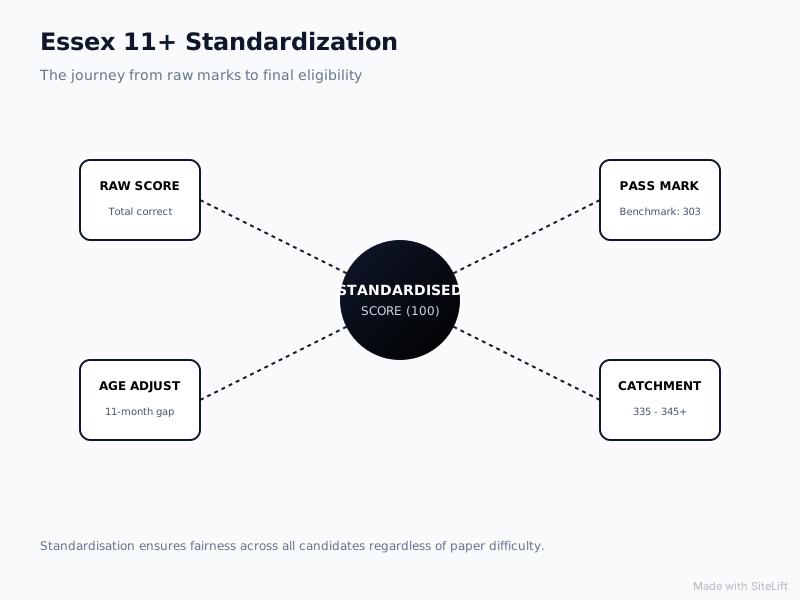
At its core, Essex 11+ standardization converts raw test marks into a normalized scale. When candidates sit the English and Mathematics papers set by the CSSE, raw marks simply record how many questions were answered correctly. Standardisation transforms these raw figures so that results can be fairly compared across different exam years and age groups.
Raw Marks vs. Standardised Scores Explained
A raw mark tells you how many points your child earned out of the total available marks on the paper. However, a raw mark of 40/60 in a year where the exam paper was exceptionally difficult might represent an outstanding achievement, whereas 40/60 on an easy paper might only be average. Standardised scores convert these raw numbers onto a standardized bell curve where the average (mean) score is set at 100 for each subject.
Why Simple Percentages Aren't Fair in CSSE Exams
If admissions were based purely on percentage scores, test difficulty would dictate entry standards. In a year with a difficult English paper, overall percentage scores across Essex would drop, unfairly reducing candidate pass rates. Standardisation eliminates this problem by measuring how far a child's performance deviates from the average performance of all children who took the exact same paper that day.
How Age-Standardisation Adjusts for Birth Month Differences
Children born in September are nearly a full year older than those born in the following August. Research published by the National Foundation for Educational Research (NFER) indicates that age-standardisation accounts for up to an 11-month developmental difference between the oldest and youngest children in an academic year cohort.
To offset this difference, the statistical model applies a slight upward scaling to younger candidates. A child born in August who scores the exact same raw mark as a child born in September will receive a slightly higher age-adjusted standardised score.
How Essex 11+ Standardization Calculates CSSE Marks
Understanding how the Consortium calculates final scores helps remove the mystery surrounding results day in October.
       [ Raw English Score ]  +  [ Raw Maths Score ]
                 │                         │
                 ▼                         ▼
       Statistical Standardisation (Mean = 100, SD = 15)
                 │                         │
                 ▼                         ▼
       [ Standardised Eng ]   [ Standardised Maths ]
                 │                         │
                 └───────────┬─────────────┘
                             ▼
               [ Aggregate CSSE Score ]
               (Target Threshold: 303+)
The CSSE Scoring Formula and Paper Weightings
The CSSE examination consists of two separate papers: English and Mathematics. Unlike some regions where papers carry equal raw weighting, the CSSE standardises each paper individually to a mean score of 100 with a standard deviation of 15. The two standardized scores are then added together to form an aggregated total standardised score out of a theoretical maximum (usually around 380–400).
The Role of the Mean and Standard Deviation
Standard deviation measures how widely student scores spread out around the average score. By setting a fixed standard deviation (typically 15 points), the CSSE ensures that roughly 68% of test-takers score between 85 and 115 on a single paper. Only the top candidates achieve standardised scores above 130 per paper.
Step-by-Step Example: From Raw Marks to Final Score
- Raw Mark Collection: A student scores 42/60 in English and 48/60 in Maths.
- Standardisation Mapping: Statistical software calculates where these raw marks fall compared to the entire Essex test cohort for that year.
- Age Adjustment: The software incorporates the child's exact birth date in years and months.
- Subject Score Generation: The child is awarded a standardised score of, say, 112 in English and 124 in Maths.
- Final Aggregation: The scores are combined to produce a total CSSE score of 236 (or mapped onto the combined CSSE scale around the 303 benchmark).

Understanding Essex Grammar School Cut-Off Scores and Pass Marks
Gaining a grammar school place depends heavily on how a child's final aggregate score compares with local school entry requirements.
What Is the Historical CSSE 'Passing Score' Threshold?
According to public admissions criteria from the Consortium of Selective Schools in Essex (CSSE), an aggregated standardised score of around 303 or higher has historically been considered the general benchmark for gaining a grammar school place in Essex. However, achieving 303 does not guarantee entry—it simply means the candidate has met the minimum selective standard required to be considered.
Catchment Area vs. Open Choice Score Differences
Cut-off scores vary significantly depending on whether you live within a school's designated priority catchment area:
- Catchment Applicants: Local children usually secure places at lower cut-off scores because schools prioritize community access.
- Out-of-Catchment (Open Choice) Applicants: Competition for non-catchment seats is intense. Historical CSSE admissions data shows that top-tier Essex grammar schools like King Edward VI Grammar School (KEGS) and Colchester Royal Grammar School (CRGS) often require out-of-catchment cut-off scores exceeding 335 to 345.
| Grammar School | Priority Catchment Cut-Off (Approx) | Out-of-Catchment Cut-Off (Approx) |
|---|---|---|
| King Edward VI Grammar School (KEGS) | ~335 | 345+ |
| Colchester Royal Grammar School (CRGS) | ~320 | 340+ |
| Colchester County High School for Girls (CCHSG) | ~320 | 338+ |
| Southend High School for Boys / Girls | ~303 - 310 | 325+ |
Key Factors That Cause Annual Cut-Off Score Fluctuations
Cut-off scores move up or down every year based on three major variables:
- Cohort Size: More applicants competing for the same number of seats drives cut-off scores upward.
- Score Distribution: If a cohort performs exceptionally well, the threshold score needed to rank in the top 120–180 candidates rises.
- Parental Choice Patterns: Changes in local housing growth or transport routes alter preference numbers for specific schools.
Infographic by SiteLift
Strategic Steps for Parents: Interpreting Your Child's October Score
Results are released in mid-October, well before the national Secondary Common Application Form (CAF) deadline on October 31st. Official guidelines from Essex County Council require parents to submit their final preferences by this date.
Reading the Official CSSE Results Notification
Your results sheet will state your child's individual standardised scores for English and Maths, along with their overall aggregated total score. It will also indicate whether your child achieved the 303 benchmark threshold.
Assessing Realistic Chances for Priority Grammar Schools
Compare your child’s total score against the historical cut-off scores for your target schools over the past 3–5 years:
- Comfortably Above Historical Cut-Off: Name the school as your top preference on the CAF.
- Within 3–5 Points of Historical Cut-Off: Still worth listing as a high preference, provided you also include realistic non-selective backup choices lower down the form.
- Well Below Historical Cut-Off: Consider putting local comprehensive options higher on your list to avoid wasting a preference slot.
Pro Tip: Always list schools on your CAF in order of your true preference. Secondary admissions operate on an equal-preference system, meaning schools are not told where you ranked them when allocating places.
How to Use Mock Exam Scores to Target Weaker Areas
During revision, raw mock test percentages give vital clues about where your child is dropping points. Tracking raw performance across individual maths topics highlights specific areas needing improvement before exam day.
How Targeted CSSE Practice Helps Maximize Your Standardised Score
Because Essex 11+ standardization ranks children relative to their peers, every single raw mark earned moves your child further up the percentile curve.
Why Accuracy and Speed Drive High Raw Scores in Maths
The CSSE Maths paper demands both speed and problem-solving flexibility. Children who master mental arithmetic and rapid problem comprehension make fewer unforced errors under timed exam conditions. Gaining just 3 or 4 extra raw marks in the maths paper can lift a child's standardized score by 8 to 10 points on the final curve.
Targeting Key CSSE Maths Topics for High Point Yields
To maximize raw score returns, focus revision on frequently assessed CSSE maths topics:
- Multi-step word problems involving fractions, decimals, and percentages
- Algebraic equations and sequence pattern recognition
- Perimeter, area, and compound geometric shapes
- Applied data representation and probability charts
Pro Tip: Encourage your child to tackle multi-step algebra and word problems daily. CSSE papers regularly feature extended problem-solving questions where systematic working earns crucial partial credit.
Prepare Your Child with Exam-Authentic Practice
Understanding the mechanics of standardisation is only half the battle—building your child's raw mark confidence is what ultimately secures a top score.
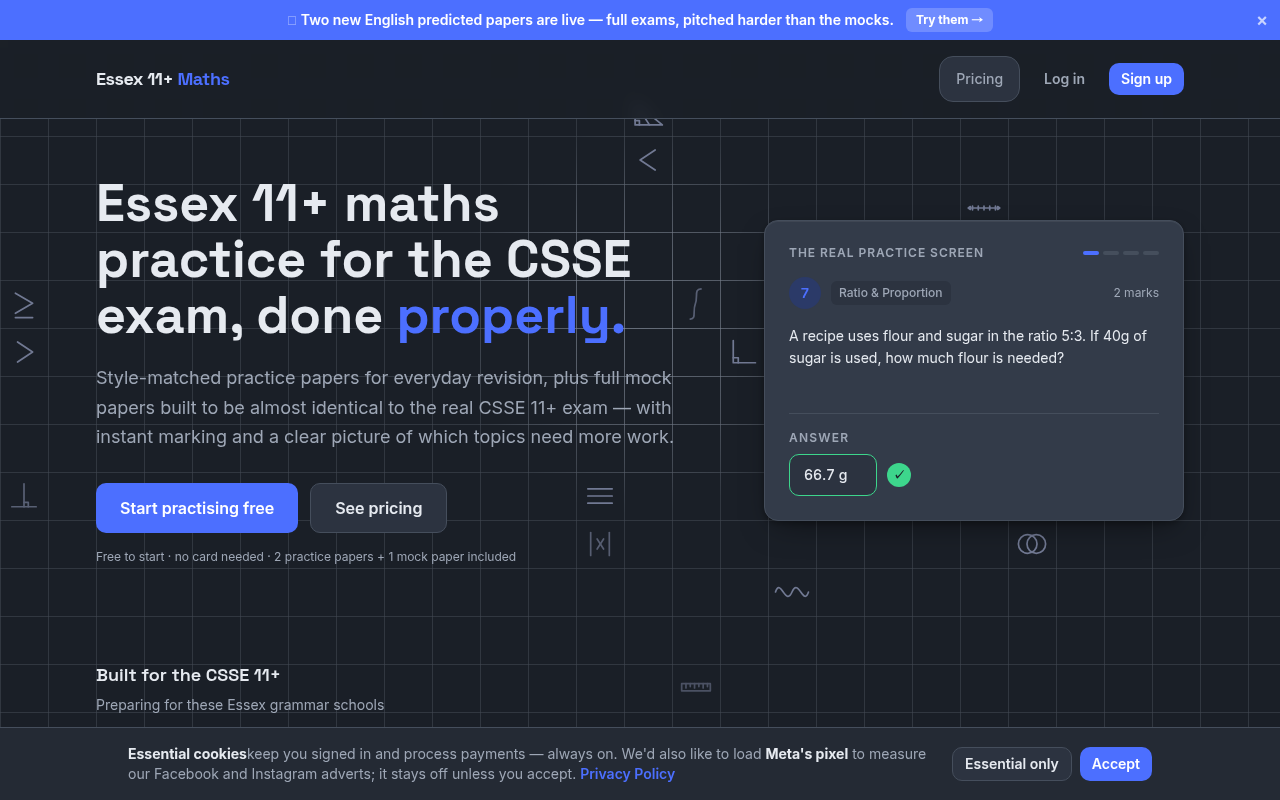
At Essex 11+ Maths Practice for the CSSE Exam, we provide style-matched revision materials designed specifically for the Essex CSSE paper structure. Our platform offers realistic online practice papers, worked step-by-step solutions, and immediate topic tracking to identify weak spots before exam day.
You can start practicing completely free, or explore our flexible monthly and annual plans on our Pricing | Essex 11+ Maths Practice page to give your child the ultimate preparation advantage.
— essex11mathspractice.co.uk
Frequently Asked Questions
What is a competitive standardized score for the Essex CSSE 11+?
While an aggregate score of 303 is the historical baseline qualifying threshold, competitive scores vary by school. Local catchment seats at Southend or Westcliff grammar schools often require scores between 305 and 315. Top open-choice schools like KEGS or CRGS generally require out-of-catchment scores between 335 and 345+.
Is a child born in August given extra marks on the Essex 11+ exam?
Age-standardisation does not add a fixed number of extra marks to a summer-born child's test score. Instead, the statistical algorithm evaluates a child's raw performance against other candidates of the exact same age in years and months, scaling the final standardized score slightly to ensure fairness.
How are raw marks calculated into the total CSSE standardised score?
Raw marks from the English and Maths papers are statistically adjusted using the mean and standard deviation of the entire candidate cohort that year. Each paper is standardized to a mean score of 100, age-adjusted, and then combined to form the total aggregate CSSE score.
What is the maximum achievable standardised score on the CSSE 11+?
Because standardisation is based on statistical distribution, the exact theoretical maximum varies slightly each year. However, maximum scores generally top out between 380 and 400 for a perfect performance across both papers.
Can a child pass the 11+ with a low mark in one paper if the other is high?
Yes. The CSSE system uses an aggregated total score. A student who scores lower on the English paper can still achieve a qualifying score above 303 if their Maths score is sufficiently high to pull up the total combined result.