Cubes and Nets: Master 3D Reasoning for the CSSE Maths Paper
Cubes and Nets: Master 3D Reasoning for the CSSE Maths Paper
When Year 6 pupils face spatial reasoning questions on the Essex 11+, their confidence often wobbles. Spatial visualization questions involving cubes and nets present a unique challenge: unlike standard arithmetic or long division, you cannot simply grind out an answer with a rote algorithm. Instead, children must mentally fold, twist, and manipulate two-dimensional patterns into three-dimensional solids under strict exam conditions.
In the Consortium of Selective Schools in Essex (CSSE) Maths paper, spatial reasoning is not tucked away in a separate non-verbal reasoning test. It sits directly inside the mathematics paper. According to data published by the Consortium of Selective Schools in Essex, over 6,000 pupils sit the 11+ examination each year, competing for roughly 1,000 grammar school places across Essex. With qualifying thresholds routinely separated by fractions of a mark, dropping two or three marks on a tricky 3D net question can make all the difference.
Mastering cubes and nets does not require natural-born spatial genius. It comes down to systematic rules, reliable elimination techniques, and disciplined visual habits. This step-by-step tutorial will teach your child how to spot valid nets instantly, track opposite faces, and solve shaded rotation puzzles with total accuracy.
Prerequisites: What You Need to Know Before Tackling Cubes and Nets
Before jumping into complex rotations, your child needs a firm grip on fundamental geometric properties and the right toolset for paper practice.
Core KS2 Properties: Faces, Vertices, and Edges
At Key Stage 2, children are introduced to the core components of three-dimensional solids. As outlined in the BBC Bitesize Key Stage 2 Maths curriculum guide, a standard cube has:
- 6 flat square faces of identical size.
- 12 straight edges of equal length.
- 8 vertices (corners where three edges meet).
Understanding these numbers is non-negotiable. If an exam question presents a net with five or seven squares, it cannot form a closed cube. If two edges that are meant to fold together have unequal lengths, the net is invalid. Reinforcing these foundational 3D shapes nets KS2 properties prevents silly mistakes before mental folding even starts.
The CSSE Paper Context: Why 3D Spatial Reasoning Matters
According to Department for Education (DfE) Key Stage 2 assessment statistics, approximately 73% of pupils met the expected standard in mathematics in 2023, yet spatial reasoning and shape properties remain among the lowest-scoring reasoning strands nationally.
Primary schools often push 3D geometry to the summer term of Year 6—long after the September 11+ exam has taken place. The CSSE Maths paper tests spatial agility under real time pressure, frequently embedding open-ended, multi-step nets questions that demand written workings rather than simple multiple-choice guesses.
To work through this guide at home, prepare:
- Squared grid paper (1 cm or 0.5 cm).
- A pencil and ruler.
- Scissors and tape (for physical validation when learning).
- A standard six-sided die.
Step 1: Categorise Valid Cubes and Nets Using Simple Grouping Rules
There are exactly 11 valid nets of a cube. Many tutoring resources tell children to "just imagine folding them", which invariably leads to mental exhaustion during a timed test. Instead, teach your child to classify the nets of a cube Year 6 curriculum expectations require into four recognizable visual families.
The '1-4-1' Pattern Family (6 Variants)
The 1-4-1 family is the most common and easiest to remember. It features a central horizontal spine of 4 squares in a straight row, with 1 square attached to the top edge and 1 square attached to the bottom edge.
- The 4 squares in the row wrap around to form the four vertical walls of the cube.
- The top and bottom squares fold inward to form the roof and floor.
- As long as there is one square on top and one square on the bottom, their specific horizontal positions can shift. This produces 6 distinct configurations.
Example of a 1-4-1 Net:
    [ ]
[ ][ ][ ][ ]
        [ ]
The '1-3-2' and '2-2-2' Families (4 Variants)
The next families break the central spine into shorter runs:
- The 1-3-2 Family (3 variants): A spine of 3 squares in a row, with 1 square on one side and a block of 2 squares on the other.
- The 2-2-2 Family (1 variant): Often called the "steps" or "zigzag" pattern. It consists of three parallel pairs of squares staggered diagonally.
Example of a 1-3-2 Net:      Example of a 2-2-2 Net:
    [ ]                          [ ][ ]
[ ][ ][ ]                           [ ][ ]
       [ ][ ]                          [ ][ ]
The '3-3' Stairs Pattern (1 Variant)
The final valid configuration is the 3-3 family. It consists of two parallel rows of three squares offset by exactly one square, resembling a chunky pair of stairs.
The 3-3 Net:
[ ][ ][ ]
   [ ][ ][ ]
Pro Tip: Teach your child the "Instant Disqualification" rules. A net can NEVER fold into a cube if it contains:
- 5 or more squares in a single line.
- A 2x2 solid block of 4 squares (these will bunch up and overlap).
- More than 2 squares sharing a single fold line on one side of a spine.
Step 2: Master Cubes and Nets with the 'Skip-One' Rule for Opposite Faces
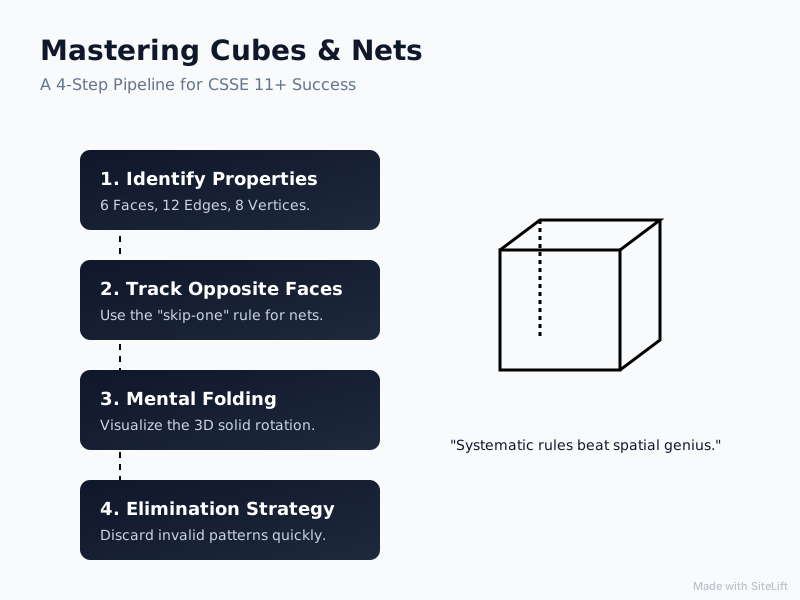
Once your child knows whether a shape folds into a cube, the next task is determining which faces land opposite each other. The Skip-One Rule is the fastest, most reliable shortcut in cube net reasoning 11+.
Finding Straight-Line Opposites
In any straight run of three or four squares within a net, two faces separated by exactly one square will always end up directly opposite each other on the folded cube.
Infographic by SiteLift
| Line Configuration | Square 1 | Square 2 | Square 3 | Square 4 | Resulting Opposites |
|---|---|---|---|---|---|
| Row of 3 | Face A | Middle | Face B | — | Face A is opposite Face B |
| Row of 4 | Face A | Face C | Face B | Face D | A is opposite B; C is opposite D |
Consider a standard horizontal row of four squares labelled 1, 2, 3, 4:
- Square 1 skips Square 2 and lands opposite Square 3.
- Square 2 skips Square 3 and lands opposite Square 4.
Children do not need to mentally fold these faces. They simply trace the straight line, skip the adjacent square, and pair them up.
Navigating Corners to Find Perpendicular Opposites
What about the outer tabs that do not sit in a straight row of four? When a tab folds 90 degrees around a central row, it pairs with the opposite tab on the other side.
To prove this:
- Identify and label your first pair of opposites using the Skip-One Rule on the main row (e.g., mark them both A).
- Identify the second straight-line pair (mark them both B).
- The remaining two unpaired squares—no matter where they sit on the outer edges—must be opposite each other (mark them both C).
This process of elimination eliminates 90% of spatial guesswork within seconds.
Step 3: Visualise Edge and Vertex Connections Under Rotation
CSSE questions often test beyond simple opposite faces. They ask: "Which edge meets edge X?" or "Which three faces share vertex Y?" Solving these requires deliberate visualising nets practice.
Tracking Corner Junctions (Where 3 Faces Meet)
Every corner (vertex) of a folded cube is created by three distinct faces coming together. On a flat 2D net, any corner where two squares meet at an internal 90-degree right angle will "zipper" together when folded.
       [ B ]
       [ A ][ C ]
In the corner between Face B and Face C, the right edge of Face B and the top edge of Face C will fold up toward each other until their edges touch. The inner corner shared by Faces A, B, and C becomes a single vertex.
Edge-Matching Techniques for Complex Folds
To track edges without physical scissors, use the Number Walking technique:
- Pick an internal corner where two edges meet at 90 degrees. Label these matching edges 1 and 1.
- "Walk" outward along the perimeter of the net.
- The next exterior edge along the first branch will pair with the next exterior edge along the second branch. Label them 2 and 2.
By stepping around the boundary of the net one edge at a time, your child can systematically label every edge pair without getting lost in 3D space.
A research study published by the British Journal of Educational Psychology demonstrated that targeted spatial reasoning training significantly improves overall performance in mathematical problem-solving among children aged 10–11. Practising edge-matching on paper directly strengthens the neural pathways responsible for this mental manipulation.
Step 4: Solve Patterned and Shaded Cube Reasoning Problems
The toughest questions on the Essex 11+ Maths paper do not use blank nets; they use faces marked with symbols, diagonal stripes, shading, or dice pips.
Tracking Orientation of Symbols (Arrows, Diagonals, Dots)
A common trap involves directional symbols, such as an arrow pointing toward a specific edge. When the net folds, the direction the arrow points changes relative to the viewer.
Follow this 3-step checklist to verify symbol alignment:
- Check Opposites First: Does the 3D drawing show two symbols visible at the same time that should be on opposite faces? If Face A and Face B are opposite on the net, they can never both be visible on a standard 3D drawing showing three faces. Eliminate invalid options immediately.
- Anchor the Base: Pick one complex face (e.g., a diagonal slash) and treat it as the stationary "floor".
- Fold Adjacent Faces Inward: Mentally bring the adjacent wall up toward the base. Ask: Does the diagonal line touch the corner of the adjacent face, or the flat edge? Trace the point of contact directly on the paper.
The CSSE Dice Numbering Rule (Opposite Faces Sum to 7)
Examiners love dice questions. Standard dice follow a universal mathematical rule: opposite faces must add up to 7.
- 1 is always opposite 6 ($1 + 6 = 7$)
- 2 is always opposite 5 ($2 + 5 = 7$)
- 3 is always opposite 4 ($3 + 4 = 7$)
If the CSSE paper states that a net represents a standard die, your child does not need to guess the numbers. They apply the Skip-One Rule from Step 2: if face 2 is on Square 1, Square 3 must be 5.
Pro Tip: If a question shows three visible faces of a standard die displaying 3, 4, and 6, the drawing is mathematically impossible! Because 3 and 4 add to 7, they are opposite faces and can never be seen at the same time.
Why Spatial Reasoning is the Secret Differentiator in the Essex 11+
In my experience tutoring students through the Essex grammar school admissions process, parents spend months drilling fractions, percentages, and algebra, while largely ignoring 3D geometry. That is a tactical mistake.
Arithmetic questions test speed and precision, but spatial reasoning tests cognitive adaptability. When examiners place a complex shaded cube question halfway through a 50-minute paper, it acts as a speed bump designed to disrupt momentum. Children who rely on vague "gut feel" freeze up, waste four valuable minutes trying to visualise the shape, and panic.
Children who possess a systematic framework—identifying the net family, applying the Skip-One Rule, and running edge elimination—solve the problem in under 45 seconds. They bank the marks and preserve their mental energy for the open-ended word problems at the end of the test.
Troubleshooting Common Pitfalls in 11+ Cube Net Questions
Even well-prepared students stumble on specific recurring optical illusions. Keep an eye out for these three exam-day pitfalls:
1. The 'Overlapping Flap' Optical Illusion
When a net looks almost like a classic cross, children often assume it folds correctly. However, if two outer tabs sit directly across from one another on adjacent spine squares, they will fold into the exact same spatial plane. The cube will have a double-thickness wall on one side and a gaping hole on the other. Always check that outer tabs alternate or balance properly across the spine.
2. Misjudging Rotational Symmetry Under Exam Pressure
Nets presented diagonally on the page (rotated at a 45-degree angle) frequently disorient Year 6 pupils. The human brain struggles to apply horizontal rules to tilted axes.
- The Fix: Teach your child to physically turn their exam paper until the spine of the net sits completely horizontal or vertical before attempting to fold it.
3. Over-Relying on Mental Folding Instead of Thumbnail Sketching
When working under adrenaline, purely mental folding breaks down. If a problem involves rotating a cube twice (e.g., "rolled forward, then rolled right"), relying solely on memory is risky. Encourage your child to spend 10 seconds drawing a quick 2D cross thumbnail on their working paper, tracking the face letters after each roll.
Expected Outcome and Next Steps for CSSE Maths Success
By working through the steps in this guide, your child should now be able to:
- Recognise and validate the 11 standard cube nets within 10 seconds.
- Pair opposite faces instantly using the Skip-One Rule.
- Trace shared vertices and edges using coordinate walking.
- Detect contradictory faces on standard dice problems without hesitation.
Timed Practice Drills for Cube Net Reasoning 11+
To transition these skills from conscious techniques into second-nature exam habits, implement this two-week revision structure:
- Week 1 (Concrete to Pictorial): Print out blank grids of all 11 valid nets and 5 common invalid nets. Have your child cut them out, predict whether they will close, identify opposites using colour markers, and physically fold them to verify.
- Week 2 (Pictorial to Abstract): Shift entirely to on-paper timed drills. Give your child sets of four 3D cube perspectives and ask them to determine which corresponds to a flat, patterned net within 30 seconds per question.
If you want exam-authentic materials specifically tailored to the Essex format, explore the diagnostic tools at Essex 11+ Maths Practice. Our platform offers style-matched practice questions, full-length CSSE mock tests, and detailed topic tracking that pinpoints spatial reasoning gaps before exam day. You can review our clear pricing options to find the right preparation plan for your family.
— essex11mathspractice.co.uk
FAQ
How many nets of a cube are there, and do 11+ students need to learn all of them?
There are exactly 11 valid nets of a cube. While students do not need to memorize every shape in isolation, they should learn the four core structural families: the 1-4-1 pattern (6 variants), the 1-3-2 pattern (3 variants), the 2-2-2 pattern (1 variant), and the 3-3 pattern (1 variant). Grouping them this way allows pupils to recognise any valid net instantly.
What is the easiest way for a Year 6 child to visualise folding a cube net mentally?
The easiest method is using the "Skip-One Rule" rather than trying to construct the 3D solid all at once. In any straight line of squares, faces separated by one square are always opposite. By identifying two opposite pairs first, the remaining two faces must naturally form the final opposite pair, removing the need for complex mental gymnastics.
How do cube net questions appear in the Essex CSSE Maths paper compared to standard GL or CEM exams?
GL and CEM tests typically use multiple-choice formats where students select one matching cube from four or five options. The CSSE Maths paper often features open-ended questions where pupils must draw missing faces on an incomplete net, calculate missing values using dice rules, or write down the letters of opposite faces with full mathematical reasoning.
What should my child do if they get stuck on a 3D rotation question during the exam?
If your child feels stuck, they should stop trying to fold the entire cube mentally. Instead, they should find one clear landmark face (like a distinct symbol or shaded square) and look at its immediate neighbour. By eliminating answer options where impossible opposites appear together, they can often reduce a 4-choice problem down to a single remaining option without full mental rotation.