Cube Numbers for the 11+: Fast Recall Tricks and CSSE Practice Questions
Cube Numbers for the 11+: Fast Recall Tricks and CSSE Practice Questions
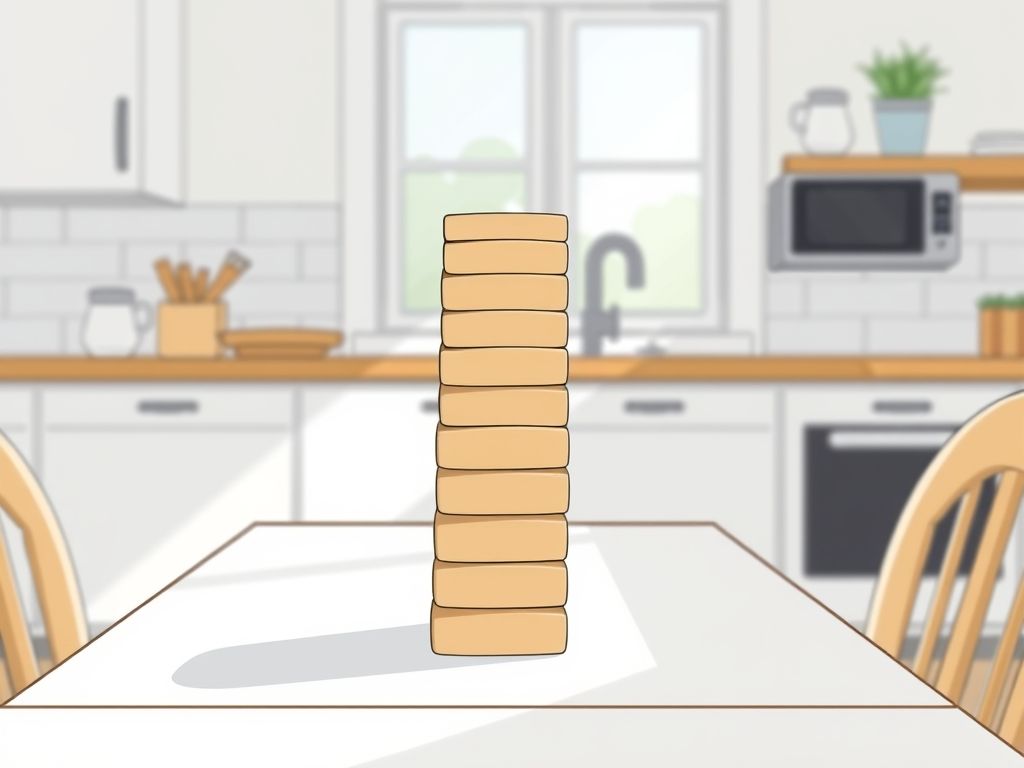
If your child freezes when they see $4^3$ or $6^3$ in a paper, they are not alone. A cube number looks tiny on the page but it can steal precious minutes in the CSSE 11+ if it is not fluent.
I have seen bright Year 5 pupils lose marks not because they cannot reason, but because they stop to work out $5 \times 5 \times 5$ from scratch. This guide fixes that. You will get a clear definition, the full cube numbers list to 10, tricks for how to find cube numbers quickly, the square and cube numbers Year 5 comparison schools teach, and five CSSE-style questions with worked solutions.
What Is a Cube Number? A Simple Definition for 11+ Success
What does 'cubed' actually mean in maths?
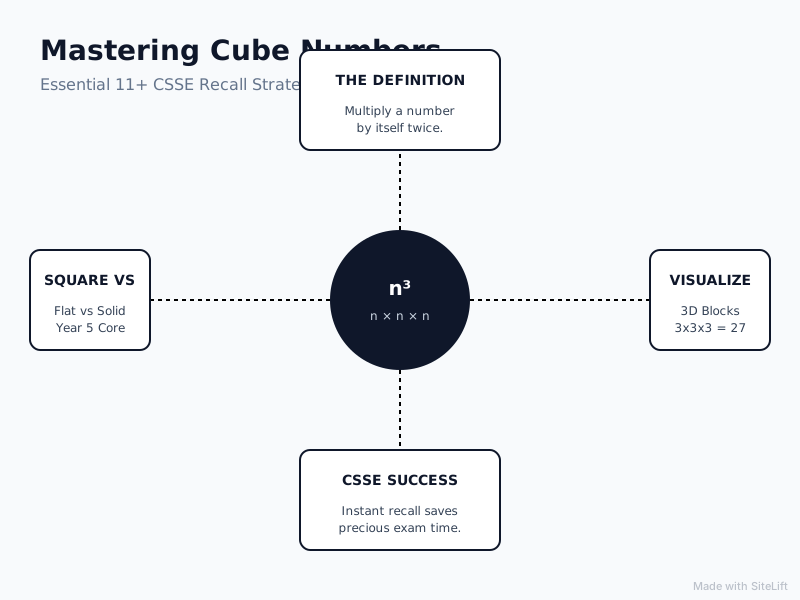
A cube number is what you get when you multiply a whole number by itself, then by itself again:
n cubed = n × n × n
We write it with a small 3: $n^3$. So $3^3$ means $3 \times 3 \times 3 = 27$.
That little 3 tells you to multiply twice, not just once. This is the number one source of confusion in 11+ maths number facts practice.
How to visualise cube numbers with building blocks
Grab some interlocking cubes if you have them. For $3^3$:
- Make a flat $3 \times 3$ square — that is 9 cubes.
- Stack three of those layers on top of each other.
- You now have a solid $3 \times 3 \times 3$ block with 27 small cubes.
That is why we call it cubed. Squared numbers make a flat square. Cubed numbers make a solid cube. Once children see it, the vocabulary sticks.
For extra visual practice, the BBC Bitesize KS2 Maths revision hub has short videos that show squares as flat shapes and cubes as blocks.
Why do cube numbers matter for the CSSE 11+?
The CSSE maths paper is non-calculator, tightly timed and rewards instant recall. If you know that $7^3 = 343$ without working, you can spend your thinking time on the actual problem — sequences, volume, or two-step reasoning.
Number fluency matters more broadly, too. According to the 2024 Key Stage 2 attainment statistics, 73% of pupils met the expected standard in maths in 2024. In a selective test like the CSSE, you are competing well above that average, so shaky times tables and cubes stand out quickly.
What Is the Cube Number List to 10 Every 11+ Pupil Should Memorise?
The essential cube numbers list to 10 with answers
For the CSSE, learn these cold to 10. Say them aloud, write them from memory, then cover and repeat.
| n | $n^3$ calculation | Answer |
|---|---|---|
| 1³ | 1 × 1 × 1 | 1 |
| 2³ | 2 × 2 × 2 | 8 |
| 3³ | 3 × 3 × 3 | 27 |
| 4³ | 4 × 4 × 4 | 64 |
| 5³ | 5 × 5 × 5 | 125 |
| 6³ | 6 × 6 × 6 | 216 |
| 7³ | 7 × 7 × 7 | 343 |
| 8³ | 8 × 8 × 8 | 512 |
| 9³ | 9 × 9 × 9 | 729 |
| 10³ | 10 × 10 × 10 | 1000 |
Print that table and stick it on the fridge for a week. Research from the Education Endowment Foundation highlights retrieval practice and spacing as high-impact strategies for retaining number facts, which is why little-and-often testing beats one long cram session. You can read more in their teaching and learning toolkit on retrieval practice.
Should you learn cubes to 12 or 15 for stretch questions?
Core recall to 10 is enough for almost every CSSE question. For confident pupils aiming for top grammar-school scores, add:
- $11^3 = 1331$
- $12^3 = 1728$
You do not need to go to 15. Time is better spent on applying cubes to 10 in sequences and volume problems.
Fast recall tricks: 5 cubed and 10 cubed anchors, odd and even patterns
Pro Tip: Anchor on 5³ = 125 and 10³ = 1000. Everything else sits between them. If an answer for 6³ comes out as 126 or 1216, you know instantly it is wrong.
Three patterns my pupils love:
- Odd stays odd, even stays even. The cube of an odd number is always odd (27, 125, 343). The cube of an even number is always even (8, 64, 216). Use it to eliminate multiple-choice distractors.
- Last-digit patterns repeat. $4^3$ ends in 4, $6^3$ ends in 6, $9^3$ ends in 9. If you work out $7^3$ and get an even answer, you have slipped.
- 0 and 1 are special. $0^3 = 0$ and $1^3 = 1$. Examiners love to slip these into sequences because children overthink them.
How to Find Cube Numbers Quickly Without a Calculator?
Step-by-step method: multiply twice and check
Teach this exact routine for how to find cube numbers under pressure:
Example 1: $4^3$
- First multiply: $4 \times 4 = 16$
- Multiply again: $16 \times 4 = 64$
- Sense-check: even × even × even must be even. 64 fits.
Example 2: $6^3$
- First multiply: $6 \times 6 = 36$
- Multiply again: $36 \times 6 = 216$ (30 × 6 = 180, 6 × 6 = 36)
- Sense-check: answer should be between $5^3$ (125) and $10^3$ (1000). 216 fits.
Pro Tip: Always do the square part first. If you know squares to 10 × 10 fluently, cubes become a one-step extension rather than a new topic.
This links directly to the Year 4 Multiplication Tables Check, which according to the Department for Education is designed to ensure pupils have fluent recall of number facts to support progression to upper Key Stage 2 topics such as square and cube numbers.
How to find cube roots and estimate answers in exam conditions?
A cube root is the inverse. It asks: which number was cubed to make this?
- $\sqrt[3]{125} = 5$ because $5^3 = 125$
- $\sqrt[3]{64} = 4$ because $4^3 = 64$
- $\sqrt[3]{1000} = 10$ because $10^3 = 1000$
The CSSE rarely uses the $\sqrt[3]{}$ symbol, but it tests the same idea in words: “Which number cubed gives 343?”
For estimation, bracket between anchors. Is 400 closer to $7^3$ (343) or $8^3$ (512)? It is closer to 343, so the cube root of 400 is just over 7.
Are calculators allowed in the CSSE 11+ maths paper?
No. The CSSE maths paper is non-calculator. That is why the Essex 11+ (CSSE) Maths & English Practice guide stresses mental methods and clear written layout.
Show both multiplications on paper. It takes two seconds and prevents the classic error of doing $4 \times 3 = 12$ instead of $4 \times 4 \times 4$.
What Is the Difference Between Square and Cube Numbers in Year 5 and Year 6?
Square and cube numbers side-by-side comparison
Children often learn square and cube numbers Year 5 together, which is helpful — until they mix them up.
Infographic by SiteLift
| n | Squared ($n^2 = n \times n$) | Cubed ($n^3 = n \times n \times n$) |
|---|---|---|
| 2 | 4 | 8 |
| 3 | 9 | 27 |
| 4 | 16 | 64 |
| 5 | 25 | 125 |
| 6 | 36 | 216 |
| 7 | 49 | 343 |
| 8 | 64 | 512 |
| 9 | 81 | 729 |
| 10 | 100 | 1000 |
Think: squared = flat (2D), cubed = solid (3D). Squared needs two copies of the number. Cubed needs three.
For mastery-style tasks that stretch this understanding, I often point parents to NRICH enrichment tasks on squares and cubes from the University of Cambridge.
Why do pupils mix up square and cube numbers?
Three errors come up again and again in marking:
- $3^3 = 9$ (they squared instead of cubing)
- $3^2 = 27$ (they cubed instead of squaring)
- $2^3 = 6$ (they did $2 \times 3$ instead of $2 \times 2 \times 2$)
The fix is language. Insist on saying “three cubed equals three times three times three” aloud, not just “three cubed equals 27.”
How does the National Curriculum cover square and cube numbers in Year 5?
In England, Year 5 pupils are expected to recognise and use square numbers and cube numbers, and the notation $^2$ and $^3$. You can see the exact objective in the national curriculum mathematics programmes of study.
That Year 5 foundation is assumed in Year 6 SATs and absolutely assumed in the 11+. The gap is stark later on: according to what numeracy means for everyday life, around half of working-age adults in England have numeracy levels at or below those expected of primary school children. Early fluency now saves a lot of pain later.
How Is a Cube Number Tested in the CSSE 11+ Maths Exam?
CSSE questions rarely say “write down $6^3$.” They hide the cube number inside sequences, missing-number boxes and volume word problems.
Here are five exam-authentic styles to practise:
Q1. Missing number
$\Box^3 = 64$
Solution: Ask “what times itself three times makes 64?” $4 \times 4 \times 4 = 64$, so the missing number is 4.
Q2. Sequence
1, 8, 27, 64, ___
Solution: These are $1^3, 2^3, 3^3, 4^3$. Next is $5^3 = 125$.
Q3. True or false reasoning
Mia says $2^3$ is double $2^2$. Is she correct? Explain.
Solution: No. $2^2 = 4$, $2^3 = 8$. Doubling 4 does give 8 here, but her reasoning fails generally. For example, $3^2 = 9$, double is 18, but $3^3 = 27$. She multiplied by 2 instead of multiplying by 2 again ($4 \times 2$ vs $4 \times 2$ looks the same here by coincidence — test with 3 to see the difference).
Q4. Volume of a cube
A storage cube has edges of 5 cm. What is its volume?
Solution: Volume of a cube = edge³. $5^3 = 5 \times 5 \times 5 = 125 cm³$. Do not forget the cubed units.
Q5. Two-step trap
Find the difference between $4^3$ and $4^2$.
Solution: $4^3 = 64$, $4^2 = 16$. Difference = $64 - 16 = 48$. The trap is rushing and doing $4 \times 3$ and $4 \times 2$.
Common traps: 0 cubed, 1 cubed and volume-of-a-cube word problems
Watch for:
- $0^3$ and $1^3$ in sequences — they look too easy, so pupils second-guess.
- Questions that say “squared” but children read “cubed” under time pressure. Underline the word.
- Volume questions that give edge in cm but ask for answer — many forget cm³.
Next steps: test yourself with exam-authentic timed practice
Knowing the list is step one. Recalling it in 30 seconds inside a mixed paper is step two.
That is exactly what essex11mathspractice.co.uk is built for — style-matched CSSE maths questions with instant marking, worked solutions and topic tracking, so you can see whether cubes, sequences or volume is the weak spot. Start free and build up to relaxed papers, then full mocks.
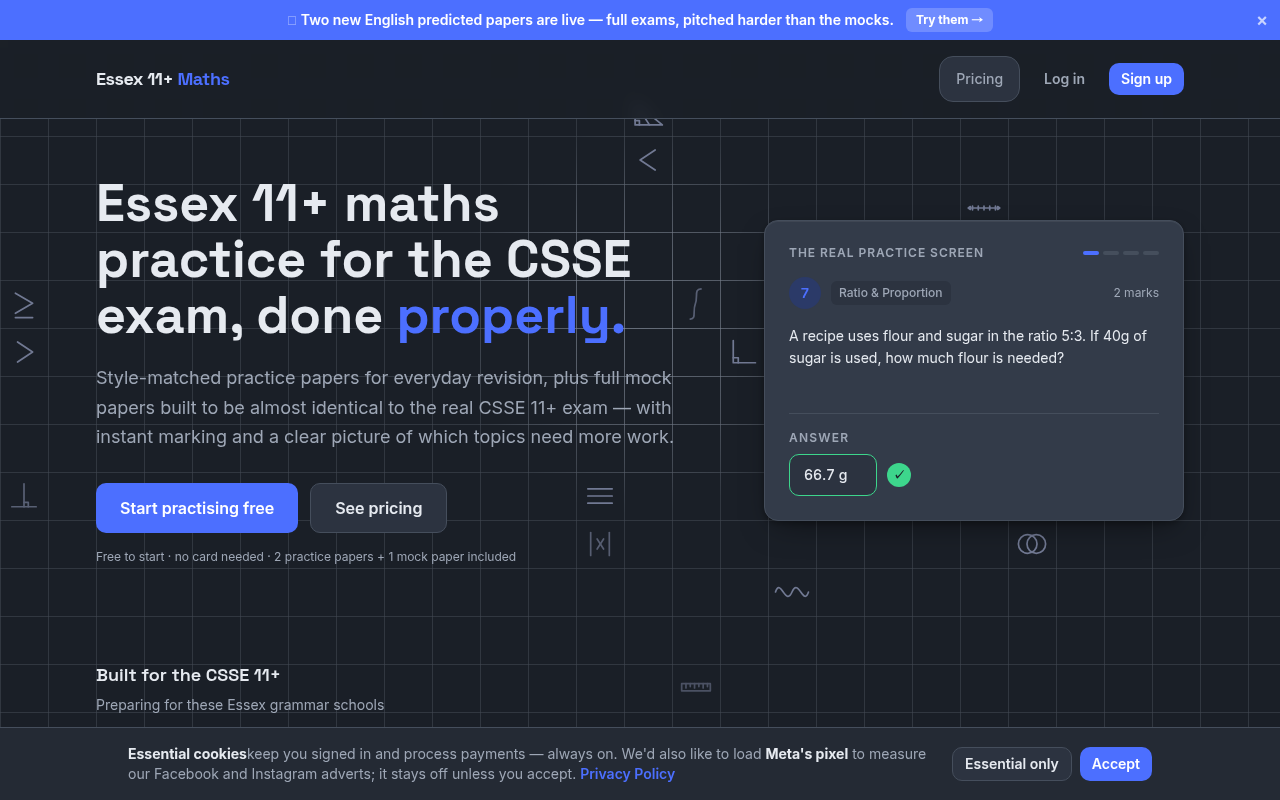
You can also check pricing for full CSSE maths and English access — free practice is forever free, with full access from £9.99/month.
Key Takeaways
| What to remember | Detail |
|---|---|
| Definition | Cube number = n × n × n, written $n^3$ |
| Must-memorise list | 1, 8, 27, 64, 125, 216, 343, 512, 729, 1000 |
| Anchors | $5^3 = 125$, $10^3 = 1000$ |
| Squares vs cubes | $3^2 = 9$ (flat), $3^3 = 27$ (solid) |
| CSSE method | Multiply twice, show working, no calculator |
| Biggest traps | Mixing squared/cubed, $2^3 = 2 \times 3$, forgetting cm³ |
My View: Why Cube Number Fluency Is Underrated for the 11+
I will be honest: when parents ask me what to prioritise, they expect me to say fractions, algebra or wordy problem-solving. I say cubes, squares and times tables first.
Here is why from marking hundreds of papers. A child who knows their 11+ maths number facts cold walks into the CSSE calm. They spot 27, 64, 125 instantly as cubes, they do not burn three minutes on $8 \times 8 \times 8$, and they have brain space left for the tricky bit — interpreting the question.
I teach cubes as a confidence trick, not a chore. Two minutes a day of rapid recall, a silly mnemonic for 7³ = 343 (“lucky 7s, 3-4-3”), and always linking back to volume with real boxes. In my experience, that beats an hour of weekend drilling every time. Fluency first, fancy reasoning second — the scores follow.
FAQ
What is a cube number in simple terms?
A cube number is a number multiplied by itself twice. For example, 27 is a cube number because $3 \times 3 \times 3 = 27$. We write it as $3^3$ and say “3 cubed.” You can picture it as a solid cube made from small building blocks.
What are the first 10 cube numbers?
The first 10 cube numbers are 1, 8, 27, 64, 125, 216, 343, 512, 729 and 1000. These correspond to $1^3$ through to $10^3$. For the 11+, memorise this cube numbers list to 10 so you can recall any of them in under five seconds.
How do you find a cube number quickly?
Multiply the number by itself, then multiply the answer by the number again. For $6^3$, do $6 \times 6 = 36$, then $36 \times 6 = 216$. Knowing squares to 10 helps a lot, and anchoring on $5^3 = 125$ and $10^3 = 1000$ lets you sense-check.
What is the difference between square and cube numbers?
A square number uses a number twice ($5^2 = 5 \times 5 = 25$) and makes a flat square. A cube number uses it three times ($5^3 = 5 \times 5 \times 5 = 125$) and makes a solid cube. The common mix-up is thinking $3^3 = 9$ — that is $3^2$.
Do I need to know cube numbers for the 11+ and CSSE exam?
Yes. You need instant recall to 10 for sequences, missing-number questions and volume of a cube. The CSSE paper is non-calculator, so examiners expect you to know $4^3 = 64$, $5^3 = 125$ and similar facts without working from scratch.
— essex11mathspractice.co.uk