20 Minutes to Pass CSSE Writing Tasks in Essex, Checklist and Plan
20 Minutes to Pass CSSE Writing Tasks in Essex, Checklist and Plan

The CSSE continuous writing section is two short, exam-style tasks answered in about 20 minutes. Aim for tightly controlled six to seven sentence responses that show sensory detail, clean punctuation and a clear sense of purpose. Length loses to accuracy here: examiners reward control, not word count. Get that balance right and both tasks are genuinely manageable within the time you have.
TL;DR:
- Focusing on the task, using varied, precise sentences, and controlling vocabulary and grammar are essential for high-scoring responses with only six to seven sentences.
- Practice should include short, timed exercises addressing different prompt types like description, instructions, or storytelling, emphasizing clear structure and sensory detail.
- Self-marking with targeted feedback on focus, sentence variety, vocabulary, and SPaG helps improve writing quality more effectively than broad corrections.
- Authentic past papers and mark schemes from CSSE provide the most accurate practice, as they reflect real exam timing, prompts, and marking criteria.
- Regular, short practice sessions with immediate feedback and simulated exam conditions develop the self-management and stamina needed for the timed writing tasks.
Table of Contents
- What CSSE writing tasks actually look like in the exam
- What examiners actually mark, turned into a coaching checklist
- Three worked examples: what a strong six-sentence answer looks like
- How to practise: a weekly routine that actually moves the needle
- Where to find official past papers and trusted practice material
- Essex perspective: practical notes for local families and tutors
- How Essex 11+ Maths Practice supports CSSE writing preparation
- Sources
- FAQ
What CSSE writing tasks actually look like in the exam
Candidates face two separate continuous writing prompts and must answer both, in their own words, inside a suggested 20 minutes for the whole section. The official continuous writing paper asks for roughly six to seven sentences per answer, which sounds short until a child tries to cram a full story into it under time pressure.
Prompt types repeat across published papers, so pattern recognition genuinely helps here. Expect one or more of these:
- Descriptive tasks: describe a place, object or character using sensory detail
- Instructive tasks: explain how to do something clearly and in order
- Narrative-from-image tasks: build a short story from a single picture
- Personal reflection tasks: write about an experience, feeling or opinion
Both questions sit within the wider 60-minute English paper, and the CSSE practice-material guidance confirms candidates can tackle continuous writing at any point during that hour. Some children prefer to get it out of the way first while their ideas are fresh; others save it for last once the comprehension section has warmed up their reading brain. Either approach works. What matters is knowing the section exists as a distinct block with its own time budget, rather than treating it as an afterthought squeezed into whatever minutes remain.
What examiners actually mark, turned into a coaching checklist
The CSSE sample mark scheme rewards five things consistently across its band descriptors: focus on the task, controlled vocabulary, accurate tense and grammar, a structured response with connectives, and varied punctuation. None of these require a long answer. They require a precise one.
A child who writes seven flawless, varied sentences will usually outscore one who writes fourteen rambling ones. Spelling, punctuation and grammar (SPaG) sit inside almost every band, which means a single misplaced apostrophe rarely sinks a response, but a pattern of comma splices or repeated basic errors will. Strong answers tend to vary their sentence openers, use at least one semicolon or colon correctly, and stick rigidly to the question asked. Weak answers drift off-topic, repeat the same sentence structure (“I saw… I saw… I saw…”) and rely on vague adjectives like “nice” or “big” instead of specific, chosen detail.

Pro Tip: Read the response aloud. If every sentence starts the same way, a child’s ear will catch it faster than their eye will on the page.
Here is a simple four-point rubric parents and tutors can apply to any practice answer:
- Focus (0 to 4): Does it answer the actual question, start to finish?
- Sentence variety (0 to 4): Are openers and connectives varied, not repetitive?
- Vocabulary and originality (0 to 4): Is word choice specific and imaginative rather than generic?
- SPaG (0 to 4): Are spelling, punctuation and grammar accurate and controlled?
That gives a score out of 16, which scales roughly against the published band descriptors. It is not an official CSSE tool, but it turns a vague “that’s quite good” into something a parent can actually use week on week.
Three worked examples: what a strong six-sentence answer looks like
Seeing the mark scheme applied to real writing makes it click faster than reading the descriptors alone. Here are three model answers, each annotated against what examiners actually reward.
-
Descriptive prompt: “Describe a stormy night.” “Rain hammered against the window like tiny fists demanding to be let in. The old oak outside bent and groaned, its branches scratching the glass with every gust. Somewhere down the street, a bin lid clattered across the pavement and rolled into darkness. I pulled my blanket tighter, though the cold had already found its way in. Lightning split the sky for half a second, painting the room silver. Then the thunder came, low and long, like the sky clearing its throat.” Six sentences, three senses used (sound, touch, sight), varied openers, and a simile that earns its place rather than showing off.
-
Instructive prompt: “Explain how to plant a seed.” “First, choose a small pot and fill it three-quarters full with soil. Next, press your finger gently into the centre to make a hole about two centimetres deep. Drop the seed in carefully, then cover it with a thin layer of soil. Water it slowly so the soil settles without washing the seed away. Place the pot somewhere warm and bright, such as a windowsill. Finally, check it daily and water it whenever the top layer feels dry.” Clear sequencing words, no wasted sentences, logical order throughout.
-
Narrative-from-picture prompt (image of an abandoned lighthouse). “The lighthouse stood alone, its paint peeling like old skin. Sara pushed open the rusted door, and it groaned as though waking from a long sleep. Dust hung in the air, catching the last light of evening. She climbed the spiral stairs two at a time, her footsteps echoing louder than they should have. At the top, the lamp room was empty except for a single seagull feather. She picked it up, wondering who had left it there.” Original detail (the feather, not a generic “she looked around”), economical pacing, and a hook rather than a full resolution.
Common mistakes to avoid: overloading one sentence with three ideas, repeating “and then” as a connective, and writing dialogue nobody asked for. Keep the story tight and finish on a strong image, not a rushed “and that was the end.”
How to practise: a weekly routine that actually moves the needle
Short, frequent timed sessions beat occasional marathon ones, and that advice comes directly from how CSSE itself frames continuous writing practice. A realistic weekly plan looks like this:
- Monday, 10 minutes: Warm-up drill (see below). No full task yet, just loosening the writing muscle.
- Wednesday, 20 minutes: Full timed practice, both tasks, clock running exactly as it will in the exam.
- Friday, 15 minutes: Mark the Wednesday piece together using the four-point rubric, then correct SPaG errors line by line.
Micro-drills work best in short bursts rather than long sessions. Try a five-senses challenge, where the child writes six sentences describing a scene using a different sense in each one. Try a punctuation swap, rewriting a single paragraph to include a comma, a colon and a semicolon correctly. Try a sentence-opener shuffle, banning the word “I” as the first word of every sentence for one practice piece.
Pro Tip: Mark for one thing at a time. A page covered in red pen for every issue at once teaches nothing; three focused corrections a child can actually remember teach a lot.
Self-marking works for the first pass, but bring in a tutor’s eye every few weeks. A second reader catches patterns a parent, too close to the work, often misses, such as a child who always avoids full stops in favour of “and” because full stops feel like giving up too soon.

Where to find official past papers and trusted practice material
Authentic CSSE material beats generic KS2 writing worksheets every time, because the prompts, timings and mark schemes match what a child will actually face. Start here:
- The CSSE continuous writing past papers for genuine exam-format prompts
- The sample mark scheme to self-correct against real band descriptors
- The CSSE practice-material page for the most recently published papers and updates
For families wanting exam-hall conditions rather than kitchen-table practice, several local providers across Essex run mock exams and small-group creative writing sessions. These give children a feel for writing alongside other candidates under a strict clock, which home practice alone cannot fully replicate.
Essex perspective: practical notes for local families and tutors
Essex candidates sit a paper where nobody tells them when to switch tasks. That self-management is a skill in itself, and it needs rehearsing, not just assuming. A local mock exam or small-group session adds real time pressure that a kitchen table cannot fully recreate. Prioritise three short timed sessions a week over one long Sunday slog. Little and often wins here.
How Essex 11+ Maths Practice supports CSSE writing preparation
Timed practice only works if someone marks it fast enough for the feedback to matter, and that is where Essex 11+ Maths Practice fits into the routine above. The platform is built around CSSE-style questions with instant marking and worked feedback, so a child finishing a timed writing drill on a Wednesday evening does not wait until Friday’s tutor session to learn what went wrong.
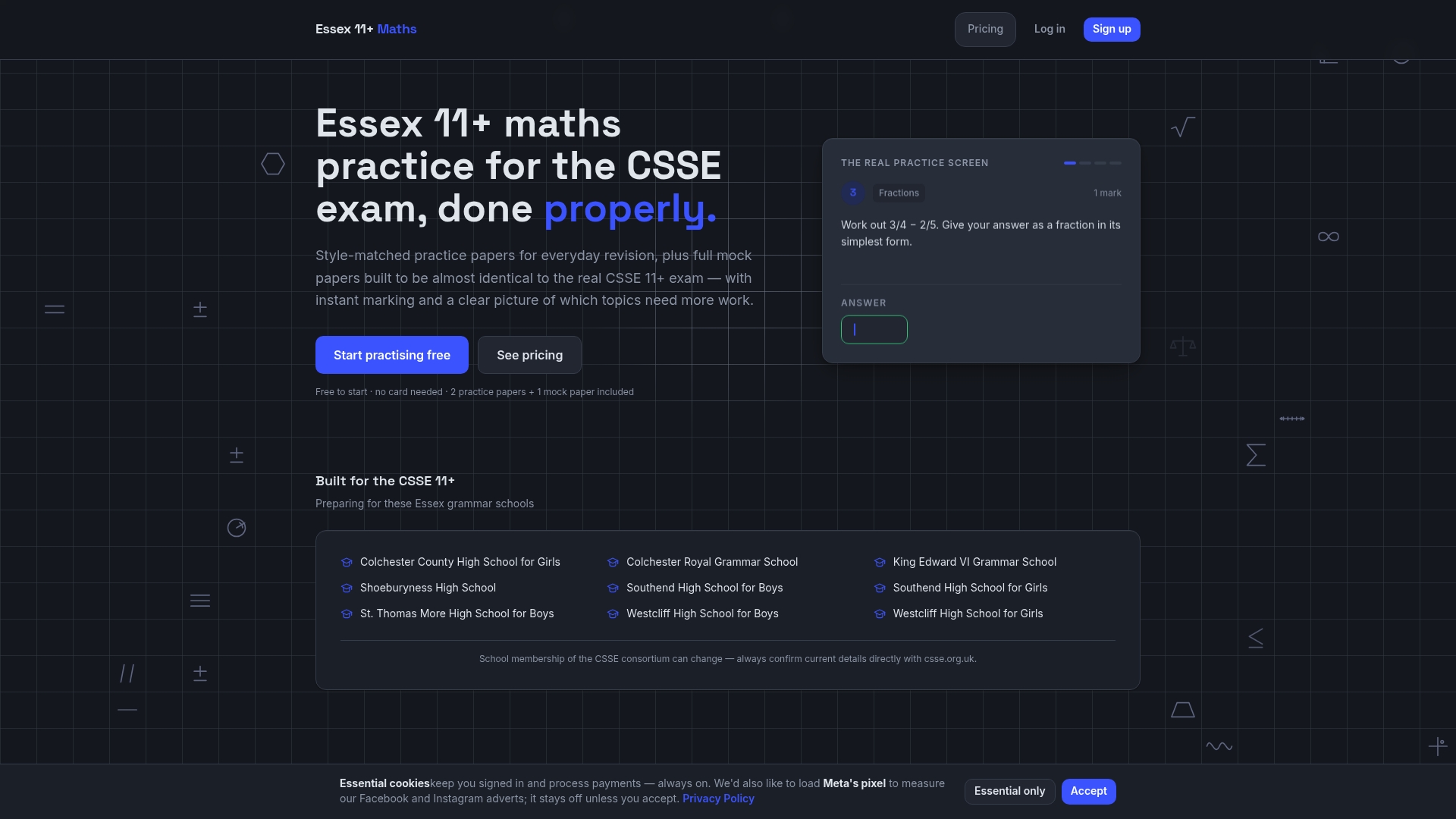
Good exam preparation involves practising in the exact format of the real exam, getting feedback immediately, and using progress tracking to identify skills needing further practice. Pair a Wednesday timed writing drill with a Thursday maths session on the platform, and a child builds exam stamina across both papers without either subject falling behind. Start with free access to see the format, then move to a monthly or yearly plan once the weekly routine sticks. Check the pricing page for current plan details before committing.
Sources
FAQ
How long should each CSSE writing task take?
Aim to split the suggested 20 minutes roughly evenly between both tasks, leaving a minute or two to check spelling and punctuation. Rehearsing this split at home matters more than rehearsing content, since running out of time on the second task is the most common practice failure.
How many sentences should a CSSE writing answer be?
Official papers suggest around six to seven sentences per response. Quality and control matter far more than reaching a specific number, so a tightly written six-sentence answer will usually beat a sprawling ten-sentence one.
What do CSSE examiners look for most?
The sample mark scheme rewards focus on the task, varied sentence structure, controlled vocabulary and accurate spelling, punctuation and grammar. Originality within a clear structure scores higher than a longer but repetitive answer.
Where can I get official CSSE writing past papers?
Download authentic papers and mark schemes directly from the CSSE practice-material page, which hosts the most recently published continuous writing tasks. Using genuine CSSE prompts rather than generic worksheets gives far more accurate practice.
Does Essex 11+ Maths Practice help with English preparation too?
Essex 11+ Maths Practice focuses on CSSE-style maths papers with instant marking, worked solutions and progress tracking. Pairing its timed maths sessions with a written English routine, as outlined above, builds the same exam stamina and self-timing skills that continuous writing tasks demand, and current plans are listed on the pricing page.
Written with BabyLoveGrowth to get found on Google and AI search