Essex Parents: CSSE Standardisation — 303 Floor, Formula & Local Prep
Essex Parents: CSSE Standardisation — 303 Floor, Formula & Local Prep

CSSE 11+ results are reported as a single standardised score, built by converting your child’s raw marks in English and Maths onto a common scale, each paper weighted equally at 50%. That total, not the raw percentage, decides consideration for a grammar school place. Offers never go to a child scoring below 303, but cut-offs shift every year, so treat that figure as a floor, not a target.
TL;DR:
- A child’s standardised CSSE score combines equally weighted English and Maths results, with a minimum consideration score of 303, but cut-offs fluctuate annually.
- The standardisation process adjusts for paper difficulty by scaling raw marks against cohort mean and variability, meaning scores differ year to year even for similar performance.
- Historical cut-offs indicate approximately 320 to 330 as competitive for mid-tier schools in strong years, but actual thresholds depend on cohort strength and application volume.
- Effective preparation involves multiple methods, such as mock exams, tutoring for weak topics, and app-based practice, to improve raw scores before standardisation.
- Access arrangements require early completion of supporting documents and Headteacher’s letters, with late submissions potentially disqualifying the request for special support.
Table of Contents
- How does CSSE standardisation actually work?
- Comparing your options for CSSE preparation in Essex
- Step-by-step: how raw marks become a CSSE standardised score
- What cut-offs and historical guidance sheets tell you (and what they do not)
- Access arrangements: what parents must do and by when
- Interpreting results and next steps for parents in Essex
- Scores matter, but they’re not the whole decision
- A practical way to raise raw marks before standardisation
- Sources
- FAQ
How does CSSE standardisation actually work?
CSSE does not simply add up marks out of 100. Every candidate sits two papers: English, which runs for 60 minutes plus 10 extra minutes of reading time, and Maths, at 60 minutes. Each paper score gets statistically standardised against the whole cohort before the two are combined 50/50 into one total.
That process exists because raw marks alone are unfair. If the English paper turns out harder than usual one year, raw scores drop across the board through no fault of the children sitting it. Standardisation corrects for that, so a child’s result reflects performance relative to everyone else in that year’s cohort, not the luck of a particular paper’s difficulty.
Before comparing local providers who can help your child prepare for both papers, it helps to understand what “a good score” even means in CSSE terms, and that starts with knowing exactly how the number is generated.
Comparing your options for CSSE preparation in Essex
Families across Essex generally lean on three types of support: full mock exams under exam conditions, one-to-one tuition, and app-based practice. Each does a different job, and most successful applications use more than one.
- 11 Plus Mock Exams in Essex - CSSE & CCHS Chelmsford Test Centre runs a high volume of sittings on genuine test dates, which is valuable if your child has never experienced exam-hall pressure before the real thing.
- Colin Arnold Tuition suits families who want a tutor to identify specific weak topics and build a personalised study plan rather than generic worksheets.
- KidSmart works well for households juggling clubs and travel, since practice happens on a phone or tablet whenever there’s a spare 20 minutes.
- Essex 11+ Maths Practice fits families who want structured, CSSE-style maths and English questions with instant marking, so weak topics surface immediately rather than after a tutor session or mock exam is graded days later.
None of these approaches conflicts with another. A child doing weekly app practice, occasional tutor sessions, and two or three full mock sittings before the real exam covers the ground far more thoroughly than any single method alone.
Step-by-step: how raw marks become a CSSE standardised score
The maths behind this looks intimidating on paper, but the logic is simple once you see it worked through. CSSE uses this formula to convert a raw mark into a standardised score:
Standardised score = (((raw score − mean) ÷ standard deviation) × 15) + 100
Here’s what each term means. The mean is the average raw mark across every child who sat that paper. The standard deviation measures how spread out those marks are, whether most children scored close to the average or whether results varied wildly. The formula rescales every result so the cohort average lands at 100, with a standard deviation of 15 either side, a system set out in CSSE’s own statistical appendix.
Because English and Maths are weighted equally, a child scoring exactly average on both papers ends up with a standardised score close to 100 on each, giving a combined total near 300, roughly the midpoint of the whole distribution.
Worked example: Suppose the Maths paper has a mean raw score of 45 and a standard deviation of 10. A child who scores 60 raw marks would calculate as (((60 − 45) ÷ 10) × 15) + 100, which comes to 122.5, rounded to the nearest whole number by CSSE’s own convention. If that child scored similarly on English, their combined total would sit somewhere around 240 to 250, which is below the 303 floor.

Pro Tip: Don’t try to reverse-engineer this year’s mean and standard deviation from last year’s figures. CSSE recalculates both every single sitting, so the same raw mark can produce a different standardised score from one year to the next.
What cut-offs and historical guidance sheets tell you (and what they do not)
CSSE publishes historical guidance sheets showing the lowest standardised score that secured a place at each school in previous years. Parents routinely misread these as promises. They are not. CSSE itself frames the sheets as reference material only, since cohort strength and the number of applications both shift the cut-off annually.
303 is the minimum standardised score CSSE will consider for any grammar school place. Scoring below it removes a child from the process entirely; scoring above it simply means the application proceeds, not that a place follows.
When reading a guidance sheet, focus on three columns: the lowest successful score for that year, the number of offers made, and the year itself. A single low year doesn’t set a new baseline. A run of several years trending upward tells you more than any one figure in isolation.
Access arrangements: what parents must do and by when
CSSE applies a tiered framework for extra support, ranging from straightforward extra time through to more substantial adjustments for documented needs, detailed in its SEND guidance. Getting the paperwork right, and early, matters more than most parents expect.
- Identify the tier your child likely needs, based on existing school reports or professional assessments, well before the application window opens.
- Complete forms F1 and F2 with the required supporting evidence, such as an educational psychologist’s report or specialist teacher assessment.
- Secure form F3, the Headteacher’s Letter, from your child’s primary school and submit it alongside F1 and F2 by the published deadline.
- Chase your primary school early if the letter is slow to arrive; a late F3 can mean the whole request is not considered, regardless of the strength of the evidence.
Interpreting results and next steps for parents in Essex
Once a standardised score arrives, compare it against the relevant guidance sheet for the specific school, not a generic average. As a rough marker, a total near 320 to 330 has historically been competitive for mid-tier CSSE schools in stronger years, while the most sought-after schools typically need a higher figure. Exact thresholds move annually, so use the sheet for direction rather than certainty.
If a score falls close to a school’s likely cut-off, most families benefit from acting rather than waiting:
- Review the guidance sheet trend for that specific school across several years, not just the most recent one.
- Check CSSE’s own timeline for appeals or special consideration if there were exceptional circumstances on the day.
- Target revision on the weaker of the two papers rather than repeating strengths.
- Book a further mock sitting if one is available before any appeal deadline, to build confidence and stamina.
Pro Tip: If English and Maths standardised scores differ by more than 15 to 20 points, that gap usually points to a genuine topic weakness rather than an off day, worth addressing directly before results season ends.
Scores matter, but they’re not the whole decision
A high standardised score gets a child considered. It doesn’t settle which school is actually right for them. Historical guidance sheets tell you what happened before, not what will happen this year, so weigh them against travel time, sibling links, and how your child actually feels walking into that building. The maths behind the score is precise; the decision that follows shouldn’t be treated the same way.
A practical way to raise raw marks before standardisation
Standardisation only converts the marks your child already has, so the real leverage sits in raising those raw scores before test day. Essex 11+ Maths Practice offers CSSE-style maths and English questions built to match the actual exam format, not generic Key Stage 2 worksheets, with instant marking and worked solutions on every answer.
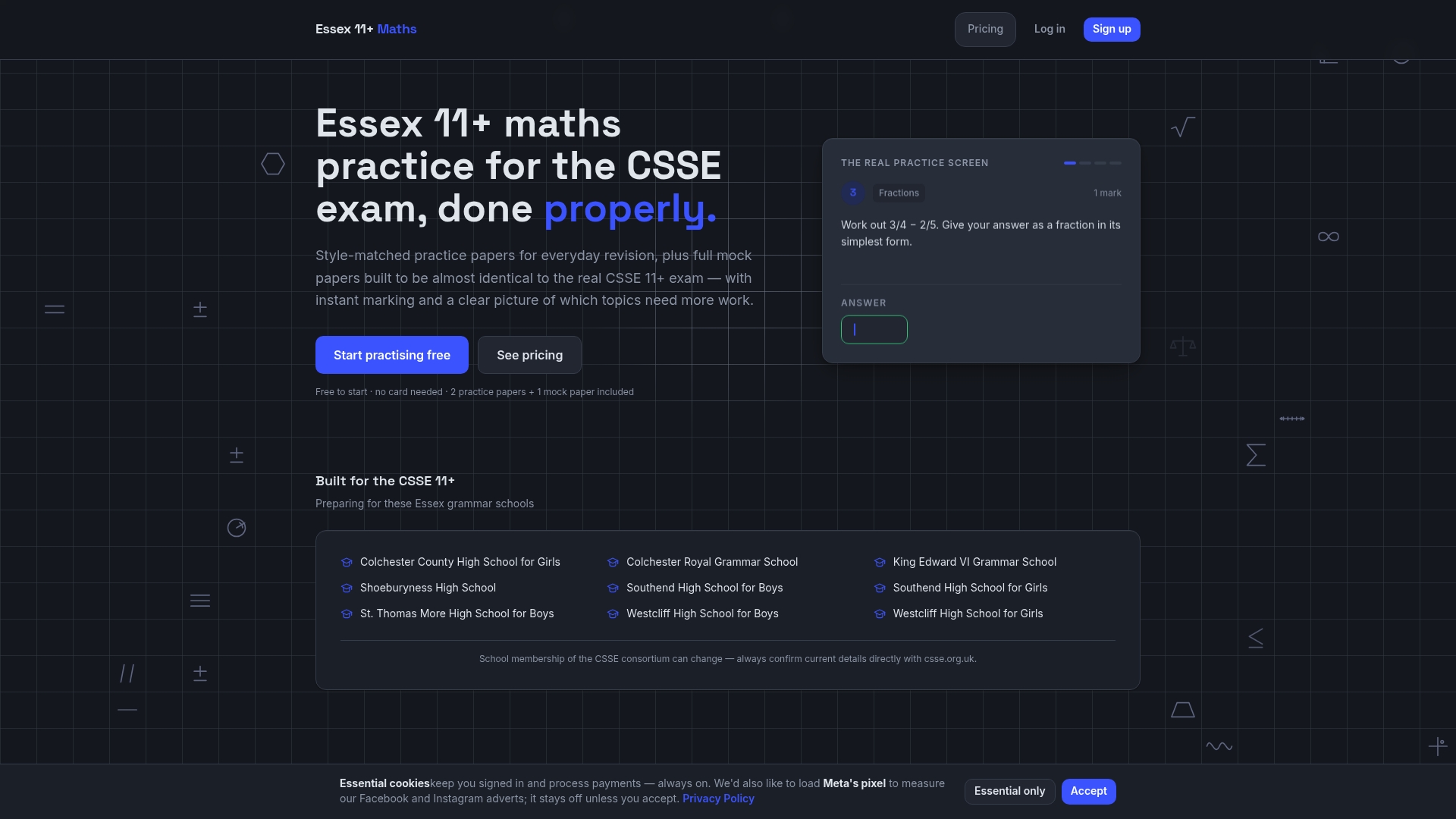
That instant feedback loop is what makes it a useful companion to mock exams and tuition rather than a replacement for either. A mock sitting tells you the overall score; a tutor session diagnoses a topic; daily practice with immediate marking shows exactly which question types still trip your child up, week by week, through progress tracking that flags weak areas early enough to fix them.
Access starts with a free plan, with Monthly subscriptions at £9.99 per month or Yearly at £64.99, both unlocking the full topic library and mock papers. Try the free starter access today and see which topics need attention before committing to a paid plan.

FAQ
How are CSSE scores calculated?
CSSE converts each child’s raw mark on the English and Maths papers into a standardised score using the cohort’s mean and standard deviation, scaled so the average sits at 100. The two standardised scores are then combined equally, each contributing 50%, to produce the final total.
What is the pass mark for CSSE?
There isn’t a fixed pass mark in the traditional sense, but CSSE will not consider any child scoring below a total standardised score of 303. Clearing 303 means the application is considered; it doesn’t guarantee a place at any particular school.
What is a good 11+ standardised score?
A score near 300 represents roughly average performance across the cohort. Historically, totals around 320 to 330 have been competitive for mid-tier CSSE schools in stronger years, though the most oversubscribed schools typically require higher, and thresholds move annually.
What are the cut-off marks for CSSE secondary schools in 2026?
Cut-off marks vary by school and change every year depending on cohort strength and application numbers, so there’s no single fixed figure for 2026. Check the current historical guidance sheet for the specific school you’re applying to, and treat past years as a trend rather than a promise.