CSSE Past Papers for Maths: How to Practise Smarter, Not Just More
CSSE Past Papers for Maths: How to Practise Smarter, Not Just More
Sitting down with your child to tackle their first csse past paper is often an eye-opening moment for Essex parents. You might watch an otherwise confident Year 5 pupil—someone cruising at "greater depth" in primary school—stare blankly at a multi-step word problem or run out of time with a third of the paper left untouched.
Preparing for grammar school entry in Essex is an academic marathon. With thousands of applicants competing for a finite number of selective places, completing past papers is an unavoidable rite of passage.
Yet, year after year, families fall into the same trap: they print out every paper they can find, set a kitchen timer, mark the test, sigh over a mediocre percentage, and immediately move on to the next one. This "paper burning" approach causes frustration, anxiety, and rapid burnout without actually fixing underlying conceptual gaps.
To secure a grammar school desk, your child needs deliberate, targeted practice. Here is how to make every single paper count.
Key Takeaways
| Focus Area | Common Mistake | Smarter Practice Strategy |
|---|---|---|
| Paper Volume | Rushing through 15+ papers back-to-back | Working through fewer papers deeply with thorough diagnostic review |
| Pacing | Enforcing strict 60-minute timings too early | Mastering problem structures untimed before introducing section pacing |
| Curriculum Alignment | Relying on generic GL Assessment or CEM work | Focusing exclusively on CSSE-style independent multi-step questions |
| Error Handling | Checking the mark scheme and moving on | Logging every missed question in an active "Mistake Log" for re-testing |
| Standardisation | Expecting 90%+ raw scores on every test | Targeting consistent 75–80%+ raw marks, aligned with age-standardised cut-offs |
What Is the CSSE Maths Exam and Why Is It Unique?
The 11+ admissions landscape in Essex can be confusing. Unlike regions that contract commercial testing bodies like GL Assessment, the Consortium of Selective Schools in Essex sets and moderates its own independent entrance examination.
According to the Consortium of Selective Schools in Essex (CSSE), over 6,000 pupils register annually to compete for approximately 1,000 grammar school places across Essex. With regional grammar schools significantly oversubscribed, every single mark on the mathematics paper carries immense weight.
+-----------------------------------------------------------------------+
|                       CSSE 11+ EXAM STRUCTURE                         |
+-----------------------------------+-----------------------------------+
|              ENGLISH              |            MATHEMATICS            |
|       60 Minutes (60 Marks)       |       60 Minutes (60 Marks)       |
| Comprehension, Applied Grammar,   | Multi-Step Arithmetic, Algebra,   |
|         Creative Writing          |   Geometry, Logic & Data Analysis |
+-----------------------------------+-----------------------------------+
                  \                               /
                   \                             /
              Standardised & Scaled to a Mean of 300 Marks
                   (50% English  |  50% Mathematics)
The CSSE Structure and Participating Essex Grammar Schools
The CSSE exam governs entry to eight prestigious grammar schools across the county:
- King Edward VI Grammar School (KEGS), Chelmsford
- Chelmsford County High School for Girls (CCHS uses a separate CEM/FSCE test, but KEGS remains CSSE)
- Colchester Royal Grammar School (CRGS)
- Colchester County High School for Girls (CCHSG)
- Southend High School for Boys (SHSB)
- Southend High School for Girls (SHSG)
- Westcliff High School for Boys (WHSB)
- Westcliff High School for Girls (WHSG)
- Shoeburyness High School (selective stream)
If you are planning your Essex grammar school entry practice, you must understand that the CSSE Maths paper does not use multiple-choice answer sheets. It is a traditional write-in examination booklet where children must show their workings, explain their reasoning, and write their final values clearly in provided answer spaces.
How CSSE Maths Differs from Standard Key Stage 2 SATs
Primary school teachers do an admirable job covering the national curriculum, but standard Key Stage 2 teaching will leave your child underprepared for the CSSE.
The Standards and Testing Agency designs national curriculum assessments to check whether a child has achieved age-expected fluency. By contrast, the CSSE entrance exam is an unapologetic ranking test designed to separate the top 15% to 20% of academic performers.
SATs Mathematics vs CSSE 11+ Mathematics
=============================================================================
CRITERIA            KS2 SATs                          CSSE 11+ MATHS
-----------------------------------------------------------------------------
Format              Multiple-step, accessible layout  Dense, multi-layered phrasing
Algebra             Basic substitution & formulas     Simultaneous & word-based algebra
Spatial Reasoning   Simple perimeters, areas, nets    Composite shapes & 3D visualisation
Pacing              Generous (~1.2 mins per mark)     Tight (1 minute per mark)
Objective           Assess national minimum standard  Rank competitive top-decile cohorts
Where a SATs question might ask a pupil to calculate the perimeter of a rectangle with given dimensions, a CSSE paper will present a compound shape made of overlapping rectangles, give the difference between their perimeters, and ask for the missing length of an unlabelled side. The mathematical principles are rooted in Year 6 curriculum concepts, but the application demands deep lateral thinking.
The Structure of the Paper: Marks, Timings, and Question Flow
The CSSE mathematics paper is strictly timed: 60 minutes for 60 marks.
This enforces a brisk pace of one mark per minute. The layout typically features an escalating ramp of difficulty:
- Questions 1–15: Mental arithmetic, rapid calculation, fractions, decimals, and basic percentages.
- Questions 16–45: Word problems covering multi-step ratio, speed/distance/time, unit conversions, Venn diagrams, and algebraic substitution.
- Questions 46–60: Unfamiliar spatial puzzles, logic-grid problems, non-routine sequences, and deep problem-solving tasks.
Pro Tip: Never let your child tackle a practice paper chronologically if they freeze on hard questions. Train them to bank the first 25–30 marks rapidly so they build an emotional cushion before tackling multi-tiered problem solving.
Where Can You Find an Authentic CSSE Past Paper?
Knowing where to get reliable practice material is half the battle. Because the CSSE writes bespoke papers, off-the-shelf revision books from major high-street publishers rarely capture the authentic tone, font, pacing, and layout of the real exam.
Official CSSE Past Paper Packs vs Free Online Resources
The most authentic source of historical tests is the consortium itself. You can purchase physical past paper packs directly from the official CSSE website. These packs contain genuine tests sat by candidates in prior years, complete with basic mark schemes.
However, many free online forums and generic resource hubs circulate old, low-resolution scanned PDFs from tests taken 10 or 15 years ago. While maths concepts remain consistent, the specification has evolved over time. Relying solely on blurry printouts from 2008 can introduce outdated conventions that confuse children.
The Scarcity Issue: Why Historical Papers Run Out Quickly
There are only so many genuine past papers available. If you print every historical csse past paper you can buy from the consortium, you will likely have around 8 to 10 past exams.
If you begin your campaign in January or February of Year 5, you will burn through that stack within two months. Once your child has seen a paper, they cannot sit it a second time with an unbiased diagnostic score; they will recall the answers or remember the "trick" hidden inside the wording.
Ticking through authentic papers too early leaves families without reliable testing benchmarks during the critical final push between July and September.
Using Style-Matched Practice Materials to Bridge the Gap
To preserve official past papers for mock-exam milestones, you need style-matched materials that mimic the consortium's distinctive feel.
       Generic 11+ Publishers             Authentic CSSE Style
   +-----------------------------+    +-----------------------------+
   | - Multiple-choice bubbles   |    | - Write-in working spaces   |
   | - Standard single-step math | vs | - Two-part nested questions |
   | - Predictable format styles |    | - Cross-topic word problems |
   | - Uniform question ramps    |    | - Differentiator logic tier |
   +-----------------------------+    +-----------------------------+
Generic 11+ revision workbooks often default to multiple-choice formats designed for GL Assessment regions like Buckinghamshire or Kent. Using those for CSSE preparation builds poor habits: it teaches children to guess from given options rather than showing clear, structured working on blank lines. Dedicated, style-matched platforms allow pupils to develop the exact pencil-and-paper stamina needed on exam day.
How to Practise Smarter: A 3-Stage CSSE Past Paper Revision Strategy
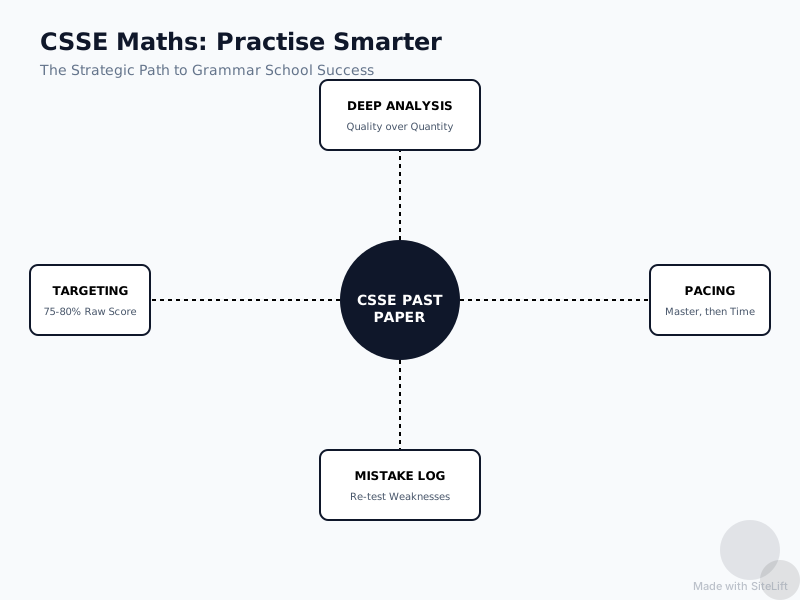
If your child sits a test, gets 64%, looks over the answers with you for five minutes, and stacks the paper in a folder, you have wasted a valuable resource. Authentic improvement happens inside the post-test analysis.
To see genuine score progression, structure your CSSE maths past papers practice across three distinct phases.
                 A 3-STAGE REVISION STRATEGY

   [Stage 1: Diagnostic] -----> [Stage 2: Pacing] -----> [Stage 3: Remediation]
     * Untimed deep-dive         * Sectional sprints       * Active Mistake Log
     * Map knowledge gaps        * Strict 1 mark/min       * Re-test errors at
     * Verify mechanics          * Build 60-min stamina      48-hr & 7-day marks
Stage 1: Untimed Diagnostic Analysis and Topic Mapping
When introducing full-length papers in early Year 5, take the clock away entirely.
Give your child a past paper and tell them: "Take as long as you need to solve every question you understand."
This isolates their conceptual knowledge from time pressure. If a child takes 90 minutes to score 85%, their issue is purely speed and retrieval fluency. If they take 90 minutes and score 52%, the issue is structural: they have blind spots in foundational topics like percentages, fractions, or algebra.
After an untimed paper, map every incorrect question into one of three categories:
- Knowledge Gap: Concepts they have never been taught (e.g., calculating the interior angles of irregular polygons).
- Application Failure: They know the formula, but could not decode the word problem.
- Careless Arithmetic: They wrote $7 \times 8 = 54$ midway through a multi-step calculation.
Stage 2: Sectional Timing and Exam-Pace Simulation
Once knowledge gaps are closed, introduce time limits gradually. Do not jump straight into a 60-minute pressure cooker; sustained focus over an hour is exhausting for a 10-year-old.
Break your practice into manageable, bite-sized sections:
- Sprint 1: Questions 1–15 in 12 minutes (rapid calculation fluency).
- Sprint 2: Questions 16–30 in 15 minutes (applied word problems).
- Sprint 3: Questions 31–45 in 18 minutes (complex multi-step geometry and ratio).
- Sprint 4: Questions 46–60 in 15 minutes (logic puzzles and differentiators).
Working in sectional sprints trains your child to identify their internal rhythm. They learn firsthand what "one mark per minute" feels like, helping them notice when they have spent four minutes stuck on an algebraic puzzle.
Stage 3: The 'Mistake Log' and Remediation Loop
The golden rule of 11+ revision is simple: a question answered incorrectly is far more valuable than one answered correctly.
Keep a dedicated physical notebook or digital spreadsheet called the Mistake Log.
                        SAMPLE MISTAKE LOG ENTRY
+------------+--------------------+-------------------------+--------------------+
| Paper Date | Question / Topic   | Why It Was Missed       | Next Re-test Date  |
+------------+--------------------+-------------------------+--------------------+
| 2021 Paper | Q34: Compound Area | Forgot to subtract the  | Friday (48h later) |
|            | & Perimeter        | inner cut-out boundary  |                    |
+------------+--------------------+-------------------------+--------------------+
Whenever your child drops a mark on a csse past paper, write out the problem in their Mistake Log. Do not simply tell them the correct answer. Sit beside them, read the worked solution together, and explain the underlying logic.
Then, apply the 48-Hour Rule: two days later, present that exact question to your child on a blank piece of paper. If they can solve it quickly and clearly, they have achieved true mastery. If they stumble again, the concept remains unlearned.
Pro Tip: Review your child's Mistake Log weekly. If the same topic crops up three times—say, inverse proportion or area of triangles—pause all full mock papers immediately and dedicate an entire weekend to targeted drills on that specific concept.
CSSE Exam Question Breakdown: Tackling High-Yield and Differentiator Questions
Knowing how to use 11+ past papers effectively requires an understanding of how CSSE papers are assembled. The consortium tests across three broad tiers of mathematical capability.
Infographic by SiteLift
Core Arithmetic and Fluency: Securing Easy Baseline Marks
The first 15 to 20 marks are baseline territory. These questions test fundamental arithmetic: long multiplication, division with remainders, fraction operations, decimal conversions, and place value.
Typical Baseline Distribution:
- Long multiplication (3 digits by 2 digits)
- Simplifying and adding mixed fractions
- Converting fractions to recurring decimals or percentages
- BODMAS/BIDMAS operations with negative numbers
In a competitive year, pupils aiming for top schools like KEGS or Colchester Royal cannot drop marks here. A careless mental slip on a two-mark arithmetic question at the start of the paper has the exact same statistical impact as missing a complex logic puzzle at the end. Build absolute, unflinching arithmetic accuracy before worrying about advanced reasoning.
Applied Multi-Step Problem Solving and Real-World Reasoning
The meat of the paper lies in questions 20 through 45. Here, mathematical operations are hidden inside dense, real-world word problems.
A standard question might look like this:
"A shopkeeper buys 24 cartons of drinks for £7.20 per carton. Each carton contains 12 cans. He sells two-thirds of the cans for 90p each, and the remainder at a 20% discount. What is his total profit?"
To solve this, a pupil must execute a precise, four-stage journey:
- Calculate total cost price ($24 \times £7.20$).
- Calculate total can volume ($24 \times 12 = 288$ cans).
- Split the volume by fraction, applying the 90p price to two-thirds and calculating the 20% discounted price (72p) for the remaining one-third.
- Sum the revenues and subtract the original cost price to isolate profit.
Children do not fail these questions because they cannot multiply or calculate 20%. They fail because they lose their place midway through the problem. Train your child to annotate word problems: underline core figures, cross out irrelevant fluff, and label each stage of their working neatly.
The 'Final 10 Marks': Non-Routine Logic and Spatial Puzzles
The final 10 to 12 marks on a CSSE paper represent the differentiator tier. This is where examiners separate top grammar candidates from the rest of the cohort.
These questions feature unfamiliar mechanics:
- Unusual symbol operations (e.g., "If $a \star b = (a \times b) - (a + b)$, find the value of $6 \star 4$").
- 3D spatial nets and isometric folding.
- Algebraic balances and logic grids.
- Non-linear number sequences (Fibonacci variants, square-number gaps).
When pupils encounter these questions under exam pressure, panic sets in. Teach your child that differentiator questions are logic puzzles, not standard school tasks. If they stay calm, work through the conditions methodically, and test possibilities systematically, these final marks are entirely achievable.
Standardised Scores Explained: What CSSE Past Paper Scores Mean
Parents frequently panic when their child scores 70% on a past paper, assuming that an entrance exam requires typical school test marks of 90% or above. The 11+ scoring system works differently.
According to data published by the CSSE, candidates receive an overall standardised score scaled to a mean of 300 across the cohort, equally weighted between English (150 marks) and Mathematics (150 marks). This standardization process adjusts raw scores to account for test difficulty and candidate age.
       RAW SCORE vs STANDARDISED SCORE (STAS)

  Raw Paper Score (out of 60)
         │
         ▼
  Cohort Difficulty Adjustment (Scales against year's cohort)
         │
         ▼
  Age Standardisation (Calculates exact age in years & months)
         │
         ▼
  Final Standardised Score (Mean 300 across both papers)
Raw Marks vs Age-Standardised Scores (STAS)
Age standardisation ensures that a child born in August is not unfairly disadvantaged when competing against a classmate born the previous September—who has had nearly a full year of additional cognitive development.
The statistical model awards a small adjustment to younger candidates based on their exact age on the day of the exam. However, standardisation does not transform a failing mark into an offer. It typically adjusts scores by only a few points, meaning consistent raw performance remains the primary goal during revision.
Realistic Benchmarks: What Raw Scores Translate to an Essex Grammar Offer?
Historical admissions discussions on forums like Eleven Plus Exams highlight how cut-off scores vary by school, gender, and catchment area.
While cut-offs shift from year to year depending on cohort performance, historical raw score trends offer useful targets:
- Colchester Royal Grammar School (CRGS) & KEGS: Aim for 80% to 85%+ raw marks (around 48–52/60). These schools historically have the highest academic thresholds in the county.
- Colchester County High School for Girls (CCHSG): Aim for 78% to 82%+ raw marks.
- Westcliff & Southend High Schools (Out-of-Catchment): Aim for 75% to 80%+ raw marks.
- Westcliff & Southend High Schools (In-Catchment): Offers often fall between 62% and 70% raw marks (around 37–42/60).
If your child is consistently hitting 75% on authentic CSSE past tests under timed conditions, they are performing well within competitive territory for selective grammar schools in Essex.
Building a Month-by-Month Timeline Leading Up to September of Year 6
To avoid an overwhelming cram session over the summer holidays, spread your preparation across the final 8 to 9 months:
Month-by-Month Revision Schedule
=============================================================================
MONTH             REVISION PRIORITY
-----------------------------------------------------------------------------
January - March   Master foundational Year 6 topics (ratio, algebra, geometry).
                  Untimed diagnostic papers; build the Mistake Log.
-----------------------------------------------------------------------------
April - May       Introduce sectional timing (15-minute bursts).
                  Identify and drill persistent topic blind spots.
-----------------------------------------------------------------------------
June - July       First timed full-length practice papers under strict conditions.
                  Target 1-mark-per-minute pacing; refine exam exam technique.
-----------------------------------------------------------------------------
August            Full weekly mock exam simulations at the actual test time (9am).
                  Remediation drills; review the complete Mistake Log.
-----------------------------------------------------------------------------
September         Taper down. Light arithmetic drills and confidence building.
                  Zero heavy past papers in the final 72 hours before test day.
Why 'Paper Burning' Fails Essex Families: The Editorial Take
I have seen countless parents make the same critical error every spring: they treat the 11+ like an administrative sprint, measuring their child's readiness by the height of completed paper stacks on the dining room table.
"We've completed twenty past papers, but their scores haven't budged from 62%."
This is the classic paper-burning trap. Working through test after test without deep analysis simply reinforces existing bad habits. If your child misinterprets algebraic word problems on Paper 1, forcing them to sit Papers 2 through 10 without targeted intervention guarantees they will misinterpret them ten more times.
Doing five papers deeply—where every missed mark is logged, analysed, explained, and successfully re-tested—yields far better results than blazing through twenty papers superficially.
Quality of analysis will always beat sheer volume of revision. The 11+ is an intellectual endurance test, and children who view mistakes as interesting puzzles to solve walk into the exam room with far more confidence than those who have been ground down by endless test papers.
— essex11mathspractice.co.uk
Smarter CSSE Practice with Essex 11+ Maths Practice
Managing dozens of paper tests, hand-marking multi-step calculations, and keeping track of recurring algebraic errors across spiral notebooks takes hours of administrative work.
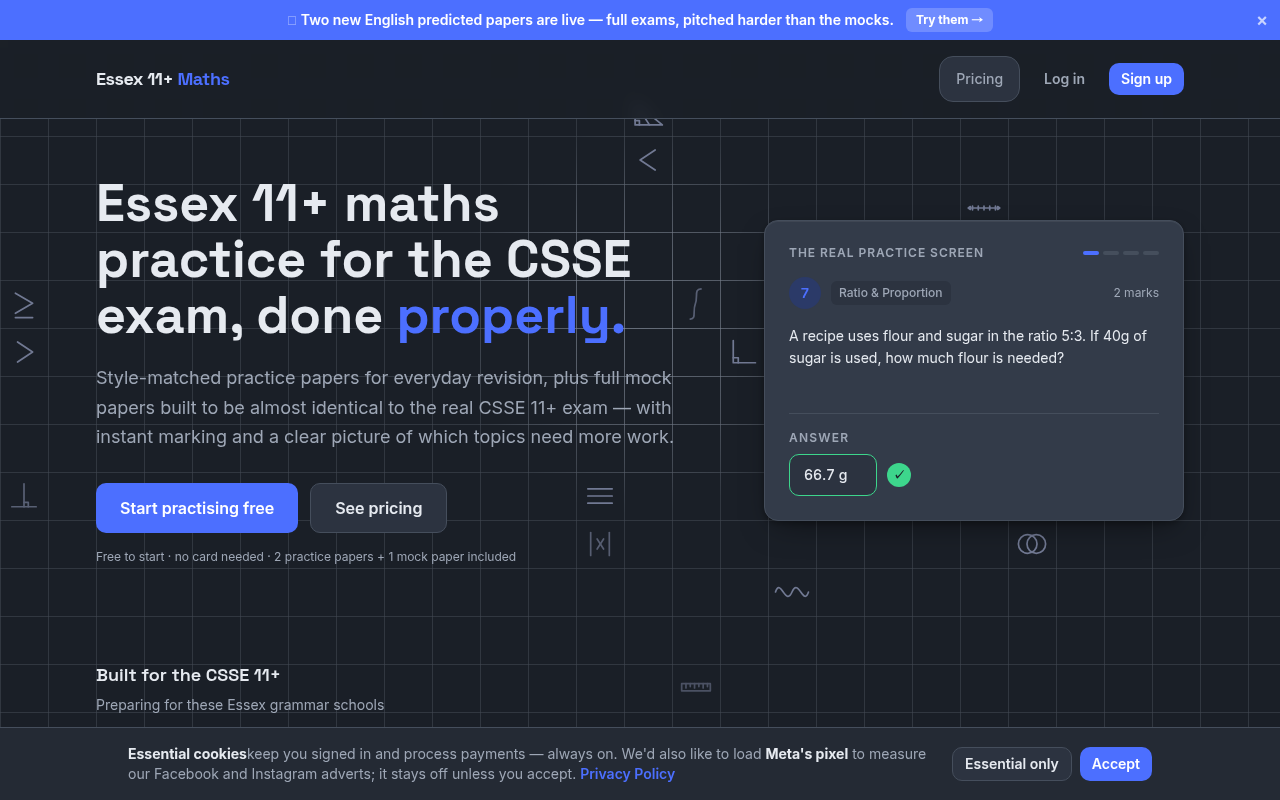
That is why we built essex11mathspractice.co.uk. Our platform provides dedicated, style-matched revision resources and mock examinations built specifically for pupils preparing for the CSSE 11+ mathematics exam.
Rather than relying on generic, multiple-choice worksheets, our questions mirror the real consortium paper format. Every problem includes:
- Instant marking and detailed worked solutions that show your child step-by-step how to resolve complex problems.
- Automated topic tracking that logs your child's performance across individual domains (like ratio, algebra, and spatial logic), pinpointing their exact blind spots.
- Full mock exams and relaxed practice modes, allowing you to balance foundational skills with authentic, timed exam simulation.
You can get started immediately with our free practice tiers, or explore our flexible monthly options on our pricing page to give your child the tools they need to prepare effectively. If you have questions about how our platform maps to the real exam, read our frequently asked questions guide.
FAQ
How many CSSE past papers should my child complete before the real exam?
Quality matters far more than quantity. Completing between 8 and 12 full-length, authentic or style-matched papers across Year 5 and Year 6 is more than enough for most pupils. What matters is the remediation cycle: spending two to three hours diagnosing mistakes, learning the underlying theory, and re-testing errors from each paper will deliver far greater score gains than churning through 25 papers without proper review.
Where can I buy or download official CSSE past papers?
Official past papers should be purchased directly from the Consortium of Selective Schools in Essex through their official website at csse.org.uk. The consortium releases past paper packs covering recent exam sittings. To preserve these genuine papers for your child's final mock simulations, use style-matched online resources during the earlier phases of revision.
What is a good raw score on a CSSE maths past paper?
Target scores depend on your chosen school and your residency status:
- Top-tier schools (CRGS, KEGS): Consistently aiming for 80–85%+ raw marks (48–52 out of 60).
- Out-of-catchment candidates (Westcliff, Southend): Aim for 75–80%+ raw marks (45–48 out of 60).
- In-catchment candidates (Westcliff, Southend): Scores between 65% and 72% (39–43 out of 60) have historically proven competitive.
Why does my child score highly on school tests but struggle with CSSE papers?
Primary school assessments (such as Key Stage 2 SATs) are criterion-referenced tests designed to verify whether a child meets expected national standards. In contrast, the CSSE 11+ is a selective norm-referenced test designed to rank the top 15% to 20% of academic candidates. CSSE questions feature dense, multi-step problem solving, complex wording, and advanced reasoning tasks rarely encountered in standard primary classrooms.
How does age standardisation affect my child's CSSE maths score?
The CSSE standardises raw marks into a Standardised Total Adjusted Score (STAS) scaled to a mean of 300. This calculation balances your child's performance against the statistical difficulty of the paper and adjusts for their exact age on exam day. Younger pupils (such as summer-born children) receive a modest point adjustment to offset the developmental gap between them and older classmates. However, standardisation generally shifts scores by only a few marks, so building strong raw performance remains the most effective strategy.