303 and Your Child's CSSE Chances: Why the Pass Mark Falls Short
303 and Your Child’s CSSE Chances: Why the Pass Mark Falls Short

The CSSE publishes a consortium minimum qualifying threshold of a total standardised score of 303, combining English and mathematics on a 50:50 basis. A total below 303 means no CSSE offer under the published criteria, though appeals and special consideration can still be awarded outside that rule. Clearing 303 makes a child eligible for consideration, not guaranteed a place.
TL;DR:
- Scoring 303 or above qualifies a child for consideration but does not guarantee a place, as school-specific cut-offs often exceed this minimum.
- Last year’s school-by-school last offer scores are more relevant for predicting chances than the consortium’s fixed threshold, and they can fluctuate annually.
- The total standardised score combines equal English and math scores, scaled against cohort performance, with scores below 303 leading to no offer under standard criteria.
- Historical data shows cut-offs range from just above 303 to into the low 370s, heavily influenced by demand, cohort strength, and priority area status.
- Effective preparation involves timed practice exams that mirror the test format, thorough review of mistakes, and tracking progress by topic to target weak areas.
Table of Contents
- What the 303 threshold means in practice
- How CSSE scores are calculated and reported
- Historical cut-offs: reading the guidance sheets and expected ranges
- How to interpret your child’s raw and standardised scores
- Timeline: results, guidance sheets and offer day
- Appeals, special consideration and next steps if scores fall short
- How to prepare effectively in the months before the test
- What tutors notice in the weeks after results
- Get exam-ready with targeted CSSE practice
- Sources
- FAQ
What the 303 threshold means in practice
Scoring 303 or above satisfies the CSSE’s own baseline. It does not tell you whether your child will get an offer from a specific school, because most Essex grammar schools set a working cut-off higher than the consortium minimum once demand and priority areas are factored in.
Think of 303 as a door rather than a destination. It opens the possibility of a CSSE offer, but the school itself decides who actually walks through, based on how many applicants it can take that year and how many of them live inside its priority area. A school with heavy oversubscription in a popular catchment might see its last offer land in the 330s or higher, while a less oversubscribed school, or a place in the outside-priority-area category, could clear at a score closer to the 303 baseline.
This is why the historical guidance sheet for 2026 entry matters more to most families than the consortium minimum itself. It lists, school by school, the score that secured the last offer the previous year, split by priority area. Reading it correctly means checking three things:
- The specific school your child is applying to, since cut-offs vary widely between schools.
- Whether your address falls inside or outside that school’s priority area, as the two categories are scored separately.
- The last offer figure for your category, which is the lowest score that secured a place, not an average or a typical score.
Parents sometimes assume a single Essex-wide pass mark decides every place. It does not. The 303 figure is the consortium’s floor, but each school’s own last-offer history is the number that actually predicts your chances. Historical figures are exactly that: historical. They shift year to year with cohort strength and application volumes, so treat last year’s guidance sheet as a guide to plausible ranges, not a fixed target.
How CSSE scores are calculated and reported
Every child sits two papers under timed conditions. Understanding how those papers turn into the number on the results sheet takes the mystery out of a total standardised score.
- English, lasting 60 minutes with an additional 10 minutes of reading time beforehand.
- Mathematics, lasting 60 minutes.
- Raw marks from each paper are converted into a subject standardised score, with English and maths each contributing 50% to the final total.
- The two subject standardised scores are added together to produce the total standardised score, the figure compared against 303 and against school cut-offs.
Standardisation adjusts raw marks against the whole cohort’s mean and spread, so a raw score is scaled relative to how every other child performed that year, rather than reported as a simple percentage. The CSSE information guide also notes that results may be analysed by date of birth, allowing for age adjustment where relevant, since children in the same year group can be up to almost a year apart in age.
A total standardised score of 303 is the consortium’s published minimum for a CSSE offer. Below that figure, a child will not receive an offer under the standard published criteria, regardless of how strong one individual paper was.
CSSE publishes both the raw subject scores and the overall standardised score on the results sheet, so parents can see exactly how their child performed on each paper before standardisation was applied. The formal standardisation formula and the full standardisation report are released only after results are despatched, which is why the mechanics behind the conversion are not visible in advance of results day.

Historical cut-offs: reading the guidance sheets and expected ranges
The historical guidance sheet is the single most useful document for setting realistic expectations, but it takes a moment to read properly.
Each row lists a school, then splits results into categories, typically inside priority area and outside priority area, with the last offer score shown for each. That figure is the lowest total standardised score that still secured a place on national offer day the previous year. It is not the average score of successful applicants, and it is not a promise that the same figure will apply again.
- Start by finding your target school and confirming whether your address places you inside or outside its priority area.
- Note the last offer score for that exact category, not the school’s overall figure.
- Treat the number as historical: it reflects one year’s cohort and demand, and can move up or down the next year.
- Build in a safety margin above the last offer score where possible, since competitive schools can see cut-offs climb year on year.
In practice, last offer scores across Essex’s selective schools have ranged from figures close to the 303 consortium minimum up into the low 370s, depending on the school and the priority area in question. That spread matters. A score that would comfortably secure a place at one school might fall short at a more oversubscribed one just a few miles away.
Why do scores move so much between schools and years? Three forces are usually at work. Cohort strength varies: a particularly strong year group nationally can push standardised competition higher at popular schools. Demand fluctuates with birth rates, local housing patterns and how many families apply to a given school. Priority area effects also matter, since a school reserving places for children living close by will often clear at a different score for outside-area applicants than for those living locally.
The practical takeaway is to set your target using the specific school and category your child falls into, not a single Essex-wide number, and to add a margin above last year’s figure rather than aiming to just scrape it.
How to interpret your child’s raw and standardised scores
Once results arrive, most parents want a quick way to read what the number actually means. These bands are a pragmatic starting point, not an official CSSE classification:
- Under 303: outside consortium consideration under the published minimum, though special consideration or appeal routes may still apply.
- 303 to 320: marginal territory, close to the consortium floor and likely to depend heavily on the specific school’s demand that year.
- 321 to 350: a competitive range for many schools, though some heavily oversubscribed schools set their last offer above this band.
- 351 and above: a strong result that clears most published historical cut-offs, though always check the specific school.
To see how the total is built, imagine a child who achieves a standardised score of 160 in English and 155 in mathematics. Added together, that gives a total standardised score of 315, which clears the consortium minimum and sits in the marginal-to-competitive range depending on the target school. A child scoring 175 in maths but only 130 in English reaches the same total, which illustrates why a strong result in one paper cannot be assumed to carry the total on its own: both subjects count equally towards the final figure.
Pro Tip: Once you have your child’s total, compare it directly against the last offer score for your specific school and priority-area category on the historical guidance sheet, rather than against the 303 consortium figure or a generic average.
Timeline: results, guidance sheets and offer day
Results are typically despatched in October, with CSSE’s historical guidance sheets published around the same time so parents can immediately compare a new result against the previous year’s context. National offer day follows in March, and this is the point at which cut-offs for that year’s cohort are finally confirmed, since places are allocated according to each school’s admissions arrangements and the volume of applications received.
Between October and March, families use the guidance sheet to judge likely outcomes, finalise school preferences with their local authority and, where a result sits below target, begin preparing any appeal evidence. Contacting schools directly about individual chances before offer day rarely produces a clearer answer than the historical data, since final cut-offs are not fixed until admissions are processed in March.
Appeals, special consideration and next steps if scores fall short
CSSE does not re-mark test papers, so a disappointing result cannot be challenged on marking grounds alone. Appeals and special consideration operate outside the published 303 threshold and outside individual school cut-offs, through a separate process handled by independent appeal panels rather than the consortium itself.
Special consideration is typically reserved for circumstances that may have affected performance on the day, such as illness or a significant disruption, and is assessed independently of the standard scoring criteria. An appeal, by contrast, usually requires evidence that the school’s admissions arrangements were not properly applied, or that there are exceptional circumstances that justify a place despite the score falling below the published cut-off.
If your child’s score sits below your target school’s likely cut-off, a few practical steps help:
- Apply to your chosen schools regardless of the score, since historical cut-offs can shift and applying keeps options open.
- Gather any relevant evidence early if you believe an appeal may be appropriate, since panels work to fixed schedules after offer day.
- Review your full list of school preferences with your local authority’s admissions page to check timing and required forms.
- Consider whether a strong non-selective preference should move up your list as a safety option.
How to prepare effectively in the months before the test
Score interpretation matters most when it feeds into a sensible revision plan for the months before the test, not just as a post-results exercise.
A workable structure for the final stretch looks like this: rotate through topics to close gaps, run timed practice papers that mirror the real format, sit full timed mock exams at intervals, and build in a review cycle after each one to correct the same mistakes before they recur. Timed, standardised-style practice matters because the CSSE test rewards pacing as much as raw knowledge: a child who knows the maths but runs out of time on paper structure will lose marks that have nothing to do with ability.
- Rotate weak topics into every practice session rather than only revising strengths.
- Sit full timed papers under exam conditions at least every few weeks in the run-up to the test.
- Review every mock immediately, focusing on why an answer was wrong, not just that it was.
- Track progress over time so the final weeks concentrate on the topics still causing errors.
The practice materials follow this exact structure. Practice content is designed to match the style and format of the CSSE 11+ maths exam rather than generic key stage 2 materials, so the pacing and question style a child meets in practice reflect what they will meet on the day. Immediate feedback and detailed solutions help a child understand where a method breaks down, and progress tracking by topic makes it easier to identify areas needing further work heading into the final weeks. Used alongside the revision structure above, timed papers early on to establish a baseline, topic rotation through the middle stretch, full mocks and focused review near the end, it gives parents a clear, evidence-based way to direct study time where it will make the most difference.
What tutors notice in the weeks after results
Parents tend to react to a CSSE result in one of two ways: relief that quickly turns to worry about the specific school, or disappointment before checking what the actual cut-off for their category was. Both reactions usually settle once the historical guidance sheet is read properly against the right school and priority area.
A simple one-week plan helps: check the total standardised score against the published 303 minimum, compare it against the correct school and category on the guidance sheet rather than an average, contact the school’s admissions office if the picture is still unclear, and, if a re-sit or appeal route seems likely, start targeted topic revision straight away rather than waiting for the outcome.
Get exam-ready with targeted CSSE practice
Score interpretation only helps if it changes what happens next in your child’s revision, and that is exactly where Essex 11+ Maths Practice fits.
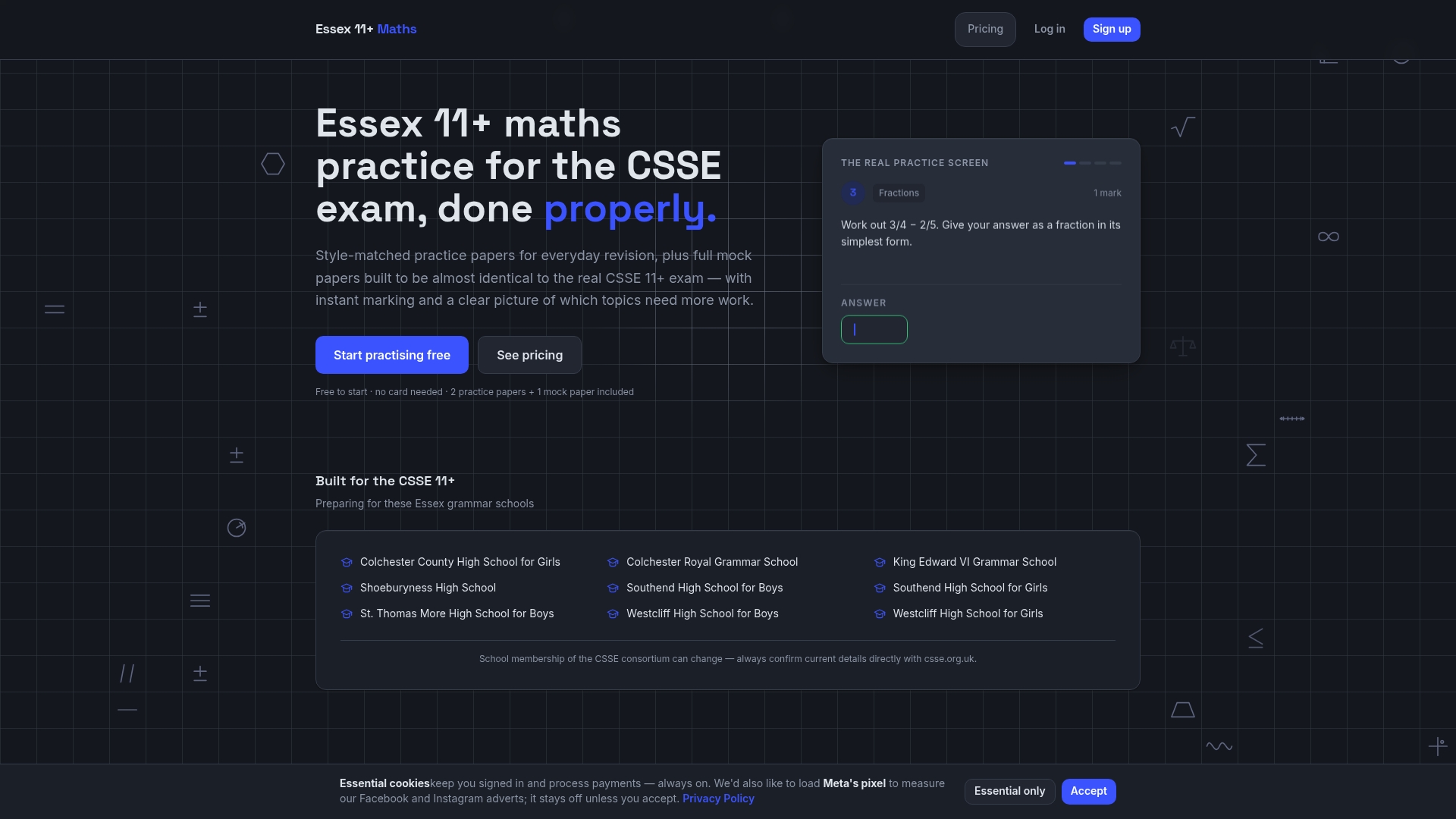
The platform’s practice papers are written specifically to match the style and format of the CSSE 11+ maths exam, so the questions your child sees in practice look and behave like the ones on the actual test rather than generic key stage 2 revision material. Instant marking and worked solutions on every question mean a wrong answer becomes a teaching moment immediately, not something reviewed days later once the method is forgotten. Progress tracking by topic makes it easy to see exactly where marks are being lost, which matters most in the final weeks before a test when time is short and needs to go on the right gaps.
- Start with free access to see how the question style compares with your child’s current practice materials.
- Use topic-by-topic tracking to identify weak areas before committing to a full revision plan.
- Move to full timed mock papers as the test date approaches, using the same instant marking to review mistakes straight away.
Full features, including complete papers, mock exams and detailed progress tracking, are available on the Monthly plan at £9.99 per month or the Yearly plan at £64.99 per year. Visit the pricing page to compare plans and start with free access today.
Sources
FAQ
What are the cut-off marks for CSSE secondary schools in 2026?
Cut-offs vary by school and by priority area rather than following a single fixed figure, though the consortium’s published minimum is a total standardised score of 303. Check the historical guidance sheet for your specific school and category to see last year’s actual last-offer score.
How are CSSE scores calculated?
Raw marks from the English and mathematics papers are each converted into a subject standardised score, and the two are added together with equal 50:50 weighting to produce the total standardised score. CSSE publishes both the raw subject scores and the combined standardised total on the results sheet.
How long is the CSSE exam?
The exam consists of two papers: English, which lasts 60 minutes with an additional 10 minutes of reading time beforehand, and mathematics, which lasts 60 minutes. Together they form the two components that make up the total standardised score.
Is CSSE multiple choice?
The CSSE information guide describes the format of each paper without characterising the test overall as multiple choice, so families should check the official guide for the current question format. Practising with materials that mirror the real paper’s style and timing is the most reliable way to prepare regardless of format.