Aim Above the 303 Floor: Official CSSE Marking Scheme PDFs for Essex
Aim Above the 303 Floor: Official CSSE Marking Scheme PDFs for Essex

Official CSSE mark schemes are published as PDFs on the CSSE website and show per-question marks, SPaG allocation and how raw marks feed into the standardised score. You’ll find them alongside past papers on the Practice Material and Examination pages at csse.org.uk, sorted by entry year. Download the version matching the year you’re practising, then use it to mark timed papers properly rather than guessing at what counts.
TL;DR:
- The official CSSE mark schemes are organized by entry year and should be downloaded from the Practice Material page to ensure accuracy.
- Marking schemes separate comprehension, applied reasoning, and continuous writing, awarding full marks for precise, supported answers and well-structured responses.
- CSSE maths schemes prioritize method marks for correct approaches and show working, with the final answer being less critical than the process.
- Standardised scores are calculated using a secret formula that adjusts for cohort variability and age, with scores below 303 generally not resulting in offers.
- Using official mark schemes in a two-pass routine helps identify weak areas, with instant online practice tools offering precise feedback and progress tracking.
Table of Contents
- Where to download the official CSSE marking guidelines
- How does the CSSE English marking scheme work?
- How does the CSSE maths marking scheme allocate marks?
- How does CSSE convert raw marks into standardised scores?
- Understanding CSSE historical cut-offs and pass marks
- Using mark schemes for revision that actually works
- Verifying an official CSSE mark scheme PDF
- A closing word on fair preparation
- How Essex 11+ Maths Practice fits your CSSE revision plan
- Sources
- FAQ
Where to download the official CSSE marking guidelines
The Practice Material page on Csse is the canonical source for both past papers and the mark schemes that go with them. Each document is organised by entry year, so a paper set for 2025 entry has its own matching PDF, separate from the 2024 set.
When you’re searching the page, look for these details before downloading anything:
- File names that state the paper type and entry year clearly (for example, “English paper 2023 entry marking scheme”).
- Separate documents for English and maths, since CSSE does not combine them into one file.
- A publication note or date stamp confirming the PDF is the finalised version, not a draft.
If a file you need seems to be missing or a link is broken, contact the CSSE office directly rather than relying on a copy from a tutoring forum or third-party site. The postal address and telephone number are listed on the CSSE Examination page, and it’s worth checking there before trusting any mark scheme sourced elsewhere.
How does the CSSE English marking scheme work?
The English paper covers comprehension, applied reasoning and continuous writing, each timed separately and marked against different criteria. One-mark questions usually reward a single correct word or short phrase, while multi-mark comprehension questions often accept a direct quotation from the text or a paraphrase, provided the meaning is preserved.
Continuous writing is where the CSSE assessment criteria get more detailed. The official continuous writing mark scheme splits marks between content and organisation on one side and SPaG (spelling, punctuation and grammar) on the other, with separate maximum marks for each. First and second markers record scores independently before they’re reconciled, which is part of why the scheme spells out acceptance criteria so precisely.
What earns full marks vs partial marks:
- Full marks on comprehension: a precise, textually supported answer that directly addresses the question, whether quoted or paraphrased.
- Partial marks: an answer that shows some understanding but misses a required element, such as naming only one of two causes asked for.
- Full marks on writing content: a structured piece with a clear beginning, middle and end, matched to the prompt’s genre.
- Partial marks on writing content: reasonable ideas let down by weak organisation or an abrupt ending.
The scheme’s own guidance notes that markers should accept paraphrase and quotation when either demonstrates understanding, which matters if your child tends to copy long passages instead of answering directly. A child who quotes accurately but doesn’t connect the quote to the question still loses marks, so accuracy alone isn’t the goal.
How does the CSSE maths marking scheme allocate marks?
Maths mark schemes follow a consistent structure: the question, the expected final answer, and a breakdown of method marks versus answer marks. This is where CSSE marks distribution differs most from a simple right-or-wrong tally, because method marks give partial credit for correct working even when the final answer is wrong.
- Method marks reward a correct approach, such as setting up the right calculation or using a valid formula, even if arithmetic slips lose the final mark.
- Alternative valid methods are usually accepted where they lead to the same result, not just the one route shown in the official answer.
- Working should always be shown on practice papers, since a correct answer with no working can lose available method marks under exam conditions.
- Calculator use follows whatever the specific paper’s rules state in that year’s scheme, so check the instructions rather than assuming.
Insisting your child shows working on every practice question, even ones they find easy, builds the habit that protects marks when a careless slip creeps in under time pressure.
How does CSSE convert raw marks into standardised scores?
Standardisation adjusts scores so that results are comparable across different test versions and cohorts, and age adjustment may also be applied depending on a child’s date of birth relative to the intake year, according to the CSSE Information Guide.

A standardised score isn’t the same as a percentage or a raw mark out of the paper total. It’s a converted figure designed to put every candidate on the same scale, and CSSE has confirmed that the exact formula for this conversion is published only after results are despatched, not in advance.
What the historical guidance actually states: CSSE’s published guidance sheet confirms that secondary school offers are not made to any child scoring under a total standardised score of 303. That figure is a minimum reference point, not a guaranteed offer threshold, and the same guidance stresses that lowest successful scores fluctuate year to year depending on cohort strength and school capacity.
- Each subject is weighted equally at 50%, so a strong maths paper can offset a weaker English result and vice versa.
- Age adjustment exists to account for the spread of birth dates within a single school-year intake.
- The 303 figure is a floor below which offers aren’t made, not a target score that guarantees a place.
Understanding CSSE historical cut-offs and pass marks
Reading the historical guidance sheet properly means separating two different things: a published minimum threshold (303) and the lowest successful score actually recorded at each individual school in a given year. Some Essex grammar schools have historically needed scores well above 303 simply because of local demand, while the minimum applies across the board.
- CSSE’s own historical sheet is explicit that these figures move year to year and should be treated as guidance, never a guarantee for your child’s application.
- There’s no single universal “pass mark” beyond the 303 floor. What actually decides admission is where your child’s standardised score ranks against other applicants for that specific school’s places.
- A child scoring below a school’s previous lowest successful score can still receive an offer in a different year, particularly where appeals or special consideration apply, or where that school’s applicant numbers shift.
Before assuming a target score rules a school out, check that school’s own admissions page for its specific process, since CSSE administers the test but individual schools set their offer criteria within that framework.
Using mark schemes for revision that actually works
A two-pass marking routine, recommended by tutoring specialists working with CSSE-style papers, keeps parents from over-marking or under-marking continuous writing. This method mirrors how CSSE’s own continuous writing scheme separates content from SPaG.
- Pass one: mark for correctness against the official scheme. Check maths answers against the expected final answer and award method marks for valid working, even where the final answer is wrong. For English, check comprehension answers against the model responses and mark continuous writing for content and organisation first.
- Pass two: mark SPaG and polish separately. Go back through continuous writing specifically for spelling, punctuation and grammar, using the scheme’s separate SPaG allocation rather than mixing it into the content score.
- Run timed simulations regularly. Full timed papers, marked immediately against the official scheme, reveal where marks are lost under pressure rather than in relaxed practice.
- Target weak topics in short, focused sessions. Once a marking pass shows a pattern, such as consistently losing method marks on ratio questions, spend a short session on that topic alone rather than repeating full papers.
Pro Tip: Keep a simple running log of which question types lose marks across several practice papers. A single low score means little, but a pattern across four or five papers tells you exactly where to focus next.
A platform like Essex 11+ Maths Practice complements this routine well, since it delivers CSSE-style questions with instant marking that mirrors the logic of an official scheme, plus worked solutions when something goes wrong.
Verifying an official CSSE mark scheme PDF
The safest sources remain the CSSE Practice Material and Examination pages directly, since third-party copies circulating online can be outdated or, occasionally, mismatched to the wrong entry year. Before you rely on any downloaded PDF for marking, run through a short checklist.
- Confirm the file is hosted on csse.org.uk, not a tutoring site or forum reposting an old copy.
- Check the entry year in the filename matches the paper you’re marking against.
- Look for a publication date or “for publication” label confirming it’s the finalised scheme.
If anything looks unclear or a document seems out of date, the CSSE Examination page lists office contact details, including phone and email, for exactly this kind of query.
A closing word on fair preparation
Official CSSE mark schemes remain the only fair standard for judging practice work, and it’s worth resisting the temptation to mark generously “for effort.” What matters more than any single practice score is the trend across several papers. A child improving steadily against the real scheme is in a stronger position than one who scored well once and plateaued.

How Essex 11+ Maths Practice fits your CSSE revision plan
Essex 11+ Maths Practice is the alternative to piecing together photocopied past papers and guesswork marking. It gives you CSSE-style maths questions built to match the real exam’s format, with instant marking and worked solutions that reflect exactly the kind of method-mark thinking the official scheme rewards.
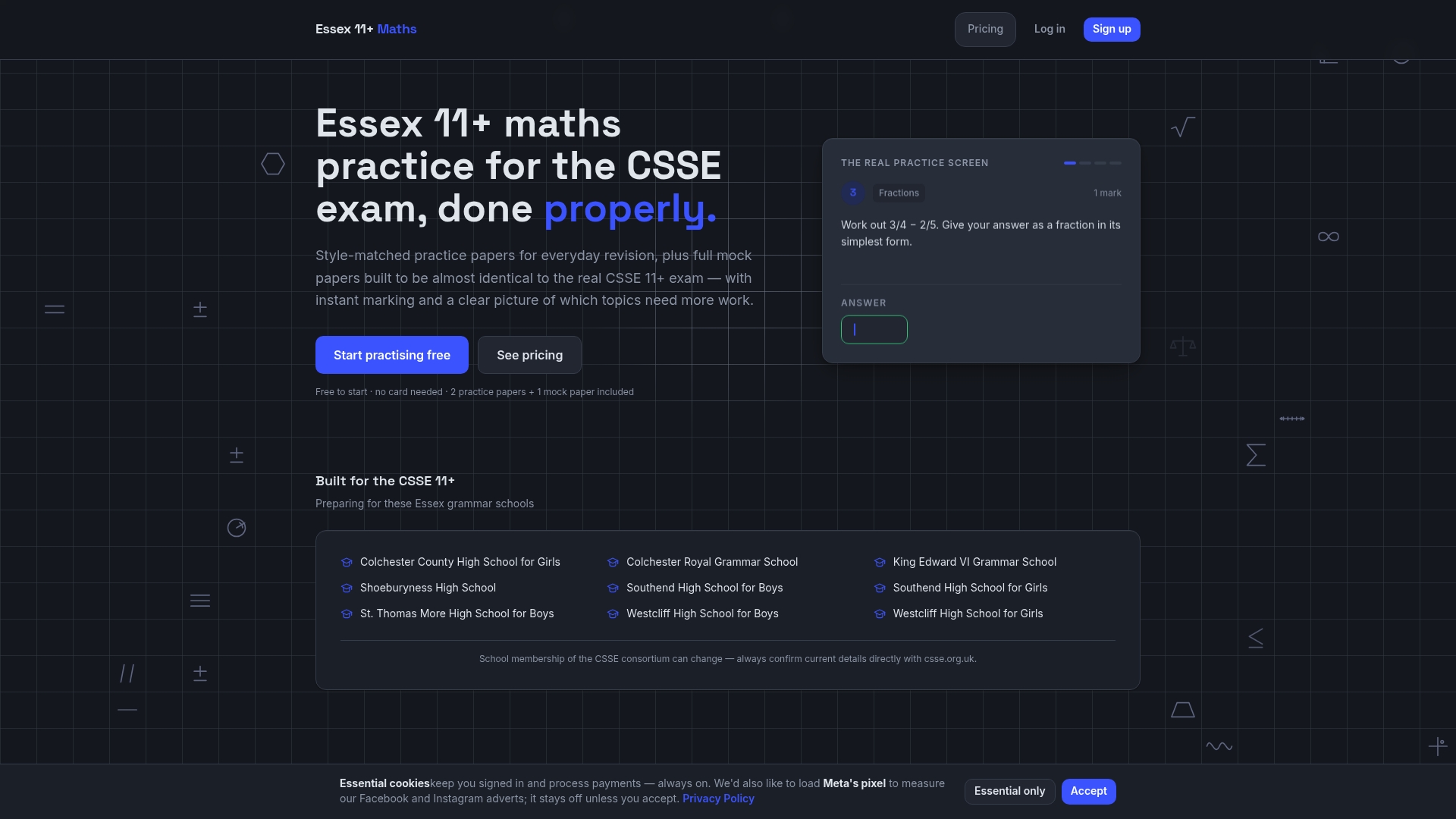
That matters for the revision routine set out above. Instead of marking a timed paper by hand and hoping you’ve applied the method-mark rules correctly, the platform marks instantly and shows the working, so your child sees straight away where a mark was lost and why. Topic-by-topic progress tracking then does the pattern-spotting for you, flagging weak areas across multiple sessions rather than leaving you to notice a trend from memory.
Essex 11+ Maths Practice offers various subscription options for access to practice materials and progress tracking. If you want a ready-to-run practice environment that mirrors official marking logic, check the pricing page and pick the plan that fits your revision timeline.
FAQ
What is the pass mark for CSSE?
There is no single fixed “pass mark” published for every school. CSSE’s own guidance confirms that secondary school offers are not made to any child scoring under a total standardised score of 303, but that figure is a minimum floor, not a target that guarantees a place at a specific school.
What are the CSSE cut-off marks for Essex grammar schools?
Cut-off marks vary by school and by year, since each school’s lowest successful score depends on how many children apply and how they perform that year. CSSE’s historical guidance sheet lists previous years’ figures explicitly as guidance, warning that they fluctuate and shouldn’t be treated as fixed targets.
What are the top grammar schools in Essex?
Essex has several selective grammar schools that use the CSSE test as their entry assessment, with admission criteria set individually by each school within the CSSE framework. Rather than ranking them, it’s more useful to check each school’s own admissions page for its specific historical intake figures and catchment rules.
How are CSSE scores calculated?
English and maths each count for 50% of the total, and raw marks from both papers are standardised rather than simply added together, according to the CSSE Information Guide. Age adjustment may also apply depending on a child’s date of birth, and the exact standardisation formula is only published after results are sent out.
Does Essex 11+ Maths Practice use official CSSE marking criteria?
Essex 11+ Maths Practice builds its questions to match the CSSE exam’s style and format, with instant marking and worked solutions designed to reflect how method and answer marks work in the official scheme. It offers Free, Monthly and Yearly plans, with full pricing details available on the pricing page.