Essex parents: CSSE exam format, 2 papers, 4 PDFs, 1 prep option
Essex parents: CSSE exam format, 2 papers, 4 PDFs, 1 prep option

The CSSE 11+ is two timed papers, English and mathematics, each worth 50% of the final standardised score and each 60 minutes long, with an additional 10 minutes of reading time built into the English paper. Both papers are marked and standardised the same way for every candidate. That structure, set out in the CSSE information guide, is the starting point for any sensible preparation plan.
TL;DR:
- Practising with official CSSE familiarisation papers and timed routines helps children learn the exact format, question styles, and pacing for the test day.
- Speed and accuracy are equally vital in the maths paper, which includes multi-step reasoning and real-world problems, requiring dedicated timed practice.
- Standardised scores depend on cohort performance, with places historically not offered to children scoring below 303, though individual school cut-offs vary annually.
- Late registration or missing deadlines can prevent a child from sitting with their peers, making early registration and confirmation essential.
- Applying for access arrangements requires supporting evidence and meeting deadlines; early preparation of all forms is crucial to ensure accommodations are in place.
Table of Contents
- English paper: sections, question types and timing
- Mathematics paper: structure, topics and pacing
- How papers are scored, standardised and how cut-offs work
- Registration, test dates and what happens on test day
- Access arrangements and SEND: applying, evidence and deadlines
- How to practise effectively using official materials
- Setting realistic expectations as a parent
- Where Essex 11+ Maths Practice fits alongside the official format
- Official CSSE documents worth downloading
- Sources
- FAQ
English paper: sections, question types and timing
The English paper tests comprehension and continuous writing within a single 60-minute sitting, preceded by 10 minutes of dedicated reading time in which candidates read the source text before answering begins, as confirmed in the CSSE information guide. Applied reasoning questions were removed from the English paper from 2024 onwards. Comprehension questions mix literal recall with inferential reasoning, asking a child to work out what a passage implies rather than simply what it states. The CSSE familiarisation English paper shows the paper’s actual layout and suggested subpart timings, which is far more useful for practice than a generic worksheet.
Based on that sample paper, a sensible in-home timing plan looks like this:
- Spend the full 10 minutes reading the passage before writing anything.
- Allow around 30 minutes for comprehension questions covering literal and inferential understanding.
- Budget around 10 minutes for applied reasoning items such as vocabulary or cloze-style questions.
- Reserve around 20 minutes for the continuous writing task, leaving a minute or two to check spelling and punctuation.
Practising against these subpart timings, rather than just the 60-minute total, teaches a child to pace themselves through each section instead of running out of time on the writing task.
Mathematics paper: structure, topics and pacing
The mathematics paper covers KS2 arithmetic and reasoning, drawing on multi-step problem solving rather than isolated calculation drills. Expect a mix of short numerical answers, reasoning questions that require working to be shown, and applied word problems that translate a real-world scenario into a calculation. The paper runs for 60 minutes with no separate reading time, so pacing across the full hour matters more than it does in English.
A practical pacing strategy for the maths paper:
- Work through short-answer arithmetic questions quickly to bank easy marks early.
- Slow down for multi-step reasoning questions and show working rather than guessing.
- Leave a few minutes at the end to revisit any flagged or skipped questions.
Timed practice sets, repeated regularly, build the speed and accuracy this paper rewards. A child who can do long division correctly but too slowly will lose as many marks as one who makes careless errors, so both speed and accuracy need separate attention during revision.
How papers are scored, standardised and how cut-offs work
Each paper contributes 50% to the total standardised score, and raw marks are converted to a standardised score across the whole cohort rather than being added up directly, as the CSSE information guide explains. CSSE also analyses results by date of birth, since children born earlier in the school year tend to perform slightly differently from those born later, and applies a statistical age-adjustment where appropriate.
CSSE publishes historical guidance sheets showing that places have not been offered to children with a total standardised score under 303, though individual schools set their own cut-offs that vary year to year depending on cohort performance. Treat any published cut-off as indicative rather than a guarantee for the year your child sits the test.
Registration, test dates and what happens on test day
Registration for the CSSE 11+ opens each year through CSSE’s own online forms, and missing the published deadline generally means a child cannot sit the test with their peers, so this is the first practical step to get right.
- Register online within the window CSSE publishes each year, well before the deadline closes.
- Watch for confirmation correspondence from CSSE or the test centre confirming which school your child will sit the test at.
- The main test takes place on a fixed Saturday, with a limited alternative Tuesday sitting reserved for candidates with a genuine religious or medical reason for not sitting on the Saturday.
- On the day, take the confirmation letter, any required identification, and standard equipment such as pens and a reading book for any waiting period.
- Test centres have fixed capacity, so a child may occasionally be allocated to a different centre or the alternate date for administrative reasons rather than anything related to their application.
Access arrangements and SEND: applying, evidence and deadlines
CSSE uses a tiered framework for reasonable adjustments, running from low-impact changes such as extra time through to higher-impact arrangements like a reader or scribe, as set out in the CSSE SEND access arrangements guidance. Applying requires three forms: the Registration Form (F1), the Access Arrangements Notification (F2), and a Headteacher’s letter (F3), supported by medical or EHCP evidence where relevant.

Decisions are made centrally by CSSE, with input from an Executive SEND Panel, rather than by individual test centres, and the guidance sets a firm submission deadline each year, for 2027 entry this fell on 26 June 2026. Missing that window can mean an arrangement simply isn’t available on the day. If a child is unwell on the morning of the test itself, contact the test centre and CSSE as early as possible, since this is handled separately from the pre-arranged access arrangements process.
How to practise effectively using official materials
The single most useful resource is the CSSE familiarisation paper itself, because it shows the exact format, question style and suggested timings rather than a generic KS2 test written for a different purpose. CSSE’s own materials suggest that a few hours spent working through the official papers teaches a child more about what to expect than weeks of unfocused drilling.
A structured routine works best: read the passage for the full 10 minutes before touching the comprehension questions, then move straight into timed arithmetic and reasoning sets for maths without a break, mirroring how the actual morning will run. Comprehension practice should use texts pitched above the child’s current reading age, since the papers are designed to stretch rather than confirm existing ability, and writing practice should include full sustained pieces rather than short paragraphs.
Pro Tip: Once a fortnight, simulate the entire timed morning back to back, English then maths, with the same breaks the test day will have, so your child practises stamina and pacing rather than isolated skills.

Setting realistic expectations as a parent
Cut-offs shift from year to year because they depend on cohort performance, not a fixed pass mark, so chasing a specific historical number is less useful than solid, consistent preparation. Prioritise quality of practice and your child’s wellbeing over sheer hours drilled, and treat the CSSE information guide as the final word on anything this article simplifies.
Where Essex 11+ Maths Practice fits alongside the official format
Once you know the CSSE maths paper rewards speed, accuracy and multi-step reasoning, the practical question becomes how to build those skills at home without guessing at what the real paper looks like. Essex 11+ Maths Practice writes its questions specifically to match the style and format of the CSSE maths paper, rather than adapting generic KS2 resources, so a child’s timed practice reflects the actual test structure.
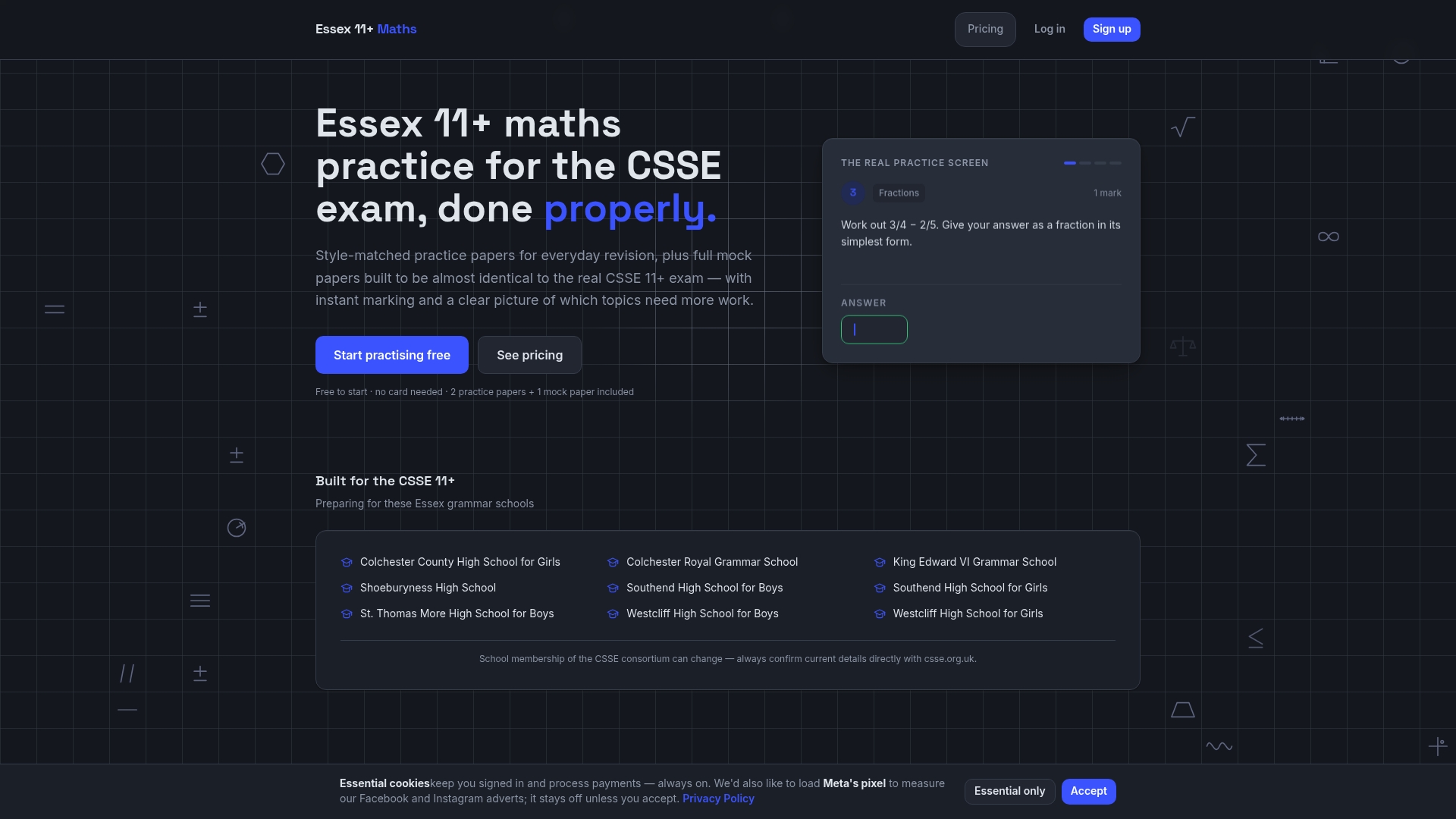
The platform’s features are built around a format match inspired by the CSSE maths paper:
- Maths papers covering arithmetic, reasoning and problem-solving question types similar to those in the real paper.
- Instant marking with worked solutions to help identify where mistakes occur rather than just providing a final score.
- Topic-by-topic progress tracking to help spot areas needing more timed practice before test day.
You can start with the free access to see how the format match works, then move to a Monthly or Yearly plan for full access to mock papers, lessons and progress tracking as the test date approaches.
Official CSSE documents worth downloading
Before test day, keep these official documents on hand:
- The CSSE information guide, covering entry details, timing and scoring.
- The CSSE familiarisation paper, showing sample questions, mark schemes and suggested timings.
- The CSSE SEND access arrangements guidance, setting out forms and deadlines.
- The historical guidance sheet, showing past standardised score guidance.
Sources
- CSSE information guide 2027 entry (CSSE-Information-Guide-2027-Entry.pdf)
- 11+ selective test SEND access arrangements 2027 entry (CSSE SEND Guidelines)
- CSSE familiarisation English practice paper (sample)
- Historical guidance sheet (scores of last selective place offered)
FAQ
What is the pass mark for CSSE?
There is no single fixed pass mark. CSSE’s own historical guidance notes that places are not offered to children with a total standardised score under 303, but individual schools set their own cut-offs, which vary from year to year depending on cohort performance.
How can I prepare for the CSSE 11+ exam?
The most effective approach is working through the official CSSE familiarisation papers to learn the exact format and timings, then building timed practice routines for both comprehension and maths reasoning. Tools like Essex 11+ Maths Practice can support the maths side with format-matched questions and instant feedback.
How long is the CSSE exam?
Each paper, English and mathematics, runs for 60 minutes, and the English paper adds a further 10 minutes of reading time beforehand, according to the CSSE information guide. In total, a candidate spends around two and a half hours across both papers including breaks.
Is 70% enough to pass the 11+?
Raw percentages don’t translate directly into a pass, because CSSE converts raw marks into a standardised score across the whole cohort before comparing them against school cut-offs. A stronger benchmark is the published historical guidance around the 303 total standardised score, though actual offers depend on the specific school and year.