15 Minutes a Day: CSSE English Strategies Essex Parents Can Start
15 Minutes a Day: CSSE English Strategies Essex Parents Can Start

The CSSE English paper tests reading comprehension, applied reasoning and continuous writing in a single sitting lasting a little over an hour, and the single best preparation priority is timed practice on official CSSE familiarisation papers rather than generic worksheets. Candidates get 10 minutes to read the material before answering, then manage their own time across the three sections. Add focused drills on quotation and explanation technique plus vivid continuous writing, and most gaps close quickly.
TL;DR:
- Timed practice with official CSSE familiarisation papers is crucial, as it best prepares students for the real exam’s question styles and time pressure.
- Focus on pairing concise quotations with detailed explanations in comprehension questions to maximize marks, especially since explanations are weighted more heavily.
- For applied reasoning, quickly annotate questions and test initial ideas against examples, skipping questions that do not yield answers within 30 to 40 seconds to save time.
- Implement a micro-plan for continuous writing that includes a hook, build points, and a planned resolution, using sensory techniques and a final review to improve clarity and marks.
- Use mock exams with instant feedback and targeted drills to track progress, with even 15-minute daily routines helping prevent stagnation especially in writing skills.
Table of Contents
- CSSE English format and essential logistics
- How to read actively and answer high-tariff comprehension questions
- Applied reasoning: efficient methods for tricky question types
- Continuous writing tactics that win examiner marks
- Practice materials: past papers, mark schemes and realistic mocks
- Time management and exam technique for test day
- Why and how Essex 11+ Maths Practice complements official CSSE study
- A parent’s perspective: one small change that worked
- Getting started with Essex 11+ Maths Practice
- Sources
- FAQ
CSSE English format and essential logistics
The English paper gives candidates 10 minutes of dedicated reading time, followed by 60 minutes to answer questions across comprehension, applied reasoning and continuous writing. Once the reading period ends, nobody prompts a pupil to move sections, so self-paced timing is a skill in its own right rather than something that happens automatically.

Scores are standardised and may be age-adjusted, which means a child born in August is compared fairly against one born in September rather than penalised for being younger in the school year, according to the CSSE Information Guide. English and maths typically carry equal weight for each candidate’s overall result.
Before test day, parents in Essex should sort the practical details:
- Register within the window the school or CSSE specifies, since late registration can affect test centre allocation.
- Check the allocated test centre and plan the journey in advance, particularly for families travelling from towns such as Colchester or Saffron Walden.
- Note that the CSSE office has published closure dates around the exam period, so queries are best sent well ahead rather than left for the final week.
How to read actively and answer high-tariff comprehension questions
Reading the questions before the passage lets a pupil scan for relevant detail rather than absorbing everything blind, a habit worth building well before exam week. Once a question is in view, the highest-scoring answers pair a short, precise quotation with a clear explanation of what it shows, since the official mark scheme rewards the explanation far more heavily than the quotation itself. A bare quotation without commentary tends to cap the mark, whatever the length of the extract chosen.
A simple three-step approach works for most comprehension items:
- Read the question fully and underline the key instruction word, such as “explain” or “describe”.
- Scan the passage for the specific line or phrase that answers it, rather than rereading from the top.
- Write the quotation briefly, then spend more words explaining what it reveals about character, mood or meaning.
A short home drill helps this stick. Give a child a single paragraph and one question, set a two to three-minute timer, and ask them to underline their chosen quotation before writing one explanatory sentence. Repeating this little exercise three or four times a week builds speed without turning revision into a chore, and progression should move from short factual questions to inference-based ones as confidence grows.
Pro Tip: Treat every quotation as evidence for a case you are building, not as the answer itself.
Applied reasoning: efficient methods for tricky question types
Applied reasoning questions cover coded words, pattern completion and short logical puzzles, and they typically demand quick, disciplined thinking rather than deep reading. Timing is tight relative to the number of items, so a fast, repeatable method matters more than raw cleverness.
- Annotate the question first, marking any pattern, letter shift or rule you can spot straight away.
- Test your first idea against one example in the question before committing to it fully.
- Eliminate answers that clearly break the rule, then choose from what remains rather than staring at all options equally.
When a question refuses to yield an answer within roughly 30 to 40 seconds, the better move is to skip it, mark it for a return visit, and protect time for the rest of the section. Short, regular puzzle practice, even five minutes a few times a week, sharpens pattern recognition faster than occasional long sessions.
Continuous writing tactics that win examiner marks
A strong continuous writing answer usually follows a simple shape: a hook that grabs attention, a build that develops tension or detail, and a resolution that closes the piece with intent. A five-minute micro-plan before writing, just a few words against each stage, stops pupils from meandering once the pen is moving.
- Jot the hook: one striking image, sound or line of dialogue to open with.
- Note two or three build points that develop the scene or story in order.
- Decide the resolution in advance so the ending feels planned rather than rushed.
Sensory and language techniques lift a piece from adequate to memorable: simile, metaphor, onomatopoeia and deliberately varied sentence lengths all help, and practising with a mnemonic such as SOAPM (sounds, opinions, actions, personification, movement) gives a structure for weaving in sensory detail without it feeling forced.
Spelling, punctuation and grammar pick up marks that are often the easiest on the paper to secure, since they do not depend on inspiration. In the final three to five minutes, a pupil should check capital letters, full stops, apostrophes and any word they were unsure how to spell.
Pro Tip: Read the last paragraph aloud in your head. Clumsy sentences usually reveal themselves the moment you “hear” them.
Practice materials: past papers, mark schemes and realistic mocks
The CSSE practice material page is the primary source for preparation, offering free familiarisation papers alongside additional packs, and it remains the only complete reference for question types and mark tariffs. Commercial resources can be useful for topic drills, but CSSE itself cautions against relying solely on lookalike materials that do not reflect its actual style.
- Download a past paper and mark scheme together, then run it under full exam timing at home.
- Mark the attempt strictly against the official scheme rather than guessing what “close enough” looks like.
- Use commercial practice papers for extra repetition on weak topics, not as a substitute for the official format.
Time management and exam technique for test day
A consistent timing plan removes the guesswork that costs marks under pressure. Suggested minute allocations from familiarisation materials put roughly 30 minutes on comprehension, 10 on applied reasoning and 20 on continuous writing after the initial 10-minute reading period, though pupils should adjust slightly based on their own strengths.
- Use the reading window to skim all three sections, not just the comprehension passage, so nothing on the paper is a surprise.
- Set an internal rule to move on from any single question that is taking noticeably longer than its share of marks suggests.
- Save the last five minutes for a SPaG check across the continuous writing answer rather than starting anything new.
For parents, a short administrative checklist avoids last-minute stress: confirm registration proof is in hand, plan the travel route the night before, and note any CSSE office closure dates from the information guide so a query does not land in a dead period.
Pro Tip: Rehearse the timing plan at home with a kitchen timer at least twice before the real exam, so the rhythm feels familiar rather than foreign.

Why and how Essex 11+ Maths Practice complements official CSSE study
Official past papers set the standard, but repeated timed practice with fast feedback is what turns familiarity into speed. Essex 11+ Maths Practice offers CSSE-style practice papers and mock exams built to mirror the real timing and question format, with instant marking and detailed feedback that flags weak topics without a week’s wait for results.
- Papers are written specifically to match CSSE-style format rather than generic key stage material.
- Instant marking and worked solutions let a family review a mock the same evening it was sat.
- Progress tracking by topic shows exactly where the next week’s revision should focus.
A simple weekly routine fits naturally around this: one timed mock, an immediate review session, then short targeted drills on whatever the feedback flags.
A parent’s perspective: one small change that worked
One pattern that tends to come up in parent conversations across Essex is a child who plateaued on continuous writing until timed practice was paired with a strict five-minute SPaG check at the end of each attempt. The mark climbed steadily within a few weeks. The lesson is not complicated: a short, consistent daily routine, even 15 minutes, beats an occasional long weekend session.
Getting started with Essex 11+ Maths Practice
If your child has not yet sat a full timed mock, that is the honest starting point, and the free plan makes it possible to try one this week at no cost.
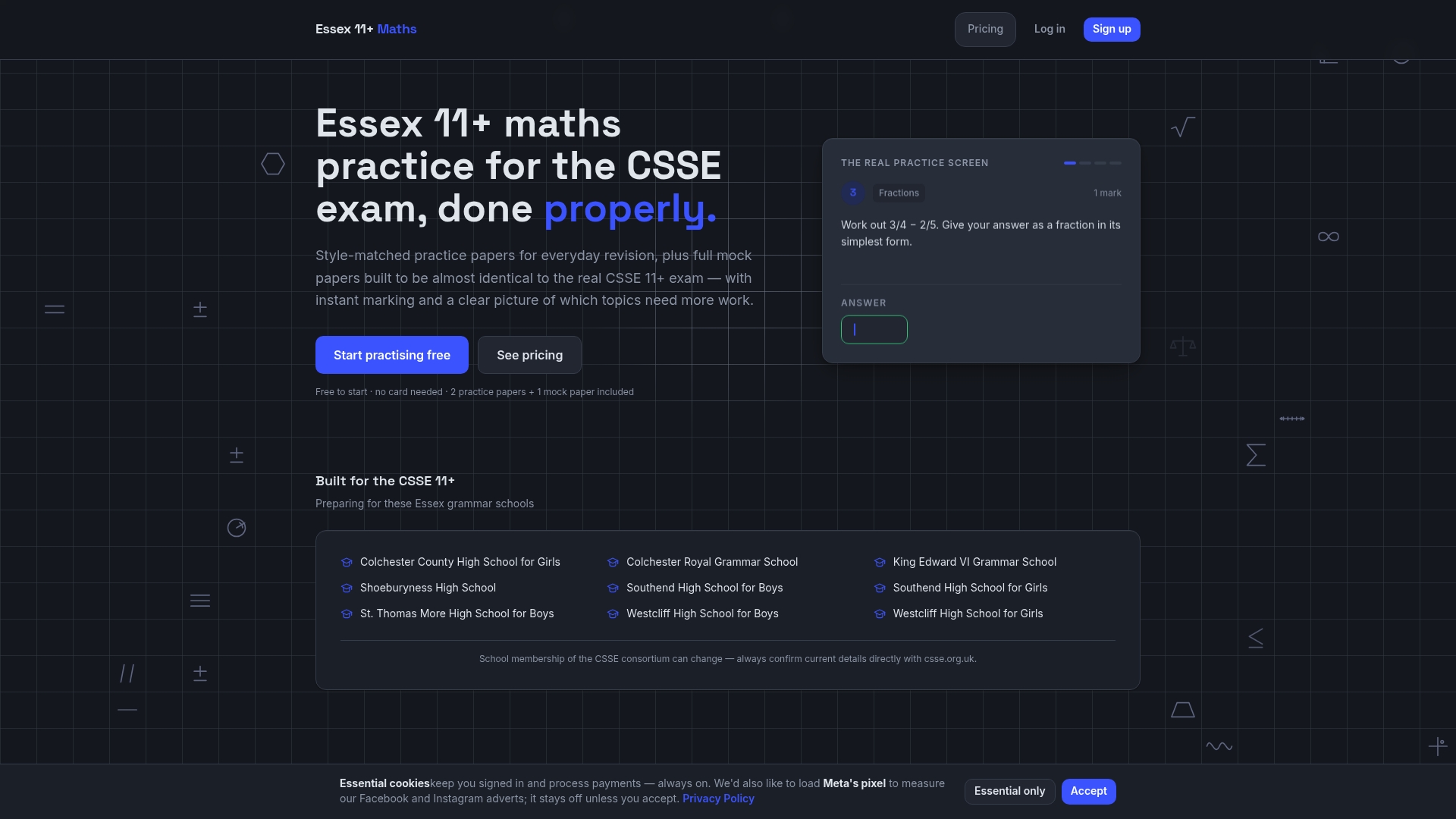
- Start with the Free plan to run a genuine timed mock and see where marks are actually being lost.
- Move to a paid subscription plan once you know which topics need sustained attention.
- Treat the platform as a complement to official CSSE papers, not a replacement for them.
Visit Essex 11+ Maths Practice to see the full range of practice material and get started.
Sources
The CSSE practice material page hosts past papers and mark schemes, while the CSSE Information Guide covers registration and test-day logistics in full.
- ENGLISH PAPER MAIN TEST 1 FOR 2023 ENTRY (CSSE)
- Engaging with CSSE 11+ English: How to write continuously
FAQ
What is the pass mark for CSSE?
CSSE does not publish a single fixed pass mark, since scores are standardised and, in some cases, age-adjusted before a school’s own admission threshold is applied. The relevant figure to check is the admitting grammar school’s own published standard for the year of entry.
Which CSSE schools are located in Essex?
CSSE coordinates entrance testing for a group of grammar schools across Essex, and families should check the current list of participating schools directly through the CSSE Information Guide for the relevant entry year. School participation can change between years, so the guide is the reliable reference rather than older listings found elsewhere.
What are the best grammar schools in Essex?
There is no single official ranking of Essex grammar schools, and the right fit depends on a family’s location, a child’s strengths and each school’s own admissions criteria. Parents comparing options are better served checking each school’s published results and open day information directly rather than relying on informal league tables.
Is CSSE multiple choice?
The CSSE English paper is not purely multiple choice: it combines short-answer comprehension questions, applied reasoning items and an extended continuous writing task. Some applied reasoning questions use a selected-answer format, but the paper as a whole requires written responses across most sections, according to the official English paper.