3–6 Minute Animated Maths Lessons for CSSE 11+: Evidence Backed Design
3–6 Minute Animated Maths Lessons for CSSE 11+: Evidence Backed Design
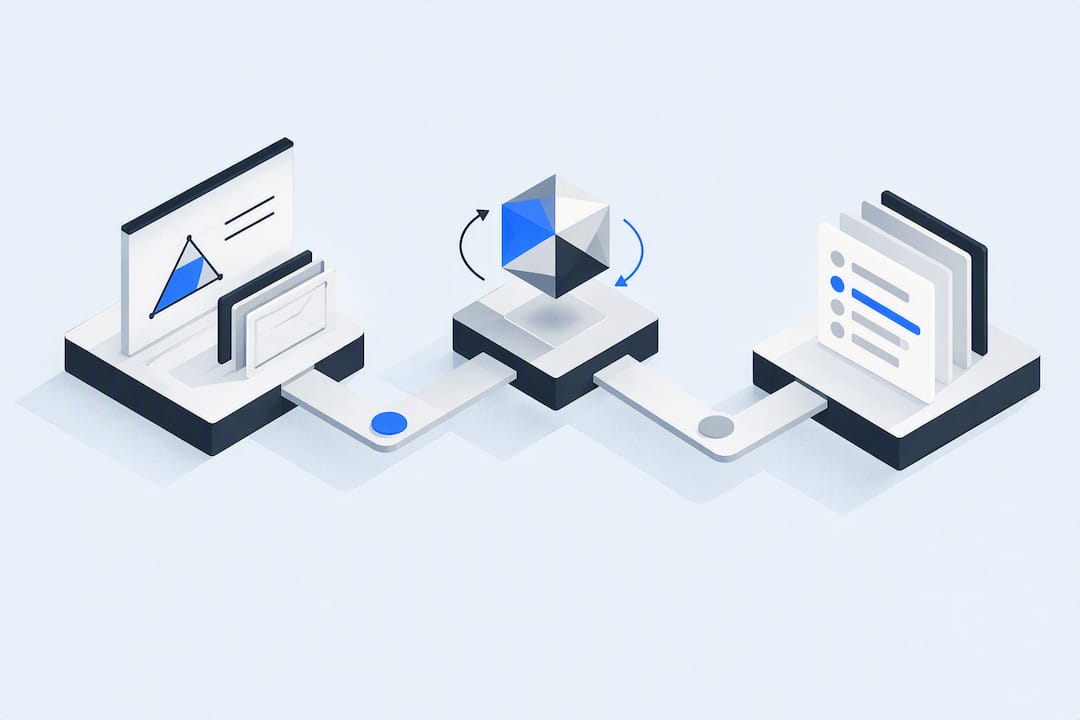
Animated maths lessons are worth using for CSSE 11+ preparation, but only the well-designed ones, and only when watching is followed by practice within minutes, not days. The evidence backs animation for topics involving movement or change, such as place value or fraction partitioning, far more than for static facts. Essex 11+ Maths Practice pairs its animated lessons with instant marking and worked solutions for exactly this reason. Watch one short lesson, then sit a timed practice set straight after.
TL;DR:
- Animation is most effective for teaching concepts involving change, such as place value, fractions, and geometric transformations, not static facts.
- Effective lessons incorporate segmentation, signaling, and active prompts to reduce cognitive load and enhance understanding.
- Pair animated lessons with immediate guided practice and manipulatives to improve retention and application of concepts.
- Focus on lessons that allow pausing, replaying, and include practice questions with instant feedback, especially aligned to the CSSE 11+ curriculum.
- Price and production quality are less important than instructional design features that support active, focused learning.
Table of Contents
- What the research says: when animation helps (and where it has limits)
- What to expect inside an effective animated maths lesson
- How to use animated lessons in a study routine for CSSE success
- Concrete lesson topics that map to CSSE 11+ maths
- How to choose an animated maths resource
- Why I’d trust design features over production value
- Try animated lessons built for the CSSE exam, not generic KS2 content
- Sources
- FAQ
What the research says: when animation helps (and where it has limits)
Animation earns its place in a maths lesson when it shows something changing, not when it simply illustrates something static. A systematic review of learning demands in instructional animations found that animated content outperforms still diagrams specifically when the concept being taught involves movement over space or time, such as a number line shifting or a shape rotating. For fixed facts, like naming a triangle’s sides, a static picture does the job just as well.
This is sometimes called the animation gap: the benefit shows up for dynamic concepts and shrinks, sometimes to nothing, for classification or labelling tasks. A systematic review synthesising 16 studies on educational animation found real gains in comprehension and engagement, but only when the animation carried genuine instructional design, not decoration.
That’s the catch most parents miss when browsing animated resources:
- Motion alone does not teach. It has to be paired with segmentation, pacing control and active tasks to reduce distraction rather than add to it.
- Gains are strongest for topics involving change: place value, fractions, ratio, geometry transformations.
- Evidence for long-term retention and higher-order problem-solving is still thin. A literature review of animation in mathematics education flags small sample sizes and short study durations as a genuine limitation across the field.
Pro Tip: If a lesson uses animation to show a static fact, that’s a sign it’s decorative rather than functional. Save your time for animations that show something happening.
Treat animated lessons as one part of a wider study plan rather than a stand-alone fix. The research supports that framing, not a bigger promise.
What to expect inside an effective animated maths lesson
Not all animated lessons are built the same way, and the difference between a good one and a mediocre one rarely comes down to production quality. It comes down to whether the lesson respects how children actually process information on screen. An ERIC-indexed review of instructional design in animated learning points to a specific set of features that convert an entertaining video into something that genuinely teaches.
- Segmentation controls. The lesson breaks into short, pausable chunks rather than running as one continuous clip, and lets a child replay a single step without rewatching the whole thing.
- Active engagement points. Prediction prompts and quick questions appear mid-lesson, not just at the end, so the child has to think rather than passively watch.
- Signalling over decoration. Key steps are highlighted clearly, arrows and colour draw the eye to what matters, and there’s no unnecessary motion competing for attention.
- Curriculum tagging. The lesson states which topic and year group it targets, and includes at least one worked example in an exam-style question format.
- Coherence. Narration matches what’s on screen at that exact moment, rather than describing something the child saw ten seconds ago.
Segmentation and signalling matter because they manage what cognitive scientists call extraneous load, the mental effort spent on figuring out what to look at rather than on the maths itself. A lesson that pauses naturally at each new idea gives a child’s working memory room to actually process it, instead of forcing them to hold five steps in their head while a narrator races through step six.
How to use animated lessons in a study routine for CSSE success
Watching an animation on its own rarely moves the needle on exam results. The evidence consistently points to animation being most useful as the opening step in a short, repeatable cycle, not as revision in itself.
A routine that works for most CSSE candidates looks like this:
- Watch a short animation, ideally 3 to 6 minutes, focused on a single concept rather than a broad topic.
- Do guided practice immediately afterwards: one worked example followed by 8 to 12 short questions, with at least some questions timed to build exam pace.
- Make the link concrete using manipulatives or a whiteboard, physically representing what the animation showed so the visual model connects to the written method a marker expects to see. The Education Endowment Foundation’s guidance on manipulatives backs this step directly.
- Repeat with spaced review days later, gradually increasing difficulty, and use instant marking to flag exactly which question types are still shaky.
The order matters more than the individual steps. Skip straight from watching to a full mock paper and most children forget the visual model within a day. Slot in guided practice within minutes of watching, and the same lesson sticks considerably better.
Concrete lesson topics that map to CSSE 11+ maths
Some maths topics simply lend themselves to animation more than others, and knowing which ones lets you spend screen time where it counts rather than on every topic equally.
- Place value and multiplying or dividing by 10, 100 or 1,000. Animation shows digits physically shifting position, which is far easier to grasp moving than as a static rule about “adding zeros.”
- Fractions, decimals and percentages (FDP). Watching a shape split into partitioned segments in real time makes equivalence and conversion visible rather than abstract.
- Ratio and proportion. Animated bar models that stretch and rescale show the relationship between quantities changing, which a printed diagram can only show as one frozen moment.
- Basic geometry and shape composition. Rotating, reflecting or combining shapes on screen demonstrates transformations that are genuinely difficult to picture from a still image.
A sample lesson flow for fraction partitioning might run: a visual model shows a bar splitting into equal parts, followed by a worked exam-style example converting that fraction to a decimal, then a short quick-fire practice set, then instant marking with corrections shown as worked solutions rather than just a tick or a cross.
| Topic | Why animation helps | What to check for |
|---|---|---|
| Place value | Shows digits shifting position dynamically | Clear signalling of decimal point movement |
| Fractions/FDP | Partitioning shown as a live process | Conversion steps narrated in sync with visuals |
| Ratio and proportion | Bar models rescale to show relationships | Practice set follows immediately |
| Geometry transformations | Shapes rotate/reflect on screen | Worked example in exam-style wording |
How to choose an animated maths resource
Before subscribing to anything, run a quick checklist against a sample lesson. Look for clear alignment with the national curriculum, the ability to pause, replay and step through segments, built-in practice with worked solutions attached, transparent pricing with no hidden tiers, and a sample lesson you can try before paying.
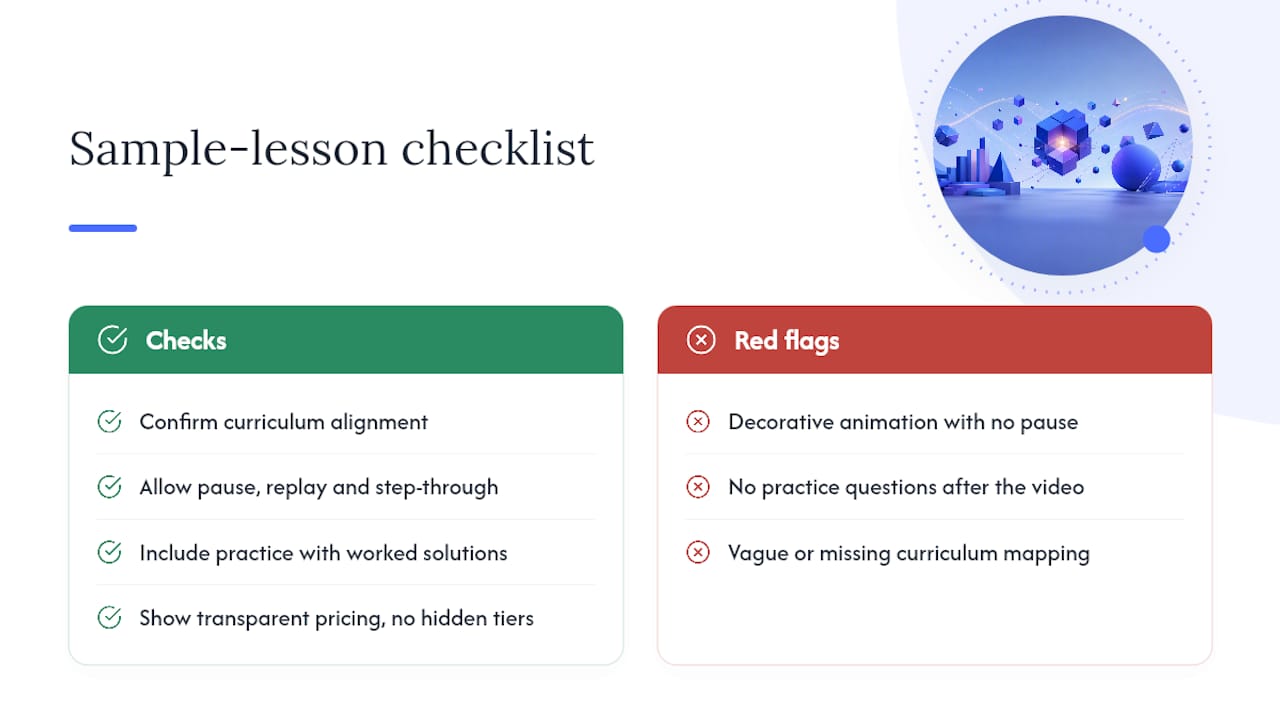
Red flags include animation that’s purely decorative with no pause function, no practice questions following the video, or curriculum mapping that’s vague or missing entirely.
Ask any provider three quick questions: Can my child pause and replay a step mid-lesson? Is there a practice set immediately after, with marking? Which exam board or curriculum year does this topic map to?
Why I’d trust design features over production value
The animated lessons that actually move a child’s understanding are rarely the flashiest ones. Watching how the research on instructional design keeps circling back to the same handful of features, mainly segmentation, signalling and immediate active practice, has shaped a consistent view here: production budget tells you almost nothing about whether a lesson teaches anything.
This guide leans on the systematic reviews and curriculum guidance cited throughout, alongside a practical read of what a CSSE-focused publisher’s animated lessons, instant marking and worked solutions actually offer a family trying to prepare efficiently. The two aren’t in tension. Research explains why a feature matters; the publisher’s product shows what that feature looks like in a real lesson a child can sit down and use tonight.
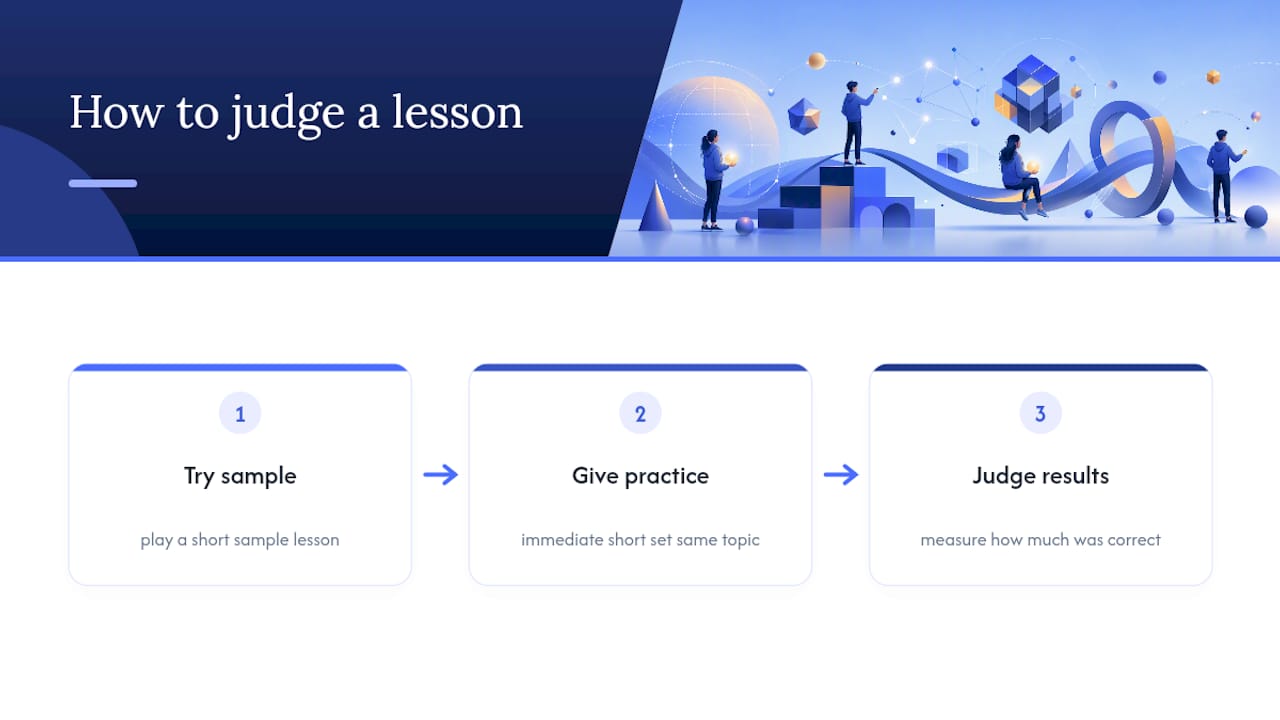
If there’s one piece of advice worth repeating, it’s this: don’t judge an animated lesson by how polished it looks. Try a sample lesson, then immediately sit a short practice set on the same topic, and judge it by how much of that practice your child gets right.
Try animated lessons built for the CSSE exam, not generic KS2 content
Most animated maths resources are built for a national curriculum audience, not for the specific style and format the CSSE 11+ paper actually uses. Essex 11+ Maths Practice writes its animated lessons and practice questions to match that exam format directly, so the worked examples your child sees look like the ones they’ll face on the day.
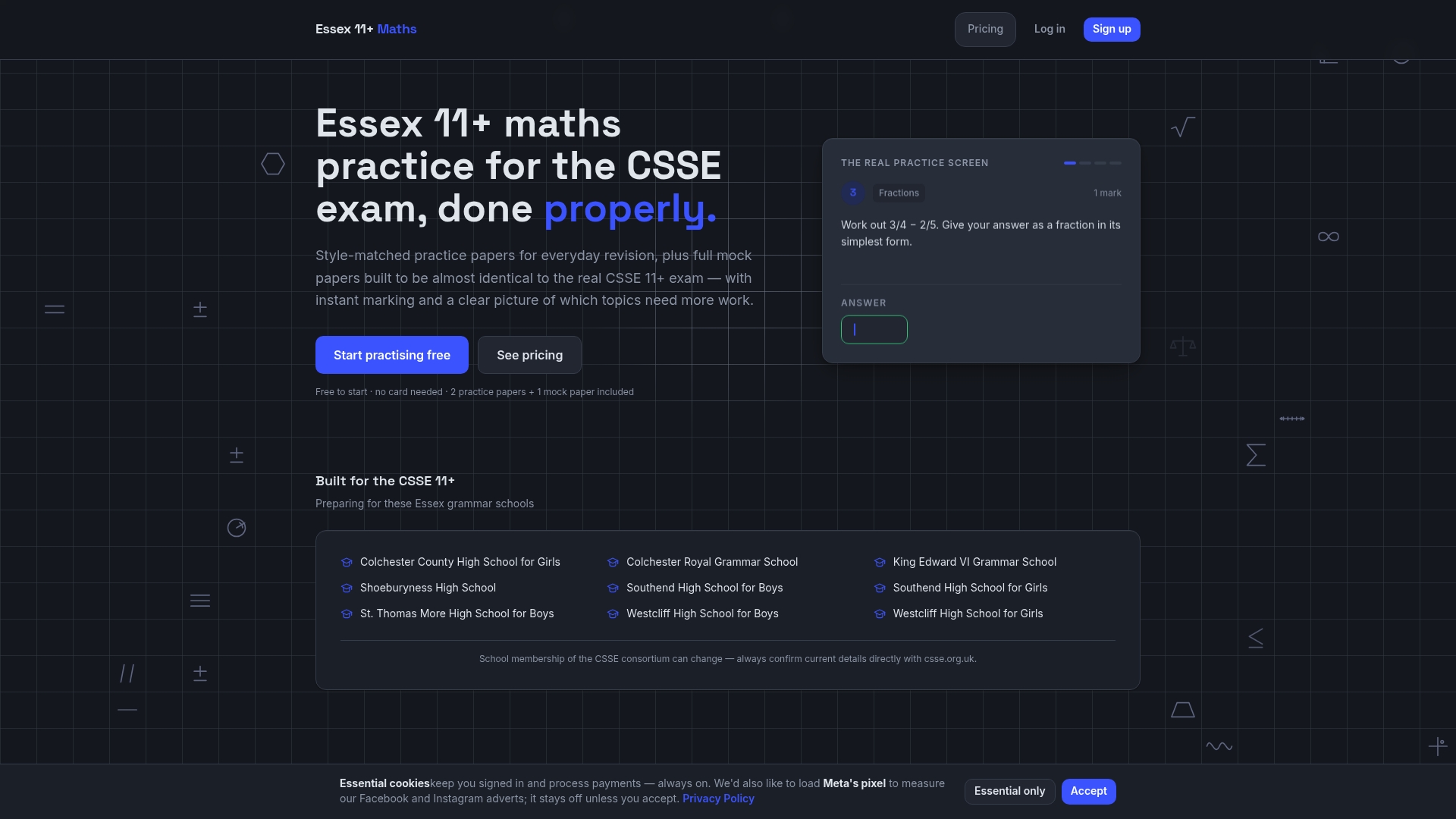
Against the checklist covered above, the platform’s lessons come with pause and replay built in, instant marking with full worked solutions attached to every question, and topic-by-topic progress tracking so you can see exactly which areas need another pass. Pricing is transparent: a free tier to start, a Monthly plan at £9.99, or a Yearly plan at £64.99, all listed on the pricing page. Start with a free lesson, follow it with a short practice set, and see how quickly weak spots surface.
Sources
- A review of learning demands in instructional animations: The educational effectiveness of animations unfolds if the features of change need to be learned
- Instructional design features matter for animated learning (ERIC indexed review)
- National curriculum in England: mathematics programmes of study
- A Systematic Review: The Impact of Educational Animation on Student Learning Outcome
FAQ
Do animated maths lessons improve exam results?
Animated lessons can support understanding, especially for topics involving change like fractions or place value, but the research is clear that gains depend on design quality and follow-up practice, not the video alone. Pairing a short animation with immediate timed practice tends to produce far better results than watching alone.
What makes an animated maths lesson effective rather than just entertaining?
Effective lessons include segmentation controls, active prompts like prediction questions, and clear signalling of key steps rather than decorative motion, according to a review of instructional design features. A lesson without pause points or follow-up questions is unlikely to build lasting understanding.
Which CSSE 11+ topics benefit most from animation?
Topics involving movement or transformation benefit most, including place value shifts, fraction partitioning, ratio and proportion, and geometric transformations. Static facts, like naming shapes, show far less benefit from animation over a still diagram.
How much does Essex 11+ Maths Practice cost?
Essex 11+ Maths Practice offers a free plan to start, with a Monthly subscription at £9.99 and a Yearly subscription at £64.99, both listed on the pricing page. All paid tiers include animated lessons, instant marking and worked solutions.
Should animated lessons replace practice papers for 11+ preparation?
No. Animated lessons work best as the first step in a study routine, followed immediately by guided practice and, ideally, manipulative work to ground the visual model in written method. Practice papers and timed question sets remain essential for building the fluency CSSE 11+ exams actually test.