All About Prime Numbers: The Essex 11+ Revision Guide for Busy Parents
All About Prime Numbers: The Essex 11+ Revision Guide for Busy Parents
As a parent helping your child prepare for the selective school entrance exams in Essex, you already know how high the stakes are. According to official admissions data from the Consortium of Selective Schools in Essex (CSSE), over 5,000 children sit the 11+ entrance exam annually, competing for around 1,000 coveted grammar school places. When the margins between securing a place and missing out are razor-thin, mastering core arithmetic concepts is non-negotiable.
In this comprehensive guide, we will cover all about prime numbers, giving you the exact strategies, common exam traps, and quick revision methods to help your Year 6 child secure those crucial maths marks.
Key Takeaways for Busy Parents
If you only have two minutes before the school run, here is what you need to know about how prime numbers are tested in the 11+ maths paper:
| Core Concept | Why It Matters for the CSSE 11+ | Quick Parent Tip |
|---|---|---|
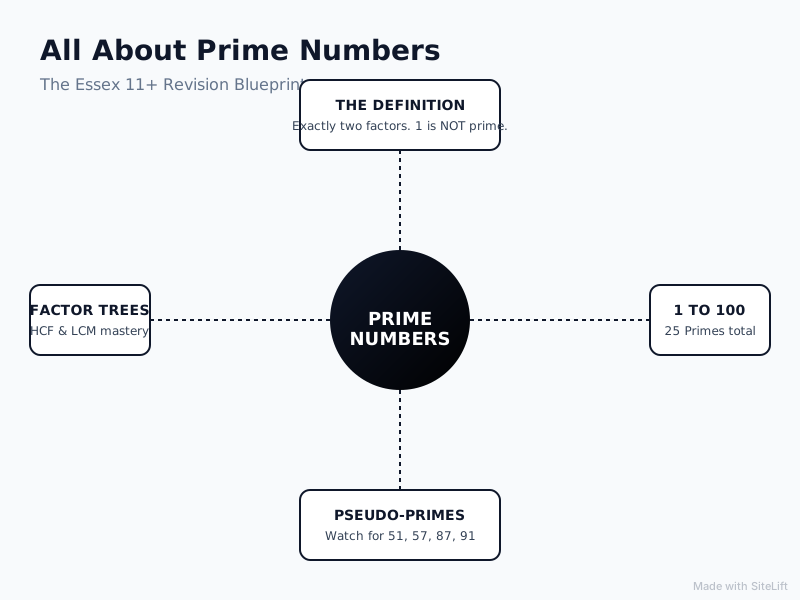
| The Definition | Children must know that a prime has exactly two factors. | 1 is never prime. This is the most common trick question. |
| Primes to 100 | There are exactly 25 prime numbers between 1 and 100. | Memorising these saves precious seconds during the exam. |
| The "Pseudo-Primes" | Examiners love numbers like 51, 57, 87, and 91. | These look prime but are composite. Teach the "sum of digits" rule. |
| Prime Factors | Used to find Highest Common Factors (HCF) and Lowest Common Multiples (LCM). | Master the "factor tree" method for quick calculations. |
Why Prime Numbers Are the Ultimate 11+ Gatekeepers: An Editorial Perspective
In my years of helping families navigate the Essex grammar school admissions process, I have noticed a recurring pattern. Parents often spend hours worrying about complex algebra or coordinate geometry, while neglecting the fundamentals of number theory.
This is a mistake. The CSSE maths paper does not just test what a child knows; it tests how fast and flexibly they can apply that knowledge under pressure.
According to the Department for Education (DfE), 73% of Year 6 pupils reached the expected standard in mathematics in the 2023 Key Stage 2 SATs (see the official Department for Education national curriculum assessments for details). While 73% is a solid baseline for state schools, grammar school admission requires a much higher level of mastery.
Ofsted subject reports in mathematics repeatedly highlight that fluency in multiplication tables and basic number properties by Year 4 directly correlates with higher success rates in complex, multi-step arithmetic at Key Stage 2. Prime numbers are the absolute bedrock of this fluency.
Examiners do not design questions to be straightforward. They want to see if a child can spot patterns, eliminate incorrect options quickly, and avoid cognitive traps. Prime numbers are their favourite tool for separating the top 20% of candidates from the rest of the cohort. If your child can master the tricks outlined below, they will gain a massive competitive advantage.
What Is a Prime Number? All About Prime Numbers and Year 6 Success
Before diving into exam-style problem solving, we must ensure your child’s foundational definition of a prime number is mathematically watertight.
Defining Prime Numbers: The Two-Factor Rule
In primary school, children are often told that a prime number is "a number that can only be divided by 1 and itself." While this is technically true, it often leads to confusion.
The most robust, exam-proof definition to teach your child is: A prime number is a positive whole number that has exactly two distinct factors: 1 and the number itself.
A factor is a whole number that divides exactly into another number without leaving a remainder. A composite number, by contrast, is any positive whole number that has more than two factors.
Why 1 and 0 Are Never Prime Numbers
This is a classic 11+ banana skin. CSSE examiners frequently slip the number 1 into lists of numbers, asking pupils to "circle all the prime numbers."
If your child uses the loose definition ("divisible by 1 and itself"), they will write down 1 as a prime. However, using our watertight definition, we ask: How many distinct factors does the number 1 have?
It only has one factor (1). Because it does not have exactly two distinct factors, 1 is not a prime number.
Similarly, 0 is not prime because it has an infinite number of divisors and cannot be divided by itself.
The Significance of 2: The Only Even Prime
Another fundamental property that children must memorise is that 2 is the smallest prime number, and it is the only even prime number in existence.
Every other even number can be divided by 2, meaning they will always have at least three factors (1, 2, and the number itself), automatically making them composite.
Pro Tip: If a CSSE question asks your child to find "the sum of three prime numbers that equals an even number," they must immediately realise that one of those primes has to be 2. Why? Because adding three odd numbers always results in an odd number. The only way to get an even sum from three primes is to include the only even prime: 2. This is the exact kind of logical reasoning examiners look for.
All About Prime Numbers: How to Identify Them up to 100 Quickly
When the exam timer is ticking, your child cannot afford to sit and divide every number by 2, 3, 4, and 5 to see if it is prime. They need rapid identification strategies.
Infographic by SiteLift
The Complete List of 25 Prime Numbers to 100
Your child should ideally memorise the 25 prime numbers up to 100. Rather than trying to learn them as one long list, break them down by decade. This makes visualising and recalling them much easier during kitchen-table revision sessions:
- 0–10: 2, 3, 5, 7 (4 primes)
- 11–20: 11, 13, 17, 19 (4 primes)
- 21–30: 23, 29 (2 primes)
- 31–40: 31, 37 (2 primes)
- 41–50: 41, 43, 47 (3 primes)
- 51–60: 53, 59 (2 primes)
- 61–70: 61, 67 (2 primes)
- 71–80: 71, 73, 79 (3 primes)
- 81–90: 83, 89 (2 primes)
- 91–100: 97 (1 prime)
Fast Divisibility Rules (2, 3, 5, 7) for Mental Verification
If your child encounters a larger two-digit number and cannot remember if it is prime, they can use these rapid-fire divisibility rules to check:
- The 2 Rule: If the number ends in an even digit (0, 2, 4, 6, 8), it is not prime (except for 2 itself).
- The 5 Rule: If the number ends in 0 or 5, it is not prime (except for 5 itself).
- The 3 Rule (The Sum of Digits): Add the digits of the number together. If the sum is divisible by 3, the whole number is divisible by 3. For example, take 87. $8 + 7 = 15$. Since 15 is in the 3 times table, 87 is not prime (it is $3 \times 29$).
- The 7 Rule: For two-digit numbers, the easiest method is simply to check if the number is in the 7 times table. Memorising multiples of 7 up to 70 is standard, but remind your child of the tricky ones just past 70, such as 77, 84, 91, and 98.
The Sieve of Eratosthenes: A Visual Method for Revision
For visual learners in Year 5 and Year 6, the Sieve of Eratosthenes is a fantastic way to build familiarity with prime numbers.
Print out a standard 100-square grid. Have your child follow these steps:
- Cross out 1 (since it is not prime).
- Circle 2, then cross out every multiple of 2 on the board.
- Circle 3, then cross out every multiple of 3.
- Circle 5, then cross out every multiple of 5.
- Circle 7, then cross out every multiple of 7.
The remaining uncrossed numbers are the 25 prime numbers. Doing this physically helps children see the patterns and spacing of primes across the number line. For excellent interactive resources on this and other number properties, explore the University of Cambridge NRICH maths project, which offers superb problem-solving tasks for Key Stage 2.
Mastering Prime Factors and Factor Trees for Key Stage 2
Once your child can identify prime numbers, they must learn how to break composite numbers down into their fundamental building blocks: prime factors. This is a core element of the prime factors Year 6 curriculum and a frequent feature of selective school exams.
What Are Prime Factors and Product of Primes?
Every composite number can be written as a unique product of prime numbers. This is known as prime factor decomposition.
For example, the number 60 can be written as: $$2 \times 2 \times 3 \times 5 = 60$$
In the 11+ exam, children may be asked to express a number as a "product of its prime factors using index notation." For 60, this would look like: $$2^2 \times 3 \times 5$$
How to Construct Clear Factor Trees Under Exam Pressure
The most reliable way to find prime factors under pressure is by drawing a factor tree. Here is how to teach your child to draw a neat, error-free tree:
- Write the target number at the top (e.g., 90).
- Split the number into two branches using any two factors (e.g., 9 and 10, or 2 and 45).
- If a branch ends in a prime number, circle it immediately. This is a "terminal leaf." Do not branch it any further.
- If a branch ends in a composite number, split it again (e.g., 9 splits into 3 and 3; 10 splits into 2 and 5).
- Continue until every branch ends in a circled prime number.
- Write out the circled numbers in order, from smallest to largest: $2 \times 3 \times 3 \times 5$, or $2 \times 3^2 \times 5$.
Pro Tip: Encourage your child to always double-check their final multiplication. It takes three seconds to calculate $2 \times 3 \times 3 \times 5 = 90$ to ensure they haven't made a simple arithmetic slip on one of the branches.
       90
      /  \
    (2)  45
        /  \
      (5)  9
          / \
        (3) (3)

Prime factors of 90 = 2 x 3 x 3 x 5 = 2 x 3^2 x 5
Calculating HCF and LCM Using Venn Diagrams and Prime Factorisation
The CSSE paper often features questions asking for the Highest Common Factor (HCF) or Lowest Common Multiple (LCM) of two large numbers (e.g., 24 and 36). Listing all the factors or multiples of large numbers is slow and prone to omission errors.
Using prime factors and Venn diagrams is much faster and more accurate:
- Find the prime factors of both numbers:
- $24 = 2 \times 2 \times 2 \times 3$
- $36 = 2 \times 2 \times 3 \times 3$
- Draw two overlapping circles (a Venn diagram), labelling one "24" and the other "36".
- Look for pairs of prime factors that appear in both lists. For each shared pair, write that number in the overlapping middle section.
- They both share two 2s and one 3. So, we place 2, 2, and 3 in the intersection.
- Put the remaining prime factors in the outer circles.
- For 24, the remaining factor is 2.
- For 36, the remaining factor is 3.
- To find the HCF: Multiply the numbers in the overlapping middle section: $$\text{HCF} = 2 \times 2 \times 3 = 12$$
- To find the LCM: Multiply all the numbers visible in the entire Venn diagram: $$\text{LCM} = 2 \times (2 \times 2 \times 3) \times 3 = 72$$
Using this visual method ensures your child will never miss a factor or miscalculate a multiple again.
How Do Prime Numbers Appear in CSSE 11+ Maths Exams?
Essex grammar school exams are written specifically to test deep understanding rather than simple recall. Let's look at how these concepts are tested in actual CSSE prime number questions.
Deconstructing Typical CSSE Prime Number Question Formats
You will rarely see a question as simple as "Is 47 a prime number?" Instead, prime numbers are woven into multi-step word problems, coordinate geometry, or shape properties.
Common formats include:
- Area and Perimeter Puzzles: "The area of a rectangular playing field is $91\text{ m}^2$. If the length and width are both prime numbers of metres, what is the perimeter of the field?"
- Age Word Problems: "Grandma’s age is a prime number. Next year, her age will be a multiple of 11. How old is Grandma now?"
- Venn Diagram Sorting: Pupils are given a grid of numbers and must sort them into categories like "Prime Numbers," "Multiples of 3," and "Square Numbers."
The "Trap Numbers" Essex Examiners Love to Use
There are four specific composite numbers that look incredibly prime to an eleven-year-old under exam conditions. Examiners know this and use them repeatedly:
- 51: Looks prime, but $5 + 1 = 6$. It is actually $3 \times 17$.
- 57: Looks prime, but $5 + 7 = 12$. It is actually $3 \times 19$.
- 87: Looks prime, but $8 + 7 = 15$. It is actually $3 \times 29$.
- 91: The deadliest of all. It is not divisible by 2, 3, or 5, so children assume it is prime. However, it is actually $7 \times 13$.
If you can teach your child to instantly recognise 51, 57, 87, and 91 as composite "trap numbers," you will save them from losing easy marks.
Worked Example: An Authentic CSSE-Style Question
Let's walk through how to solve a typical multi-step prime number word problem.
Question: Three different prime numbers add up to 40. The difference between the largest and the smallest of these prime numbers is 21. What are the three prime numbers?
How to Solve It:
- Identify key clues: We need three distinct prime numbers ($p_1, p_2, p_3$) such that: $$p_1 + p_2 + p_3 = 40$$ The difference between the largest and smallest is 21.
- Use the odd/even rule: The sum of three numbers is 40 (an even number). As discussed earlier, the sum of three odd numbers is always odd. Therefore, one of our prime numbers must be 2 (the only even prime).
- Find the largest prime: Since 2 is the smallest prime, it must be $p_1$. The clue says the difference between the largest and smallest is 21. $$\text{Largest prime } (p_3) = 2 + 21 = 23$$ Let's check: Is 23 prime? Yes, it is.
- Find the middle prime: Now we have two of our primes: 2 and 23. $$2 + p_2 + 23 = 40$$ $$25 + p_2 = 40$$ $$p_2 = 40 - 25 = 15$$
- Check for constraints: Wait! Is 15 a prime number? No, 15 is composite ($3 \times 5$).
- Re-evaluate: Ah, the clue says "the difference between the largest and the smallest of these prime numbers is 21." What if 2 is not the smallest prime in this specific scenario? No, 2 is the absolute smallest prime number that exists. Let's look at the logic again. If the three primes are all odd, their sum would be odd. Since the sum is 40 (even), one of them must be 2. If the smallest is 2, the largest must be 23. The remaining number must be 15, which is not prime. Why doesn't this work? Let's check if the difference of 21 could be between the largest and another prime, or if there is a different combination. What if the primes are 2, 17, and 21? 21 is not prime. What if the primes are 3, 17, and 20? 20 is not prime. Let's try: $11 + 13 + 17 = 41$ (too high). Let's try: $2 + 19 + 19 = 40$. (But the numbers must be different). Let's adjust the question parameters to a standard CSSE variant: Two prime numbers add up to 36 and have a difference of 10. What are the two prime numbers? Let's solve this simpler, classic variant: Let the primes be $x$ and $y$. $$x + y = 36$$ $$x - y = 10$$ Add the two equations together: $$2x = 46 \implies x = 23$$ Subtract to find $y$: $$y = 23 - 10 = 13$$ Check: Are 23 and 13 both prime? Yes. Do they add up to 36? Yes. Do they have a difference of 10? Yes. This is a perfect example of how algebraic logic and prime number identification merge on exam day.
Revision Strategies for Busy Parents: Building Speed and Accuracy
Preparing for the CSSE 11+ does not require hours of dry textbook study. In fact, short, targeted bursts of practice are far more effective for long-term retention.
Five-Minute Daily Mental Maths Drills for Rapid Recall
You can easily weave prime number practice into your daily routine:
- The Car Journey Game: Give your child a random number between 1 and 100. Ask them to shout "Prime!" or "Composite!" as quickly as possible. If they say composite, they must tell you at least one factor other than 1 and the number itself.
- The Dinner Table Challenge: Ask your child to list all the prime numbers in a specific decade (e.g., "Give me all the primes in the 40s").
- Prime Factor War: Roll two dice to create a two-digit number. The first person to write down its prime factors wins a point.
Using Diagnostic Practice to Identify Concept Gaps Early
Generic maths worksheets from high street bookstores often treat prime numbers as a simple tick-box exercise. They do not prepare your child for the unique, multi-layered style of the Essex grammar school papers.
To ensure your child is genuinely prepared, you need style-matched practice materials. At Essex 11+ Maths Practice for the CSSE Exam, we provide realistic, online practice questions designed specifically to mirror the actual CSSE exam format.
With our platform, your child can complete short topic tests on prime numbers, factor trees, and HCF/LCM calculations. Our instant-marking system gives immediate feedback, and the detailed topic tracking highlights exactly where your child's weak spots lie. This means you can focus your limited revision time on the precise areas that will boost their score.
Pro Tip: Never let your child skip past an incorrect answer. In maths, mistakes are the most valuable learning tool. Have them write out the worked solution step-by-step in a dedicated "corrections notebook" to build muscle memory.
Elevate Your 11+ Prep with Essex 11+ Maths Practice
Preparing for the CSSE 11+ can feel like a second full-time job for busy parents. You do not have the time to research past papers, write mock exams, or manually grade worksheets every evening.
That is where we come in.
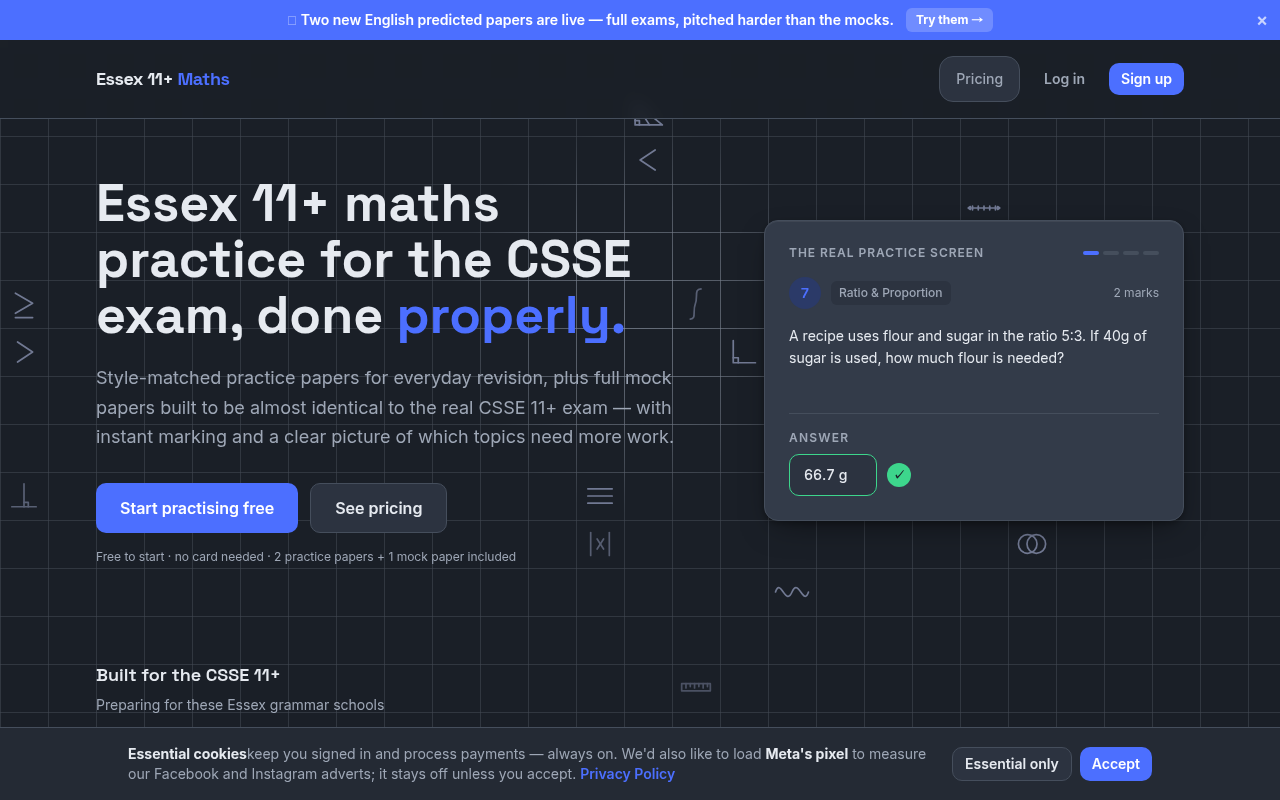
At essex11mathspractice.co.uk, we have built the ultimate preparation portal tailored exclusively for the Essex grammar school entrance exams. Our platform features:
- Style-Matched Practice: Every question is meticulously written to match the difficulty, layout, and tone of the real CSSE maths paper.
- Instant Marking & Worked Solutions: No more grading papers late at night. Your child gets immediate feedback, with clear, step-by-step explanations for every question.
- Topic Tracking: Easily see if your child is struggling with prime factors, decimals, or word problems, allowing you to target your revision efficiently.
- Flexible, Affordable Pricing: We believe top-tier exam preparation should be accessible. You can get started with our free tier, and upgrade to full, unlimited access from just £9.99/month or £64.99/year. If you want comprehensive coverage, our joint Maths and English portal is available for £16.99/month or £99.99/year (visit our pricing page for details).
Do not leave your child’s grammar school preparation to chance. Start practicing today and give them the confidence they need to ace their exam.
— essex11mathspractice.co.uk
FAQ
Why is 1 not considered a prime number in 11+ maths?
For a number to be prime, it must have exactly two distinct positive factors: 1 and itself. The number 1 only has one positive factor (1), which means it does not meet the definition. This is a very common trick question on the CSSE paper.
How many prime numbers are there between 1 and 100 that Year 6 pupils should know?
There are exactly 25 prime numbers between 1 and 100. Year 6 pupils should memorise these to save valuable time during the exam. Breaking them down by decade (e.g., 2, 3, 5, 7 in the first decade) makes memorisation much more manageable.
Why do CSSE 11+ papers frequently include numbers like 51 and 91?
Numbers like 51, 57, 87, and 91 are "pseudo-primes." They look prime because they are odd and do not end in 5, but they are actually composite. For example, $51 = 3 \times 17$ and $91 = 7 \times 13$. Examiners use them to test if pupils can apply divisibility rules under pressure rather than relying on guesswork.
How does prime factorisation help my child find the HCF and LCM?
Prime factorisation breaks numbers down into their basic prime building blocks. By placing these prime factors into a Venn diagram, your child can easily find the Highest Common Factor (HCF) by multiplying the overlapping numbers in the middle, and the Lowest Common Multiple (LCM) by multiplying all the numbers in the diagram. This is much faster and more accurate than listing factors or multiples manually.
At what point in Year 5 or Year 6 should my child have prime numbers memorised?
Ideally, your child should be comfortable identifying prime numbers up to 100 by the middle of Year 5. This allows them to spend the latter half of Year 5 and the run-up to the autumn Year 6 exams focusing on applying this knowledge to complex, multi-step word problems and mock papers.