11+ Mock Exams in Essex: 7 In-Person Centres and How to Pick the Right One for CSSE
11+ Mock Exams in Essex: 7 In-Person Centres and How to Pick the Right One for CSSE
If you’re searching for 11 plus mock exams essex parents actually rate, you’re asking the right question at the right time. The CSSE 11+ isn’t just a maths and English test — it’s a full exam-hall experience with strict timing, unfamiliar answer formats and more than 6,000 other children chasing roughly 1,000 grammar school places, according to the Consortium of Selective Schools in Essex.
I’ve seen bright, well-prepared Year 5 pupils lose 10+ marks on the day simply because they’d never sat in a silent hall with an invigilator, a ticking clock and 150 other nervous children. In-person mocks fix that before it counts.
Key takeaways
| What matters for CSSE | What to do |
|---|---|
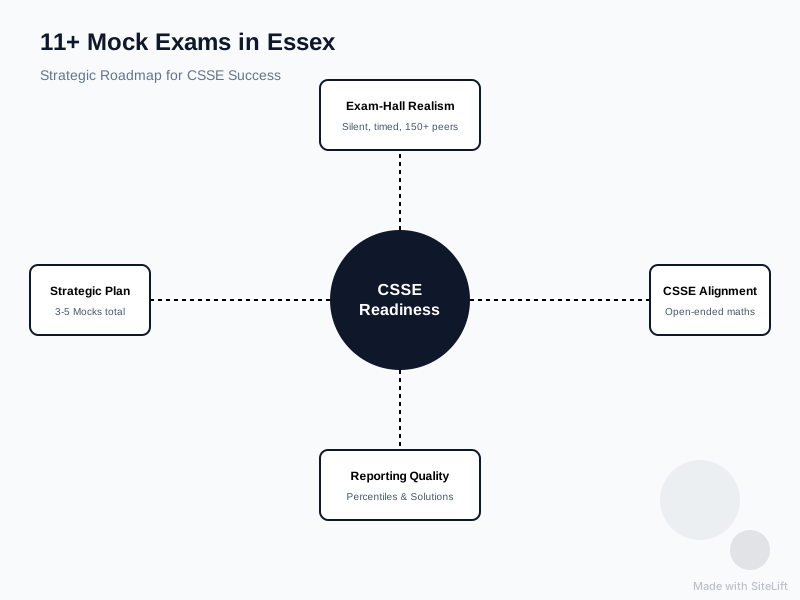
| Exam-hall realism | Book at least one large-hall mock in Chelmsford, Colchester or Southend before July of Year 5 |
| CSSE style alignment | Choose CSSE mock exams Chelmsford and county-wide providers that use open-ended maths and continuous creative writing, not generic GL multiple-choice |
| CSSE mock exam dates | Plan 3–5 mocks: baseline in spring, 2 in summer term, final polish late August |
| Reporting quality | Insist on topic breakdown, cohort percentile and full worked solutions, not just a percentage |
| Follow-up | Use each mock report to drive 2–3 weeks of targeted topic practice at home |
Why are in-person 11 plus mock exams essex critical for CSSE preparation?
The CSSE papers for Southend, Colchester, Chelmsford and Westcliff grammar schools look and feel different from most 11+ papers sold nationally. That’s why local, in-person practice matters so much.
Replicating exam day nerves and hall environment
At home, your child has snacks, loo breaks and Mum prompting them to “check question 4 again.” In the real CSSE exam, they’ll have a desk in a sports hall, a stern invigilator reading instructions, and no second chances.
Good Essex 11+ mock test centres recreate that pressure deliberately: bag store at the door, no parents in the hall, timed announcements, separate answer sheets. Children learn to block out page-turning, sniffing and chair-scraping — and to keep going when a hard question rattles them.
Pro Tip: Book the first mock early enough that a wobble doesn’t matter. March or April of Year 5 is ideal for a low-stakes shock.
Mastering CSSE timing and answer sheet mechanics
The official CSSE admissions guidance confirms the test consists of two papers — English and mathematics — taken on the same morning. Both reward speed and accuracy, but in very different ways.
CSSE maths includes open-ended, write-in answers where method and presentation earn marks. There’s no multiple-choice safety net. CSSE English blends comprehension, applied vocabulary and an extended creative writing task that must be planned and finished in limited time.
In a proper mock, children practise:
- transferring maths working cleanly without running out of space
- allocating time between comprehension and the writing task
- following invigilator instructions to the second
You can read more about what the papers involve in this overview of what the CSSE 11+ test involves, which Essex and Southend grammar schools use it.
Benchmarking your child against Essex peers
Home scores lie. A 78% on a relaxed Sunday paper tells you very little.
In-person 11+ mocks Colchester Southend cohorts are self-selecting — they’re full of motivated grammar-school applicants. If your child sits in the 65th percentile in Chelmsford in June, that’s genuinely useful intelligence for school choice across King Edward VI Grammar, Colchester Royal Grammar, Westcliff and Southend High.
According to data published by the CSSE Consortium, successful candidates generally need a standardised total above 300 across the two papers. Centres that convert raw scores to age-standardised scores and percentiles help you see how far off that bar you are.
What are the top 7 in-person 11 plus mock exams essex centres to consider?
I’m deliberately not crowning one “winner” here. The best centre depends on where you live, how your child handles pressure, and whether you need detailed diagnostics or just hall experience. Below is how the county breaks down, so you can shortlist sensibly.
For context on selective admissions nationally, see the UK Government guidance on grammar schools and selective testing.
Chelmsford & Mid-Essex mock centres
1. Central Chelmsford CSSE-specialist hall mock Usually held in a large secondary school hall near the city centre. Papers are written specifically for CSSE, with proper creative writing marking by experienced markers. Expect detailed English feedback and maths topic splits. Best for: families targeting KEGS Chelmsford who want the closest style match.
2. Mid-Essex tuition centre weekend mocks (Chelmsford / Brentwood fringe) Smaller halls (40–80 children), often run by long-standing tuition centres. Less intimidating for anxious children, quicker feedback turnaround. Best for: first-timers in spring term.
3. Brentwood large-cohort provider Draws from Brentwood, Billericay and Shenfield. Tends to offer multiple CSSE mock exam dates from May to September with fresh papers each sitting. Parking and parent waiting areas are usually easier than city-centre venues. Best for: families who need flexible dates.
Colchester & North Essex providers
4. North Colchester exam-hall mock (Colchester Royal Grammar catchment) Often the most competitive cohort in the county. If you want a brutally honest benchmark for Colchester Royal Grammar or Colchester County High, sit at least one mock here. Venues are typically schools or conference halls with proper exam desks.
5. Colchester boutique CSSE mock with 1-to-1 review Smaller provider offering 30–50 places per session plus a short parent consultation. You pay a little more, but you get human-marked writing with margin comments. Best for: children whose English writing is holding back their total.
Southend & South Essex options
6. Southend / Westcliff high-volume mock centre Large sittings (150+ pupils) very close to Westcliff High School for Boys, Westcliff High School for Girls and Southend High. Excellent for replicating the real-day buzz and nerves. Check the example Southend CSSE grammar school admissions overview to see how competitive in-catchment scores can be.
7. Leigh-on-Sea / Southend community hall CSSE mocks More nurturing, mid-size halls. Often the best value in south Essex and easier for younger siblings to wait nearby. Papers vary — ask explicitly whether maths is CSSE write-in style or generic GL multiple-choice before you book.
Infographic by SiteLift
| Centre type | Typical cost* | Cohort size | CSSE style match | Reporting depth |
|---|---|---|---|---|
| Chelmsford hall specialist | £65–£85 | 100–180 | Very high | Standardised score + topic split + marked writing |
| Mid-Essex / Brentwood weekend | £45–£65 | 40–80 | High | Percentage + brief comments |
| Colchester large hall | £60–£80 | 100–200 | Very high | Percentile rank + worked answers |
| Colchester boutique + review | £85–£110 | 30–50 | High | Full script return + consultation |
| Southend large-volume | £55–£75 | 150+ | High | Standardised score + rank |
| Leigh / Southend community | £35–£55 | 50–90 | Medium–High – check papers | Percentage + answer key |
*Prices based on 2024–2025 advertised Essex sittings; always confirm what’s included for marking of creative writing.
Pro Tip: Email before booking and ask: “Are your maths papers open-answer CSSE style, and is creative writing double-marked by a human?” If the answer is vague, walk away.
How do you evaluate and choose the right Essex 11+ mock test provider?
Don’t choose on postcode alone. Use these three filters and you’ll avoid the most common — and expensive — mistake.
CSSE style alignment vs generic 11+ papers
This is the big one. Generic GL Assessment mocks use multiple-choice maths, short NVR-style logic and tick-box comprehension. The CSSE doesn’t.
CSSE maths demands full written methods, fractions, decimals, percentages, algebra-lite problem solving and multi-step word problems with no prompts. CSSE English demands sustained writing with varied punctuation, ambitious vocabulary used correctly, and careful comprehension inference.
If a provider serves Kent, Buckinghamshire, London and Essex with the same paper, it isn’t a CSSE mock. Look for providers who talk specifically about Southend, Colchester and Chelmsford schools and show sample CSSE-style questions.
Families also preparing across the border should keep resources separate — for example, use dedicated Kent Test-style maths practice for Kent, and CSSE-specific papers for Essex.
Quality of post-exam diagnostic reporting and worked solutions
A raw score — “68%” — is almost useless on its own. What you need the next morning is:
- standardised score estimate and cohort percentile
- maths breakdown by topic: e.g., fractions, ratio, geometry, multi-step problems
- English breakdown: comprehension vs SPaG vs composition, with marked script
- full question paper returned with worked solutions
The best Essex 11+ mock test centres return scripts within 7–10 days and let you see why marks were lost. Was it misreading, timing, method, or a genuine knowledge gap? That distinction drives the next month of revision.
Logistics, venue location, and exam hall realism
Practicalities affect performance more than parents expect. Consider:
- travel time — a stressed 45-minute drive into Chelmsford before a 9am start is not ideal preparation
- hall size — shy children may do better starting small in Brentwood or Leigh, then moving to a 150-pupil hall in Southend
- dates — avoid mocks the same weekend as school plays, holidays or illness recovery
- access — check parking, drop-off rules and whether parents must leave site
Aim for at least one mock in an unfamiliar, slightly uncomfortable venue. Comfort is the enemy of exam readiness.
When should your child take their CSSE mock exams?
Timing beats quantity. Three well-spaced, well-reviewed mocks beat six rushed ones.
Spring Term (March – April): Baseline assessment
Sit one mock with no cramming. Treat it as a diagnostic X-ray. You want to discover that fractions collapse under time pressure, or that creative writing runs out after two paragraphs — while you still have five months to fix it.
Use the report to build a topic hit-list for the summer term, not to panic about grammar school choices.
Summer Term (May – July): Building stamina and filling topic gaps
This is the workhorse period. Two mocks, roughly 6–8 weeks apart, work well for most families.
Between mocks, drill the weak topics flagged in the report in short daily bursts. If mock one showed 4/12 on ratio and algebra, spend two weeks on just those, then re-test under timed conditions at home.
Many parents align CSSE mock exam dates with school holidays — one in late May half-term, one in mid-July before the summer break. Just leave at least a fortnight to act on feedback.
Late Summer / Early September: Final exam polish and condition tuning
Book a final mock in mid-to-late August, not the weekend before the real test. The goal is no longer learning new content; it’s tuning sleep, breakfast, travel, pencils, timing strategy and nerves.
After this mock, do light review only. Confidence matters more than one extra topic in the final 10 days.
How should you follow up an in-person mock exam for maximum mark growth?
The mock itself doesn’t raise scores. What you do in the 14 days afterwards does.
Analysing incorrect answers and mathematical misconceptions
Sit with the returned paper and sort every lost mark into three piles:
- Silly slips — misread units, copied numbers wrong, rushed last line
- Timing casualties — knew how to do it, ran out of time
- Don’t-knows — genuine gaps in method or vocabulary
Most Essex parents are surprised to find pile 1 and 2 are bigger than pile 3. That’s good news — exam technique is faster to fix than whole topics.
For pile 3, insist on seeing the worked solution line-by-line. Can your child re-do the question unaided two days later? If not, the misconception isn’t fixed yet.
Combining physical mock insights with online topic practice
This is where in-person and at-home prep fit together. Use the hall mock for realism and ranking; use targeted practice at home for reps.
For example, if the mock report flags percentages, perimeter and multi-step problems, spend 20 minutes a day on just those styles with instant feedback, rather than doing another full generic paper. Style-matched questions with instant marking and topic-by-topic breakdown of weak spots let you turn a vague “maths 62%” into “ratio is now 9/10, move on.”
If you’ve previously read our guide to home simulation, treat mocks as the calibration — home practice is where the mark growth happens.
Managing exam anxiety and building confidence after low scores
A low first mock score is normal, especially in a strong Colchester or Chelmsford cohort. Don’t lead with the percentile at the dinner table.
Try this script that tutors use:
- “Your timing on maths was strong — you attempted everything.”
- “The report shows two topics costing most marks. That’s fixable.”
- “Let’s pick one English target for next time — strong openings.”
Keep the original marked writing. Re-reading it in August shows progress far better than any pep talk. And avoid booking back-to-back mocks to “make up” for a bad score — tired children underperform and lose confidence.
My honest take: don’t buy mocks for reassurance, buy them for information
I’ll be blunt because I see this every year around Essex.
Too many of us book 11 plus mock exams essex providers hoping for a high score to calm our own nerves. We drive to CSSE mock exams Chelmsford, pray for 80%+, then feel crushed when our child lands at 58% in a tough cohort.
I think that’s backwards. A good mock should feel uncomfortable. It should expose the messy handwriting under pressure, the unwritten story ending, the fractions that fall apart at minute 42.
In my view, the best money I’ve seen parents spend isn’t on five large-hall mocks. It’s on two or three well-chosen hall experiences — one small and kind in spring, one big and scary in summer — plus relentless, boring, brilliant follow-up on the same CSSE-style questions at home.
If a centre won’t return the paper, won’t show you the writing marking, or can’t explain how its maths differs from GL, keep your £70. Hall experience alone you can partly recreate. Honest diagnostics you can’t.
— essex11mathspractice.co.uk
Turning a mock report into real CSSE progress
You don’t need more generic worksheets after a mock — you need CSSE-shaped reps on the exact topics that leaked marks.
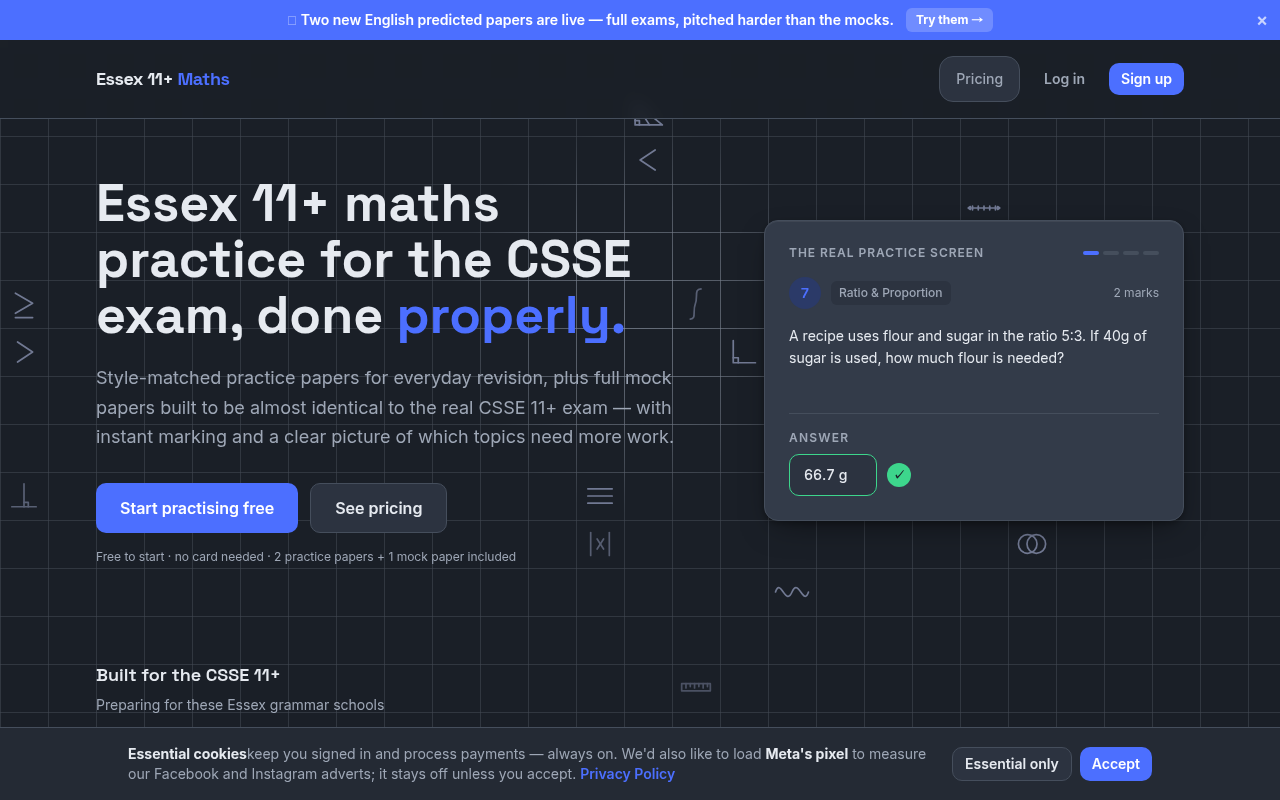
That’s what we built essex11mathspractice.co.uk for: style-matched CSSE 11+ maths questions, relaxed practice papers and full mock papers with instant marking and worked solutions, so you can see in minutes whether fractions, ratio or problem-solving is still weak.
Start free, run a topic check based on your last hall mock report, then decide if you need full access. Check free vs paid 11+ Maths and English practice plans — full access to either portal starts from £9.99/month.
FAQ
What is the pass mark for the CSSE 11+ exam in Essex?
There isn’t a fixed pass mark. The CSSE standardises scores by age across English and maths, and each grammar school sets its own cut-off each year based on places and applicant strength. As a rough guide, the CSSE Consortium indicates successful out-of-catchment candidates often need a standardised total above 300, with in-catchment cut-offs lower but still competitive. Always check the individual school’s admissions page for last year’s lowest offered score.
How many 11+ mock exams should my child take before the actual test?
For most children, 3–5 in-person mocks across Year 5 is the sweet spot. One in spring for a baseline, two in May–July to build stamina and fix gaps, and one in late August for final polish. More than that risks burnout and eats into teaching time. What matters more than number is reviewing each paper fully before booking the next.
What is the difference between GL Assessment mocks and CSSE mock exams?
GL mocks are largely multiple-choice, covering verbal reasoning, non-verbal reasoning, maths and English in short timed sections. CSSE mocks mirror the Essex format: a write-in maths paper with multi-step problems and no multiple-choice prompts, plus an English paper with comprehension and an extended, human-marked creative writing task. Sitting only GL mocks leaves Essex children underprepared for writing stamina and open-ended maths.
When are CSSE mock exam dates usually held in Essex centres?
Most Essex 11+ mock test centres run from March through early September of Year 5. Spring sittings (March–April) are smaller baselines, summer sittings (May–July) are the main preparation window, and late-summer sittings (August–early September) sell out fastest. If you want a large-hall experience in Chelmsford, Colchester or Southend, book summer dates by Easter.
Are online mock exams as effective as in-person mock test centres in Essex?
They do different jobs. In-person halls are unmatched for nerves, invigilation, peer distraction and standardised cohort ranking. Online mocks and practice platforms are better for frequent, low-cost topic drilling, instant marking and tracking weak areas week to week. The strongest approach most Essex parents use is both: in-person mocks for calibration, online CSSE-style practice for rapid improvement between them.
— essex11mathspractice.co.uk