8–10 Week 11+ Maths Revision for Essex: CSSE Focused, EEF Backed
8–10 Week 11+ Maths Revision for Essex: CSSE Focused, EEF Backed

The most effective 11+ maths revision combines CSSE-style timed practice with short daily fluency drills and regular review of mistakes. This matches the real exam format and reflects what research says about learning: fluent recall of number facts and reflection on errors build stronger problem solvers than long, unfocused study sessions. Start today with one short timed practice set or a free familiarisation paper.
TL;DR:
- Short daily fluency drills and targeted review of mistakes are more effective than long study sessions for improving maths skills.
- An 8 to 10-week revision plan should gradually shift focus from foundational skills to full timed practice and error review.
- Prioritize key topics such as mental calculation, fractions, ratios, geometry, and applied reasoning, using brief anchor sheets for reinforcement.
- Official CSSE familiarisation papers and Essex 11+ practice platforms provide the most accurate format and timely feedback for effective preparation.
Table of Contents
- An 8 to 10 week revision timetable that fits real life
- Which maths topics to prioritise for the CSSE paper
- Getting the most from CSSE familiarisation papers
- The study techniques that actually move the needle
- Fitting Essex 11+ Maths Practice into the weekly plan
- Keeping revision realistic without losing your evenings
- Where to go next with Essex 11+ Maths Practice
- Sources
- FAQ
An 8 to 10 week revision timetable that fits real life
A good CSSE maths plan has rhythm: a full timed paper every two weeks, two or three shorter focused sessions on weak topics, and a daily ten-minute fluency drill on number facts. This pattern gives a child enough exposure to exam conditions without turning every evening into a test.
Over 8 to 10 weeks, the balance should shift gradually. Early weeks concentrate on foundation skills such as times tables, fractions and mental calculation. Middle weeks add applied reasoning and multi-step problems. The final two or three weeks move to mixed timed practice that mirrors the real paper, alternating official papers with platform-based sessions.
- Weeks 1 to 3: daily ten-minute fluency drills plus two 20-minute sessions on number, fractions and measures.
- Weeks 4 to 6: introduce multi-step word problems and one full 60-minute timed paper every fortnight.
- Weeks 7 to 8: alternate a timed paper with short 15-minute diagnostic checks on remaining weak spots.
- Weeks 9 to 10: taper volume, focus on error review and confidence-building rather than new content.
Session length matters more than most parents expect. Ten to fifteen minutes suits fluency work, twenty to thirty minutes suits topic practice, and a full paper needs the full 60 minutes to be a fair rehearsal. Sessions longer than that tend to produce fatigue rather than learning.
Progress is easier to track with a simple log rather than a gut feeling. Note the score on each timed paper, but also log error types: careless slips, misread questions, or a genuine gap in method. A short weekly diagnostic, five or six questions on a single topic, shows whether a previous fix actually worked.

Pro Tip: Keep a one-page error log next to the desk and add three words after every practice session: what went wrong.
Which maths topics to prioritise for the CSSE paper
CSSE 11+ maths draws heavily on the Key Stage 2 curriculum, but the exam format rewards speed and applied reasoning as much as raw knowledge. Before adding extra resources, make sure these areas are solid:
- Mental calculation, times tables and number bonds, checked for speed as well as accuracy.
- Fractions, decimals and percentages, including converting between them under time pressure.
- Measures, ratio and proportion, and simple algebraic reasoning.
- Geometry, angles and basic statistics, including reading charts and tables.
- Applied reasoning: multi-step word problems, unit conversions and “best buy” style comparison questions.
An example CSSE familiarisation paper shows the flavour of these questions clearly: decimal addition and subtraction, missing-digit puzzles, unit conversions, Venn diagrams, pie charts and simple sequences all appear in one paper. That mix is the reason drilling times tables alone rarely produces a strong score.
A short anchor sheet for each topic, one side of paper with a worked example and three practice questions, helps a child revisit a concept without wading through a whole workbook. After each topic session, a two-minute concept check (one question, no notes) confirms whether the idea has stuck.
Pro Tip: Use one worked example per anchor sheet and ask your child to explain each step out loud before trying a similar question alone.
Getting the most from CSSE familiarisation papers
Official practice material should sit at the centre of any revision plan, not commercial workbooks alone. The CSSE maths paper lasts 60 minutes and counts for 50% of the total 11+ score, with the consortium standardising marks and applying an age adjustment where needed. Knowing this weighting early helps parents judge how much time maths deserves relative to English.
- Start with an official familiarisation paper to learn the exact format and timing rather than guessing from generic KS2 tests.
- Run full papers under real exam conditions periodically: a quiet room, a visible clock, no interruptions.
- Use shorter timed drills (ten to fifteen minutes) between full papers to target specific question types such as unit conversion or multi-step reasoning.
- Mark using the worked solutions, then log the error type rather than just the score, so revision targets the actual misconception.
- Register early and align the practice schedule so effort peaks in the weeks before the test date, not after it.
The CSSE publishes free familiarisation papers and sells practice packs directly through its office, and these remain the closest match to the real paper’s style and difficulty.
The study techniques that actually move the needle
Not every revision method earns its place. The strongest evidence points to a small set of techniques worth prioritising over generic worksheet volume.
- Short daily retrieval practice on number facts, rather than occasional long sessions, strengthens recall speed that complex problems depend on.
- Metacognitive prompts, such as asking a child to explain their method or spot their own error, work best embedded in normal maths practice rather than taught as a separate “thinking skills” lesson.
- Comparing worked examples side by side, then interleaving topics instead of practising one skill in isolation, builds flexible problem-solving.
- Diagnostic-led practice beats blanket repetition: targeted intervention based on assessment tends to close gaps faster than hours of unfocused drilling.
Pro Tip: After every practice paper, ask your child to pick one wrong answer and explain out loud where their method went astray. That single habit does more than another hour of worksheets.
Fitting Essex 11+ Maths Practice into the weekly plan
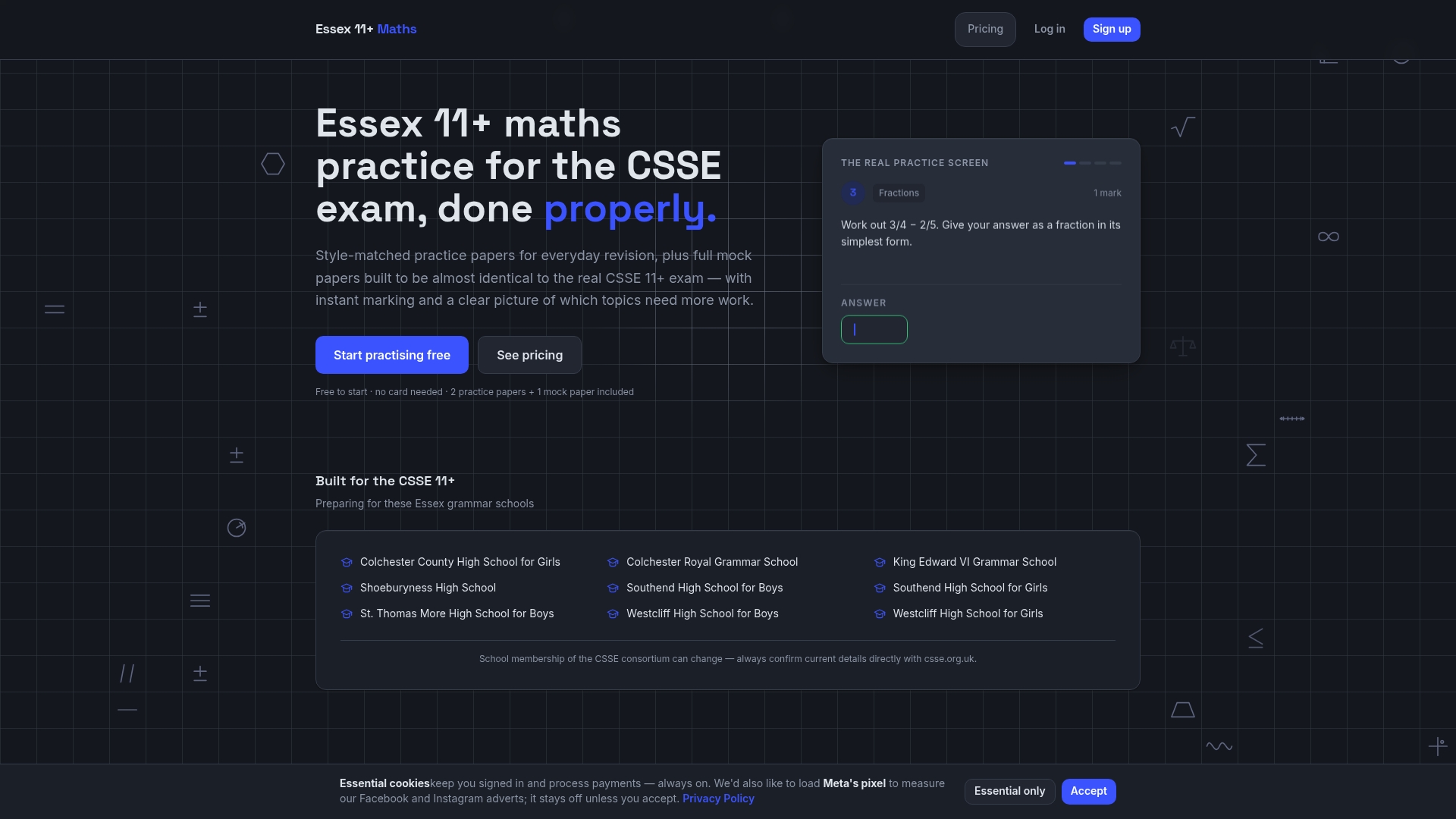
Essex 11+ Maths Practice offers CSSE-style practice papers and instant-marked questions built to match the real exam’s format rather than generic KS2 material. That makes it a practical tool for the plan above, particularly for the frequent, targeted sessions that official papers cannot provide in unlimited supply.
- Use full timed papers on the platform to rehearse exam conditions between official CSSE familiarisation sittings.
- Run short diagnostic checks weekly, using instant marking and worked solutions to spot recurring error types fast.
- After each full timed paper, whether official or platform-based, use the topic lessons to close specific gaps rather than repeating the whole syllabus.
- Track progress through the platform’s topic-by-topic breakdown to see whether previous weak areas are actually improving.
Official papers remain the best guide to format and difficulty. The platform’s value sits in volume and speed of feedback, the two things a busy household usually runs short of.
Keeping revision realistic without losing your evenings
Short, consistent sessions beat marathon cramming every time. Watch your child’s mood as closely as their score: if revision starts causing real anxiety or exhaustion, ease off before pushing on. Celebrate small wins, like fewer careless slips this week, and track just one or two simple measures.

Where to go next with Essex 11+ Maths Practice
Essex 11+ Maths Practice gives you a way to run this whole plan without stitching together separate workbooks and marking everything by hand. The Free plan lets you try CSSE-style questions and instant marking before committing to anything.
For families further into their revision timetable, the Monthly plan costs £9.99 per month and the Yearly plan costs £64.99 per year, both giving full access to topic lessons, mock papers and progress tracking.
- Start with the Free plan to test format and instant feedback with no commitment.
- Move to Monthly if you want full topic coverage during the run-up to the exam.
- Choose Yearly if you are planning revision across most of Year 6.
Use the platform for the targeted topic work and diagnostic checks described above, and lean on official CSSE papers for full-length rehearsal. Visit the pricing page to compare plans and start today.
Sources
- EEF teaching and learning toolkit — metacognition and self-regulation
- Education Endowment Foundation guidance summary (ERIC record)
FAQ
How long should 11+ maths revision take each week?
Most children manage well with a daily ten-minute fluency drill plus two or three focused sessions of twenty to thirty minutes on weak topics, alongside a full timed paper roughly every fortnight. Longer sessions tend to cause fatigue rather than extra learning.
Are CSSE papers different from normal KS2 tests?
Yes. The CSSE maths paper runs for 60 minutes and makes up 50% of the total 11+ score, with its own standardisation and question style that generic KS2 tests do not replicate exactly.
How much practice is too much?
When practice starts producing more careless errors, frustration or reluctance rather than steady improvement, it has usually tipped into diminishing returns. Diagnostic-led, targeted practice tends to close gaps faster than large volumes of repetitive worksheets.
What should we do in the final week before the test?
Taper the volume of new content and focus on reviewing the error log built up over previous weeks, alongside light confidence-building tasks rather than fresh timed papers. A calm, well-rested child on the day matters more than one extra practice session.