Six Practice Questions for 11+ Algebra With One Sentence Methods
Six Practice Questions for 11+ Algebra With One Sentence Methods

For the 11+ you only need a small set of algebra skills: simplifying expressions, substitution, solving short equations, expanding brackets and factorising, and spotting sequence rules. Learn one clear method for each, then practise mixed short questions rather than long single-topic drills, and always check your answer by substituting it back into the original problem.
TL;DR:
- Understanding the order of operations and always checking work with substitution are essential to prevent common mistakes like incorrect calculations or skipped steps.
- Practicing timed, mixed questions that mirror exam phrasing helps solidify skills in translating word problems, sequences, and algebraic expressions accurately.
- Focusing extra attention on problem types that tend to take longer or cause errors, such as solving two-step equations or factorizing, improves overall confidence.
- Using platforms offering instant feedback and worked solutions encourages efficient self-review and reinforces correct methods for the real exam.
- Short, consistent daily practice and periodic full timed papers each week build pacing, familiarity, and mastery of key algebra topics necessary for success.
Table of Contents
- Key 11+ algebra concepts explained simply
- How to solve one and two-step equations using the balance method
- Turning word problems and sequences into algebra
- Common mistakes and how to check your work
- Six mixed practice questions with answers
- Why structured, exam-style practice closes the gap
- A weekly rhythm that keeps algebra practice on track
- Get free access to CSSE-style algebra practice
- Sources
- FAQ
Key 11+ algebra concepts explained simply
Before tackling questions, your child needs to know what the words actually mean. Confusion here is where most marks get lost, not in the arithmetic itself.
A variable is a letter standing in for a number you don’t know yet, usually n or x. An expression is a string of numbers and letters like 3n + 2, with no equals sign, so it can’t be “solved”, only simplified or evaluated. An equation has an equals sign, such as 3n + 2 = 14, which means you can find the value of n. A sequence is a list of numbers following a pattern, and the algebra job is to find the rule that generates it.
Once those terms are solid, three skills carry most of the marks:
- Simplifying expressions means combining like terms. In
4a + 3b + 2a, the a terms combine to give6a + 3b. You can only combine terms with matching letters, so4aand3bstay separate. - Substitution means replacing a letter with a given number. If
a = 5, then2a + 3becomes2(5) + 3 = 13. This is one of the most frequently tested skills because it also checks whether a pupil understands order of operations. - Expanding brackets means multiplying everything inside by whatever sits outside:
3(x + 4) = 3x + 12. Factorising reverses this by finding the greatest common factor (GCF) of both terms and pulling it out, so6x + 9becomes3(2x + 3).
BBC Bitesize’s guide to algebraic notation covers these definitions with additional worked examples if your child needs a second explanation in different wording. Pupils who confuse expressions with equations tend to try “solving” something that has no equals sign, which wastes exam time on a task that isn’t actually being asked.
How to solve one and two-step equations using the balance method
Treat every equation like a set of scales. Whatever you do to one side, you must do exactly the same to the other, or the balance tips and the equation becomes false. This single idea, sometimes called the balance method, is the backbone of nearly every equation question on the exam, and 11 Plus for Parents builds its entire teaching approach around it.

Example 1: one-step equation
x + 7 = 12
Subtract 7 from both sides: x = 5
Check: 5 + 7 = 12 ✓
Example 2: two-step equation
[3x](https://brainly.com/question/40629177) + 4 = 19
Subtract 4 from both sides: 3x = 15
Divide both sides by 3: x = 5
Check: 3(5) + 4 = 19 ✓
Example 3: two-step with brackets
2(x + 3) = 16
Expand the bracket: [2x](https://www.wyzant.com/resources/answers/953411/solve-2-x-3-16) + 6 = 16
Subtract 6 from both sides: [2x](https://www.tiger-algebra.com/en/solution/linear-equation-one-unknown/2x%3D10./) = 10
Divide both sides by 2: x = 5
Check: 2(5 + 3) = 16 ✓
A short checklist keeps this method reliable under exam pressure:
- Get all letters on one side and numbers on the other.
- Write down exactly what you’re doing to each side (don’t just do it in your head).
- Do the same operation to both sides every time.
- Divide or multiply last, once the letter term stands alone.
- Substitute your answer back into the original equation to check it.
Turning word problems and sequences into algebra
11+ papers rarely hand pupils a bare equation. They wrap it in a sentence, and translating that sentence correctly is often harder than the maths that follows. Certain phrases map onto fixed operations every time:
- “More than” or “increased by” means addition.
- “Decreased by” or “fewer than” means subtraction.
- “Times as many” or “of” (in a multiplying sense) means multiplication.
- “Shared equally” or “split between” means division.
For example, “I think of a number, add 6, then double it” becomes 2(x + 6). “A number decreased by 3, then divided by 4” becomes (x − 3) ÷ 4. Reading the sentence in order, left to right, and writing symbols as you go usually avoids mistakes.
Sequences work the same way in reverse: you’re finding a rule from a pattern. For 5, 8, 11, 14, the terms increase by 3 each time, so the rule involves 3n. Testing n = 1 against the first term shows 3(1) = 3, which is 2 short of 5, so the full rule is 3n + 2. This matches the Year 6 algebra objectives around generating linear sequences from a stated rule.
Common mistakes and how to check your work
Most algebra errors on the 11+ come from a handful of predictable slips, and each has a quick fix a pupil can apply in seconds.
- Ignoring order of operations. Working
2 + 3 × 4left to right gives the wrong answer of 20 instead of 14. Quick fix: scan for brackets and multiplication before doing any addition, using BIDMAS or BODMAS as the checklist. - Doing an operation to only one side of an equation. This is the single most common cause of wrong answers in equation questions. Quick fix: write the operation next to both sides before calculating either one.
- Confusing expressions with equations. Without an equals sign, there’s nothing to “solve”, only to simplify or evaluate. Quick fix: check for the equals sign before deciding what the question is actually asking.
- Skipping the final check. Many pupils calculate an answer and move straight on.
Pro Tip: Always substitute your final answer back into the original equation before moving to the next question. It takes ten seconds and catches most silly mistakes before they cost a mark.
Six mixed practice questions with answers
Set a 20 to 30 minute timer and work through these without a calculator, then mark them straight away using the notes below. This mirrors real exam pacing far better than untimed practice.
- Simplify:
5x + 3y − 2x + y - If
a = 4, find the value of3a + 5 - Solve:
2x − 7 = 9 - Expand:
4(y + 3) - Factorise:
10x + 15 - The rule for a sequence is
4n − 1. Find the 6th term.
Answers and method notes:
3x + 4y— combine the x terms and the y terms separately.17— substitute 4 for a, multiply first, then add.x = 8— add 7 to both sides, then divide by 2.4y + 12— multiply both terms inside the bracket by 4.5(2x + 3)— 5 is the greatest common factor (GCF) of 10 and 15.23— substituten = 6into4n − 1.
Note which of the six question types took longest or went wrong, and give that topic extra attention in your next session rather than repeating everything equally.
Why structured, exam-style practice closes the gap
Primary school algebra lessons often move quickly and rarely mirror actual 11+ phrasing, which is why targeted practice on equations, substitution and sequences matters so much. A platform offering CSSE-style questions with instant marking and worked solutions suits pupils who already grasp the methods above but need timed, exam-format repetition to build real confidence.
A weekly rhythm that keeps algebra practice on track
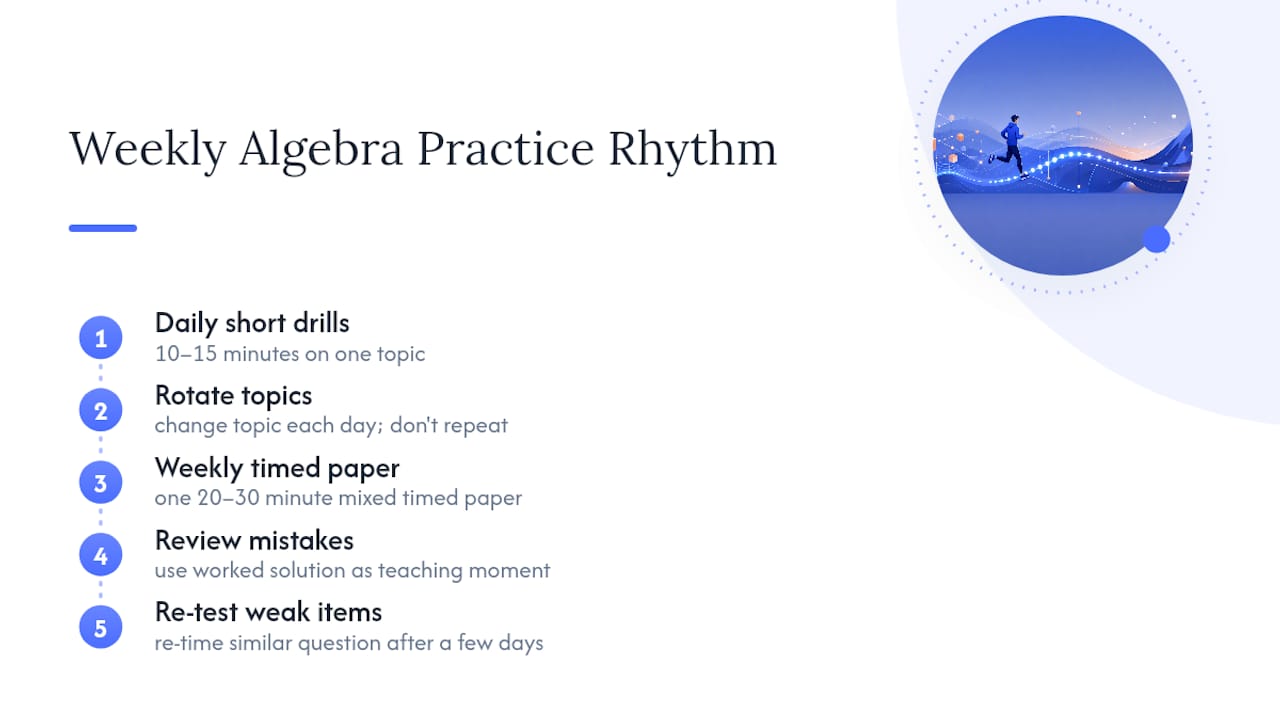
Short, frequent practice beats occasional marathon sessions. Try 10 to 15 minutes of daily drills on one topic, plus a single 20 to 30 minute mixed timed paper each week to build pacing. Rotate topics through the week rather than repeating the same one, and re-test anything that scored poorly a few days later once the method has been explained properly. When a question goes wrong, use the worked solution as a teaching moment first, then re-time a similar question once the method feels secure. Mixing short questions across topics builds confidence faster than drilling one skill for an hour.
Get free access to CSSE-style algebra practice
This platform is an alternative to generic KS2 worksheets for families preparing for the CSSE 11+: every question is written to match the real exam’s style and format, marked instantly, and paired with a worked solution so pupils see exactly where a method broke down. That’s a different starting point from photocopied revision books that were never designed with this specific exam in mind.
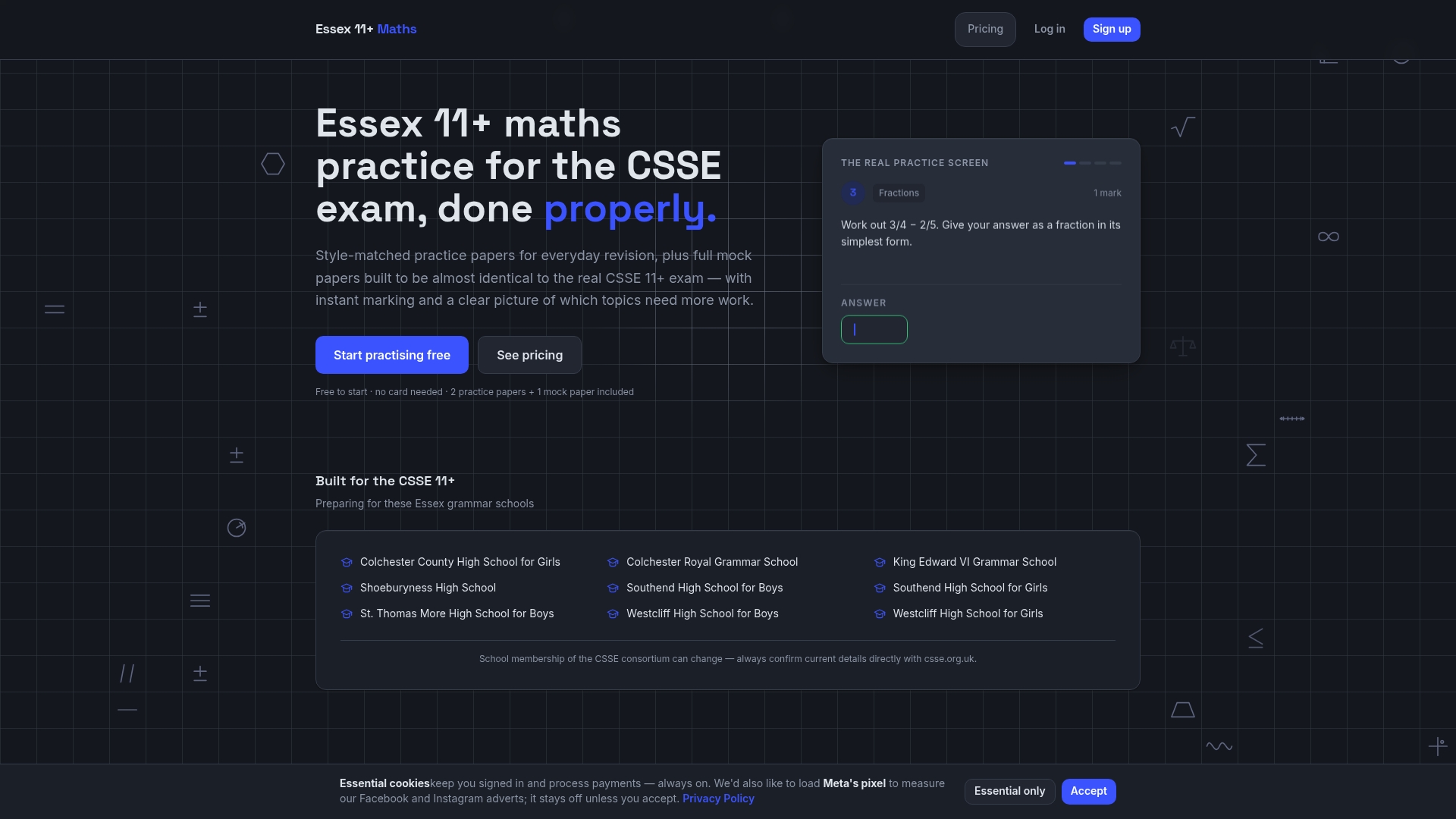
The platform tracks progress topic by topic, so parents can see whether algebra, or something else entirely, needs more attention this week. You can start with free access to try the format, or go straight to the Monthly and Yearly plans for full access to mock papers and animated topic lessons. Either way, the next step is simple: create an account and run a timed algebra set today.
Sources
- Introduction to algebra - KS3 Maths - BBC Bitesize
- 11 Plus: Key Stage 2 Maths: Algebra - Worked Examples: How to teach algebra - 11 Plus for parents
- Algebra in Year 6 (age 10–11) - Oxford Owl
- 11 Plus Maths Topics 2026 – What Is Tested & How to Master It | AlphaTest Blog
FAQ
What are the 5 basic rules of algebra?
The core rules pupils need for the 11+ are: combine like terms when simplifying, do the same operation to both sides of an equation, expand brackets by multiplying every term inside, factorise using the greatest common factor, and follow BIDMAS or BODMAS for order of operations. Mastering these five covers almost everything the exam asks.
Can you give some sample 11+ algebra questions?
Yes. Typical questions include simplifying 5x + 3y − 2x + y, substituting a value into 3a + 5, solving 2x − 7 = 9, and finding a term in a sequence given by a rule like 4n − 1. The six-question practice set above mirrors this exact mix.
How do you say “I love you” in maths?
There’s a playful answer to this involving pi, four, and a symbol that resembles a heart, though it’s a novelty rather than a genuine algebra concept. It won’t appear on an 11+ paper, but it’s a fun way to show a child that numbers and letters can be creative too.
What are the basics of algebra for beginners?
Beginners should start with what a variable, expression and equation actually mean, since mixing these up causes most early mistakes. From there, simplifying expressions and substituting numbers into them builds the foundation for solving equations and expanding brackets.
How much does Essex11mathspractice cost?
Essex11mathspractice offers a free plan with no cost, alongside a Monthly plan at £9.99 per month and a Yearly plan at £64.99 per year for full access to CSSE-style practice papers and mock exams.